An Unnecessary Invitation! - Reflections on John 6:51-58
John's Gospel emphasizes that we are to invite Jesus to live in or abide in us. But John goes even further. As Jesus abides in God, so we already "abide in Jesus." We live in Jesus' heart.

The Lively Lectionary New Testament is a blog by Rev. Dr. John Holbert that reflects on the Gospel text from the Revised Common Lectionary each week. It offers a 1000-1200 word post that relates the text to contemporary life.
John's Gospel emphasizes that we are to invite Jesus to live in or abide in us. But John goes even further. As Jesus abides in God, so we already "abide in Jesus." We live in Jesus' heart.
Imagine if Herod could stand on a stage, dark except for the spotlight that illuminates him, and offer a soliloquy in which he introduces himself to the audience and attempts to justify his actions in the deaths of both John and Jesus.
We all have our own internal "Mount of Jumpification." Either we hurl Jesus over it or we follow him with a leap of faith.
In a Gospel where the disciples never seem to get Jesus, never seem to figure out his divine identity, Jairus and the woman with the 12-year flow of blood are better models of faith than the disciples.
People who think of the sea as a scenic view from the boardwalk as they slurp their snow cones don't understand where Mark is coming from in characterizing the sea. People who have been through a hurricane or a tsunami, however, get it.
Chapter four of Mark is taken up with seed parables: the parable of the sower (4:3-8), the seed growing secretly (4:26-29), and the mustard seed (4:30-32). They teach us that God's rule is "something hidden, indirect, surprising in its manifestation and not easily perceived." (Barton, 41-42)
In Mark’s Gospel, Satan is always behind the opposition to Jesus, no matter who or what the vehicle may be. In our scene from Mark 3, Jesus is hemmed in by critics, lobbing accusations at him.
The new birth is a breaking free of unbelief into belief. It is a breaking free of darkness into light. It is a breaking free of restricted, judgmental life into abundant life.
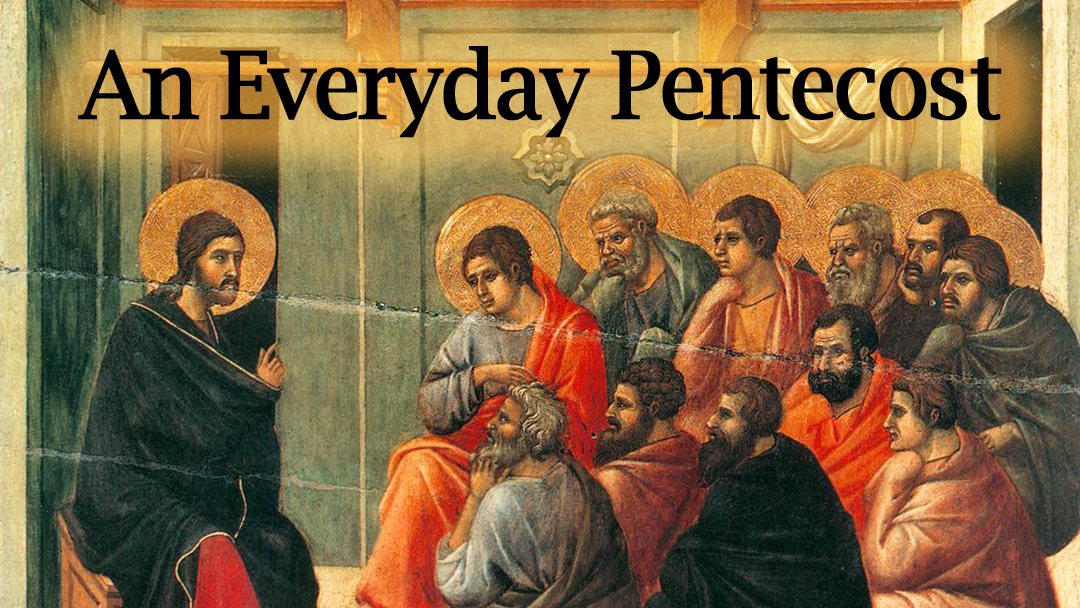
We don’t have to huddle in a room for fear of our circumstances and wait for the Holy Spirit. Pentecost is not an event we wait for. It’s one in which we participate. Every moment is Pentecost.
Given the story of the ascension of Jesus in the sight of his closest followers, the reader might well expect that the great story of the Pentecost experience would ensue immediately. Instead, we get a detailed account of the destruction of the circle of the innermost community of Jesus’s disciples by the abhorrent actions of one of their members, one chosen and active in the ministry as they all were, but who “went to his own place” at the end, leaving them all for his own interests.
Have you ever seen a triptych (pronounced trip-tik)? It's a work of art divided into three sections or panels. Taken together the three panels tell one story. Our gospel text for Ascension Day is a triptych. I like the metaphor because it conveys that the three parts of our text are related and that the text can be folded up and made portable for easy transport wherever we go.
The best quote on friendship of all comes from the best friend of all. “No one has greater love than this, to lay down one’s life for one’s friends” (John 15:13). The friendship of the best friend of all is highlighted in John’s gospel.

© SMU Perkins Center for Preaching Excellence