
YHWH Changes the Divine Mind - Reflections on Ex. 32:1-14, Twentieth Sunday After Pentecost, Year A
by John C. Holbert on Friday, July 10, 2026
Today’s text is among the very finest written texts in all of the Hebrew Bible. Having said that, it is obvious that when we read only the first 14 verses of the fabulous textual whole—which should include the entirety of this chapter along with all of the succeeding two chapters, making the full tale of Ex.32-34—we are reading only the first part of the rich narrative that comprises far more than we can read on one Sunday. At least the next week’s text is Ex.33:12-23, that extends our textual glance a bit, but still leaves so much out of a story that is superbly presented and brilliantly conceived. I will focus attention on several parts of these 14 verses given to us today.
“And the people saw that Moses delayed from coming down the mountain, so they mobbed together against Aaron, and they said to him, ‘Get up! Make for us gods who will go before us. As for this Moses, that man who brought us up from the land of Egypt, we do not know what is up with him’” (Ex.32:1). This sentence returns us to the narrative that ended in Ex.24, followed by the lengthy cultic interlude of the next seven chapters. Ancient texts regularly do such things, intersperse seemingly tangential interests among more lively tales. However, we should not be quick to avoid the cultic material of Ex.25-31, since it includes many ancient and important laws and practices that help define just who Israel was and is, adding to the narrative portraits provided. Several words are interesting here in this first sentence. “Delayed” is interestingly built on the usual word for “shame,” suggesting that Moses’ long interval on the mountain has gone on too long, and that he is “shamefully delaying” his return to the people, at least in their eyes.
The second word to note is “mobbed,” as I have translated it, using a similar meaning from Num.16:3, 20:2. The word in this context, given what happens next, means more than “assembled” or “gathered,” both possible translations of the word. The people are anxious, fearful, and desperate for someone/something to guide them in the absence of the strange leader, Moses, whose disappearance is peculiar and deeply unsettling. Hence, they mob together against Aaron, the one among them with priestly background, and the one chosen by Moses to help the people in Ex.24:14. “Rouse yourself,” they demand, and make gods for us.” They use the word ‘elohim,’ Hebrew plural for the basic Semitic word for God, El. They claim not to know what has happened to Moses (my colloquial reading “what is up with him” attempts to capture the anxious rejection of the man without any particular basis for such a rejection; the literal Hebrew is “what it is to him”).
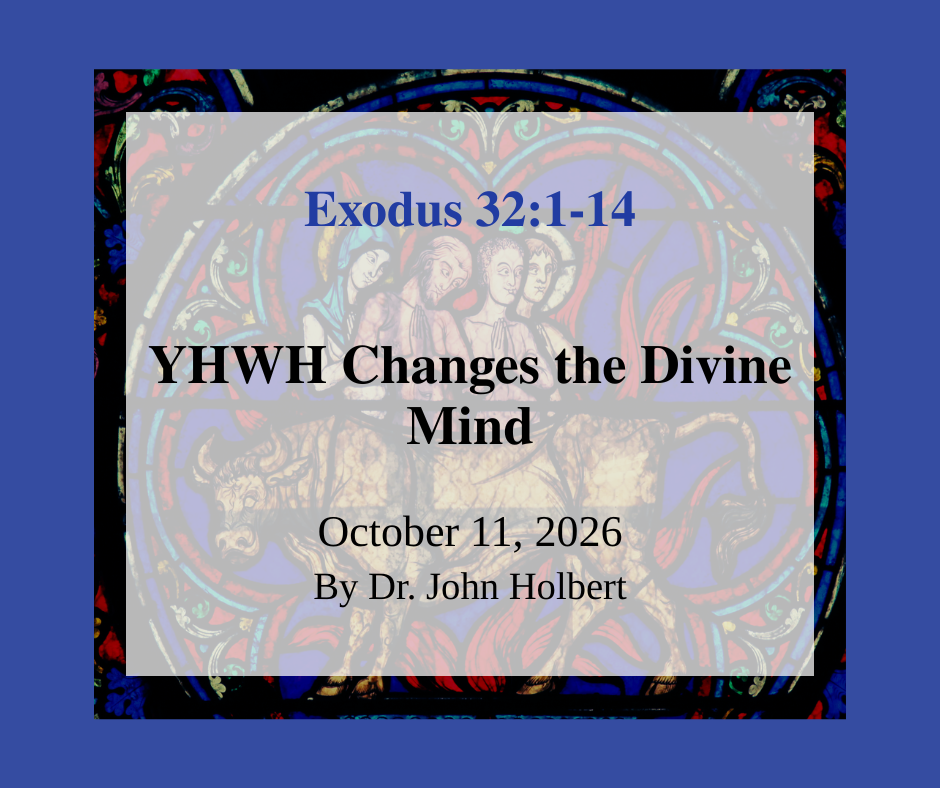
We are now ourselves anxious to see how the priest, Aaron, will react to this rather shocking demand. After all, these are the former slaves, who have again and again witnessed the power of God and Moses to make their escape from the clutches of pharaoh so miraculously real. Perhaps the priest Aaron will set them straight, will demand that they cease their foolish desire for “gods,” and will join him in prayer for their continued desert successes. Hardly! Aaron asks them for gold, that gold they plundered from the Egyptians upon their escape from Egypt (Ex.11:2), and upon receiving gold from “wives, sons, and daughters,” proceeds to do precisely what they asked of him: he “fashioned it into a mold, and made a molten calf” (Ex.32:4). Immediately, the people cry, “These are your gods, Israel, that brought you up from the land of Egypt” (Ex.32:4b). This is a decidedly odd expression, uttered right after they have said that it was Moses who has brought them out from the land of Egypt! And, of course, we know well what the first commandment of the Ten words say: it was in fact YHWH “who brought them out of the land of Egypt” (Ex.20:1). These people are verbally thrashing about, looking for someone to follow—Moses, YHWH, or these freshly fashioned molten gods.
Aaron, perhaps looking on in some horror at what his actions have unleashed, immediately “built an altar” (that is a typical Hebrew altar) in front of the calf and announces, “A feast to YHWH tomorrow” (Ex.32:5). It appears that the priest is trying to make a Hebrew worship experience from a potentially idolatrous object. The attempt fails! “They (that is the people—Aaron is nowhere in sight!) rose early in the morning and sacrificed clear Hebrew offerings—whole burnt offerings and peace offerings—and after eating and drinking rose up to revel” (Ex.32:6). That final word is delicious! It is based on the Hebrew for “laughter,” that word from which the name Isaac comes. But it has far different connotations as well. In Genesis 26:8, the king of Gerar, Abimelech, gazes out of his palace window and observes Isaac “playing with” his wife, Rebekah, after Isaac has convinced the king that Rebekah is in fact his sister. But the king sees with his own eyes that men do not treat their sisters with such sexual actions. And so it is here in Exodus. The actions of the people of Israel near the molten calf are not volleyball or cornhole—whatever they are doing the author leaves to our lurid imaginations.
Meanwhile on the mountain, Moses and YHWH are having their ongoing chat, until God breaks in to comment on the actions occurring at the foot of the sacred mountain. “Go down now, Moses, for your people whom you have brought out of the land of Egypt have corrupted themselves. They have quickly turned away from the path I have commanded for them. They have made for themselves a molten calf, they have worshipped it, sacrificed to it…YHWH said to Moses, ‘I have seen this people and without doubt they are stiff-necked (just like pharaoh!)’” (Ex.32:6-9). YHWH is in a towering rage! “Get out of my way, so that my anger may burn against them, so I may consume them, so I may make of you a great nation” (Ex.32:10). YHWH decides to wipe these wretched people off the earth, and quoting Gen.12:3 determines to start over again with Moses now in the role of Abram.
We are anxious again to see how Moses will react to all this divine bluster. Will he indeed “get out of YHWH’s way,” allowing the God to enact fury and rage, obliterating the terrible and ridiculous people. After all, it may not be bad to get rid of the whole lot of them; who better than Moses knows just how nasty they are? Moses’ reply is, however, nothing less than astonishing. “But Moses spoke plainly in the presence of YHWH, his God, ‘Why, YHWH, are so angry against your people whom you brought out the land of Egypt with great power and a mighty hand?” (Ex.32:11). They are finally not my people, says Moses, they are yours, a clever use of pronouns. “Why would you have the Egyptians say, ‘Only for evil were they brought out to kill them in the mountains, to swallow them off the surface of the earth. Curb your great rage; change your mind about your fury against the people! Remember Abraham, Isaac, and Israel (i.e. Jacob), your servants to whom you swore on your very life, promising them to increase their seed as the stars of the sky, and vowing to give them this land as an inheritance forever” (Ex.32:11-13). Moses argues against YHWH’s rage, reminding YHWH of the promise to the ancestors for land and progeny, telling YHWH that the Egyptians are liable to think YHWH is only foolish, bringing the people out of Egypt only to kill them willy-nilly in the desert, thus rendering the whole exodus a thorough waste of time and energy.
And now how will YHWH act in the face of Moses’s arguments? “YHWH changed the divine mind concerning the evil which YHWH had determined to do against the people” (Ex.32:14). In this amazing tale, three expectations are dashed. Aaron the priest molds the calf and unleashes the terrible events that follow. Moses argues YHWH out of destroying the people of Israel. And YHWH, listening to Moses’ arguments on their behalf, decides not to carry out the divine design after all. Such a powerful and wonderful tale, filled with surprise and delight!