
Water Walking and Little Faith - Reflections on Mt. 14:22-33, 11th Sunday of Ordinary Time, Year A
by John C. Holbert on Tuesday, June 16, 2026
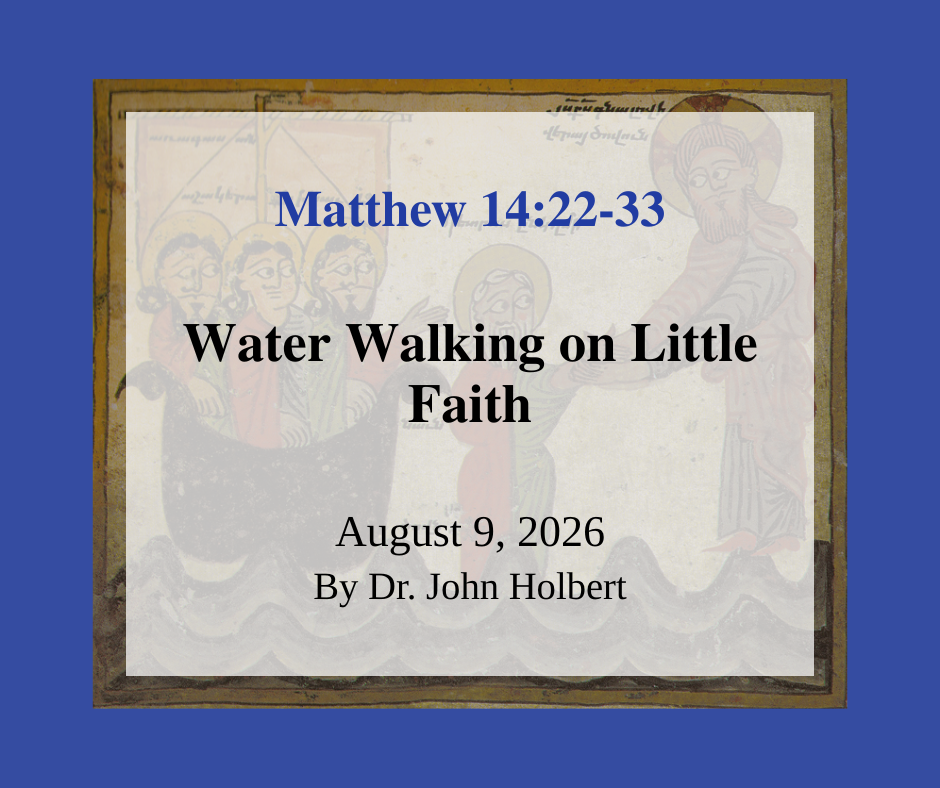
Along with last week’s feeding of the 5000, this week’s spooky event of Jesus walking on the water of the Sea of Galilee, rank as two of the most familiar and quoted scenes in the entire New Testament. Today’s ghostly water walking account may have generated more commentary—negative and positive—than any other occurrence in the New Testament. When I lived and taught in Dallas for many years, I well remember how many people looked at the Trinity River—heavily polluted with disgusting trash—and quipped that Jesus must have walked on the water there, lightly stepping from plastic egg cartons to soggy cardboard boxes. It was a lame joke, but it did call to mind the scene from Mt.14.
The event has over the centuries been used to test the faith of more than a few would-be believers. Do you believe that Jesus actually walked on the water, faith leaders would ask? Like the virgin birth and the bodily resurrection, to be a true believer in the power of Jesus, these events served as proper signposts for real Christian conviction. Let me say immediately that for me Jesus walking on water is simply not an historical event. However, the tale itself is a crucial one for Matthew’s gospel, illustrating something about Jesus of Nazareth that must be embraced and affirmed as a foundation claim concerning just who the man is. Let us see how the writer goes about it with this fabulous and fantastic incident.
The episode occurs directly after the wondrous feeding of the five thousand. Jesus is now intent on finding solace alone, a place where he might pray. Interestingly, unlike the other gospels, Matthew makes very little of Jesus at prayer; he offers instructions for praying at Mt.6:5-15 and paints the famous scene at Gethsemane where he prays while the disciples sleep (Mt.26:36-46), but beyond those two places and here Jesus is seldom depicted praying. Yet, here in Mt.14 there is deep emotion attached to his desire to be alone. “Immediately, he forced the disciples to get into the boat and go before him to the other side (of the sea) , while he dismissed the crowds. And after he dismissed the crowds, he went up to the hill country by himself to pray. Because it was evening he was alone there” (Mt.14:22-23). This is an arresting picture. Jesus “forced” his disciples to get into a boat in order to get them away from him, and away from the crowds he “dismissed,” so that he could be alone. It is a portrait of a man in need of privacy and solace.
But his solace appears to be relatively brief, because our attention is soon drawn to the boat on the sea, filled with the disciples. The boat is “Many stadia from the land,” and since a stadion is about 200 yards, the boat is far away from Jesus. The Sea of Galilee is some four and half miles wide, hence the boat is bobbing far from shore. Unfortunately, says Matthew, the boat is “being harassed by the waves, for the wind was against it” (Mt.14:24). In Mark’s version of this story, clearly Matthew’s model, it is the disciples who are “harassed” (Mark 6:48). The problem, of course, is the howling wind, a notorious problem on the Sea. Suddenly, “In the fourth watch of the night” (i.e. between 3 and 6AM), he came to them, walking upon the sea” (Mt.14:25). This time of Jesus’s epiphany suggests the long time the disciples have been struggling with the wind and also how long Jesus has been at prayer. It could well be that this time is an echo of YHWH’s intervention against the Egyptians at the very famous event at the Sea of Reeds, when “God appears at the morning watch” (Ex.14:20). In fact, that possible connection signals for Matthew what this strange event is finally about. Jesus does here what only God does, namely control the waters of the sea.
“When the disciples saw him walking on the sea, they were terrified, saying, ‘It is a phantom (ghost)!’ And they shouted out in fear” (Mt.14:26). In 1 Samuel 28, the wise woman of Endor conjures the dead Samuel at the command of Saul, and when the shade appears, she shouts, “An Elohim is coming out of the earth.” Elohim may of course mean God in the Hebrew Bible, but here it plainly means ghost or shade. Matthew’s implication is that Jesus’s actions reveal God, or perhaps that Jesus is himself God. And the next line makes that very suggestion. “Take courage,” he cries to them, “it is I” (ego eimi); don’t be afraid!” (Mt.14:27). The phrase “it is I” has a rich background in the Hebrew Bible (through the Greek Septuagint). In the famous scene at the burning bush at Ex.3:14, God is revealed to Moses with this phrase. In Is.41:3 and 43:10 the phrase is plainly a divine name. Along with the phrase “don’t be afraid,” found several times in Is.43, it is more than obvious that Matthew is identifying Jesus as the one who makes the God of Israel known, and is himself uniquely related to that God.
Peter, after Jesus calls out to the disciples about who he is and how they must not fear, says, “Lord, if it is you, command me to come to you on the waters” (Mt.14:29). Jesus immediately bids Peter to come, and Peter does indeed come down out of the boat and begins to walk on the waters. But when he saw the wind, he became afraid and began to sink. He thought, like his Lord, he might play the role of God, but he could not. Sinking, he cries to Jesus to save him, and Jesus’ reply is famous: “O you of little faith, why did you doubt?” (Mt.14:31). In Matthew the faith of the disciples is regularly called “little” (Mt.6:30; 8:26; 16:8; 17:20), not imperfect or lacking, but little. And his accusation of Peter’s “doubt” echoes that infamous line from Mt.28:16-20 where some of the disciples, in the very presence of the risen Lord, still “doubt”.
The result of this ghostly scene is found in Mt.14:33: “Those in the boat worshipped him, saying, ‘You truly are the Son of God.’” That is the ultimate message of this narrative. The identity of Jesus is made plain; he does what God does, namely controls winds and waves (see Ex.14:13-31; Ps.77:20; Is.43:16; 51:10; Hab.3:15) and he speaks as God does in the Hebrew Bible. Matthew here provides implicit claims about the divinity of Jesus. What John’s Gospel makes explicit, Matthew maintains implicitly, that Jesus is in reality God in human flesh. And, like Peter, we all may possess only “little faith,” but the presence of Jesus, who reveals God to us in our lives, provides the basis for courage in the face of such little faith, the true characteristic of us all.