
True Faith in Jesus - Reflections on John 11:1-45, Fifth Sunday in Advent, Year A
by John C. Holbert on Thursday, January 22, 2026
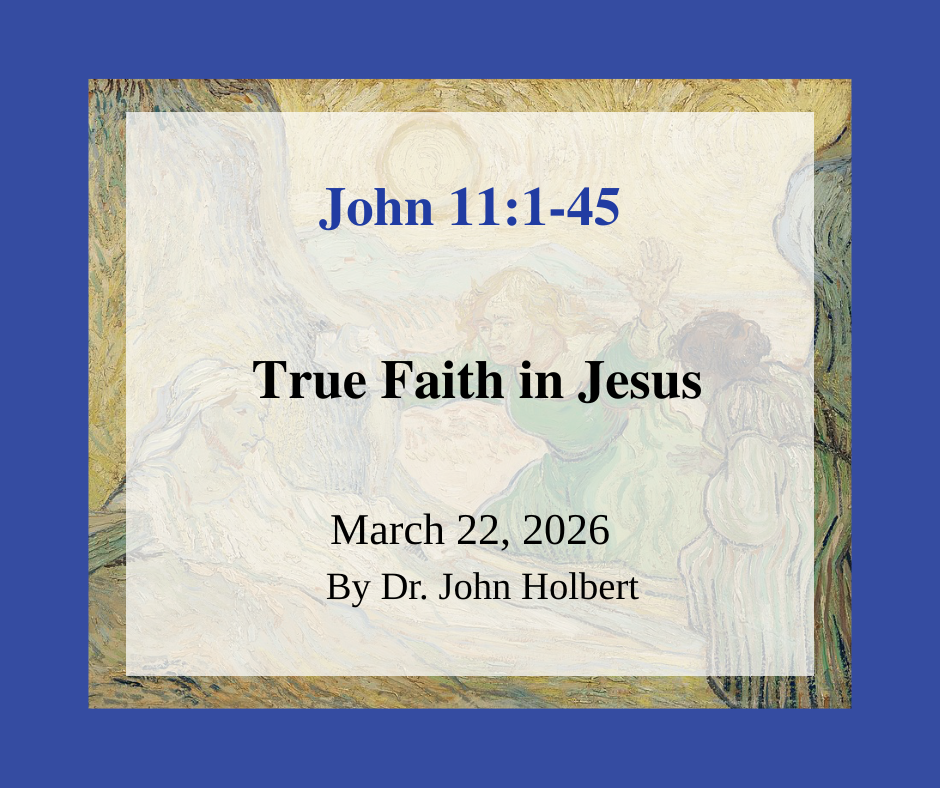
John 11 has perhaps generated more in the way of commentary—literary, artistic, and theological—than any other Johannine text. This is hardly a surprise, given the central reality of the resurrection of the dead Lazarus by the power of Jesus. Yet, in the long narrative that John has created, it is finally clear that the act of Lazarus’s raising must not be seen as the basis for faith in Jesus. In fact, to the contrary, true faith in Jesus is thwarted at every turn in John’s tale so completely that Jesus himself is forced to angry tears. Plainly, his famous weeping in 11:35—that infamous shortest verse in the Bible—is not the result of his compassion over the dead Lazarus, nor is it his sadness over the hypocrisy of the Jews in the scene, nor is it even his disappointment over the inability of both Martha and Mary to discern what faith in him must be. John has woven a rich story here, but has focused the narrative on his attempt to describe precisely what faith in Jesus is and is not.
As the story unfolds, various characters are confronted with the opportunity to express and realize what faith in this Jesus must entail, but each of the figures and groups fails in the attempt. Jesus announces at the beginning what the goal of the Lazarus event will be: “This illness is not unto death; it is for the glory of God, so that the Son of God may be glorified by means of it” (John 11:4). If Jesus was to be perceived merely as a worker of miracles (see John 9), then he would have rushed to the tomb and called Lazarus from death, thereby wowing the crowd and presenting himself as master of death and life. Instead, very surprisingly, if not shockingly, “so when he heard that Lazarus was ill, he stayed two days longer in the place where he was” (John 11:6) What? He delays coming to Bethany, though the sisters, Mary and Martha, have expressly sent word about their brother Lazarus’ sickness, urging him to come immediately. This seems cruel and heartless to deny the sisters’ pleas. Yet, this delay begins a theme in John’s story that makes it plain that Jesus’s actions are not fitted to the expectations of the world we know. Over and again, as John tells the tale, Jesus hopes those around him will understand what Lazarus’s illness will mean both for the glory of God and for his own glorification. Over and again, no one fully understands.
Martha first greets Jesus with a sharp rebuke: “Kyrie (Lord or sir), if you had been here, my brother would not have died,” but she adds the caveat, “I know that whatever you ask of God, God will give you” (John 11:21-22). Jesus replies, “Your brother will rise again” (John 11:23). Oh, I know all about that resurrection at the last day; it is a doctrine I have long embraced, she says. Jesus then says, “I am the resurrection and the life. Those who believe in me, even though they die, will live, and whoever lives and believes in me will never die. Do you believe this?” (John 11:25-26). Martha does not respond to that question, but says, Yes, Lord, I have believed that you are the Christ, the Son of God” (John 11:27). Note, Martha uses a verb form that indicates what she “had believed,” and has not deviated from that belief. She does not grasp just how her friend Jesus can be resurrection and life; she is locked into a traditional way of thinking. Little wonder that the last thing Martha ever says to Jesus in John’s story occurs at the tomb of her brother: “Lord, by this time, there will be an odor, for he has been dead four days” (John 11:39). Martha cannot move into this new and dangerous belief that Jesus presents.
Mary comes closer, but also cannot move out from her present circumstances. She is in the house, surrounded by weeping Jews, and she joins them in their deep sorrow at Lazarus’ death. When greeting Jesus, “she fell at his feet” (John 11:32) in an attitude of worship, thus beginning to recognize and illustrate the person Jesus is fact is, namely the One sent from God, the One who is God in the flesh. However, she soon rejoins the Jews in their weeping, indicating that she too remains only in the present moment of faith and belief. Jesus’ response to these copious tears is important to understand. “When Jesus saw her also weeping, and the Jews who came with her also weeping, he was deeply moved in spirit and troubled” (John 11:33). The Greek verbs here express outward anger, a kind of public snort; what causes this anger? It can only be Mary’s association with the weeping Jews, her final inability to understand what true faith in Jesus is. At the tomb, Jesus himself weeps, but not for sorrow at Lazarus. He weeps again, using a Greek verb found only here and in Hebrew.5:7, a different verb than the one used to describe the tears of Mary and the Jews, and again I suggest that his tears are the result of the complete misunderstanding of what he is about to do at the tomb of Lazarus.
The thorough misunderstanding of Jesus’s actions is made certain by the Jews who interpret Jesus’ weeping as an expression of his love for Lazarus (John 11:36). And later, the Jews plot to kill Jesus, precisely because he “performs many signs” (John 11:47). But that is hardly the point of Jesus’ activities in this story. The physical transformation of Lazarus’ dead body is not the central concern of the tale, however dramatic and memorable that has been for all later readers. The action of Jesus has revealed “the Glory of God” (John 11:4,40) in order that the disciples might believe (John 11:15,42), that Martha and Mary might believe (John 11: 26,40,42) and so that Mary and the Jews might believe (John 11:33,42). Faith in Jesus, for John, consists of the acceptance by all that Jesus is the Son of the Father, the Sent One of God (John 11:42). Yet, that final realization will not occur until Jesus’s own resurrection at the very end of John’s story. Coming to truth faith in Jesus is a long and difficult road, but once the destination is reached, the result will be eternal life, both now and in the future.