
Thwarting or Accepting Jesus's Passion - Reflections on John 18:1-19:42, Good Friday, Year A
by John C. Holbert on Thursday, January 29, 2026
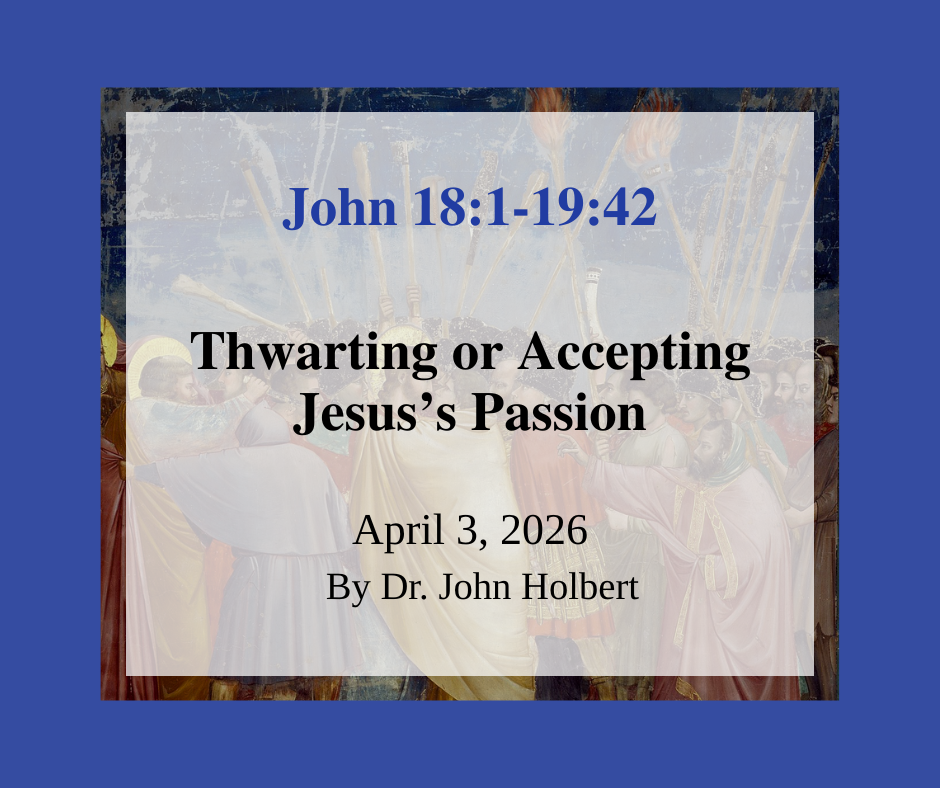
The lectionary collectors offer us a huge portion of the lengthy and rich story of the Passion according to John, thus challenging any preacher to tackle even a small portion of this immense series of texts. Unless the liturgical leader decides to perform the entire scripture in some sort of reader’s theater—and I have seen that be an effective event—the preacher must decide which part of the vast text to address in a sermon. As a writer of brief essays, I, too, must decide where to place my energies. I choose to focus attention on the very beginning of the long tale, John 18:1-11. As usual in John’s gospel, Jesus is in full control of the events in which he is the central character, but that does not mean that various figures in the story do not try to short-circuit his path which has been laid for him from the very start of the gospel. John 18 makes that fact all too clear.
The story begins (John 18:1) and ends (John 19:41) in a garden, the former in the Kidron valley, and the latter in the garden where there is a new tomb for the crucified Jesus. Some have suggested that these garden references recall the Garden of Eden in Genesis, making a movement from the “fall” of Adam and Eve to the salvation event of Jesus, but that may be stretching connections a bit far. Perhaps more importantly, the confrontations Jesus has in this first garden occur at night, always a crucial signifier for John; Jesus often has confrontations with enemies at night, and because he is the light of the world, John regularly plays many occasions off against that fact.
The first one who would stand in the way of Jesus’ necessary journey to death on the cross is Judas, the betrayer. Because he was one of the original twelve, Judas knows all too well the location of this particular garden, for “Jesus often met there with his disciples” (John 18:2). Before confronting Jesus, Judas gathers a ridiculously large retinue of a mob, including a large collection of Roman soldiers (he speira, in Greek, six hundred troops!), some Temple guards, said to be “of the chief priests” and “of the Pharisees.” The number of these people is absurdly large, and certainly historically impossible. Historical accuracy has never been high on the list of John’s major concerns; right theology has always trumped history for him. Of course, that reality is likewise true for the other gospels as well. In addition, this enormous mob is carrying “lanterns, and torches, and weapons,” a very odd assortment of materials in reality, but again John is theologizing here: the great crowd, armed with objects to light their way, has come out to confront Jesus, “the light of the world” (John 8:12, 9:5). Jesus’ enemies here, Judas, Romans, and Jews, representing the world, must bring their own sources of light to find the one who is himself the world’s light.
“Then Jesus, knowing everything that is about to happen to him, came forward and said to them, ‘Whom do you seek?’” (John 18:4). John’s gospel is always searching to answer that question: the identity of Jesus is the central issue of John’s story. “Jesus of Nazareth,” the crowd answers (John 18:5). By adding Jesus’ hometown to his name, the crowd may be a bit pejorative here; after all, the only other mention of Nazareth in the gospel is John 1:46 where Nathaniel snidely asks, “Can anything good come out of Nazareth?’ Jesus replies, “I am,” a clear echo of John 13:19, among other Johannine references, and at the utterance of that formula, “they drew back and fell to the ground.” Obviously, their search for a man to arrest has earned them and us a revelation of the one who is “I am.” Much more than a man is standing before them.
After some further repartee with the crowd, Peter, silently standing nearby, having had enough of this dialogue, draws a sword and cuts off the right ear of the High Priest’s slave; his name was Malchus. This is, of course, the way the world has traditionally settled matters of disagreement; those confronting Jesus came with weapons, and why should Peter not defend his master with a weapon? But Jesus is having none of this violent response to potential violence. “Put your sword into its scabbard; shall I not drink the cup the Father has given me?” (John 18:11). There is irony here. The name of the slave is Malchus, a noun close to the Hebrew for “king” (melek). Jesus will later be accused of being a king, but he is not the sort of king who wields a sword. Peter is fixed in the world he knows, a place of sword against sword, but Jesus must tread a different path toward a different world. The Father has given him the cup to drink, and he is intent on drinking that cup to the dregs.
Both Judas, and his cohorts, and Peter, the chief disciple, have attempted to force Jesus to follow their respective paths away from the path Jesus himself must go. In the presence of hostility and violence, Jesus demands that his disciples go free (John 18:8). And those disciples, both then and now, must follow the lead of their master. This first garden scene includes not only Jesus and his enemies, but also presages how Jesus will love his disciples eis telos, “until the end” (John 13:1). That is the love that God has made known in Jesus, and is the love that also will reveal God in the world, for John especially, God is love.