
The Wonders of the Waters - Reflections on Joshua 3:7-17, 23rd Sunday after Pentecost, Year A
by John C. Holbert on Tuesday, September 8, 2026
I have lived in the western parts of the USA for two long portions of my life, first in Phoenix from ages 6-17, and now in Los Angeles for the past 9 years. One feature characterizes both of these quite different cities: a significant issue of water, or more precisely, the lack thereof. Both cities are heavily reliant on Colorado River water, along with other western cities like Las Vegas and Denver, among others. The use of the Colorado water has been the source of contentious litigation for decades among the states that rely upon it, and now that the river has suffered under a two-decade-long drought, that contention has risen appreciably. Indeed, Lake Mead, the largest reservoir in the US, has fallen this year to only 30% of its capacity, threatening the hydroelectric generation for which it was designed, and offering a decreasing amount of water to be divided among the thirsty states in its watershed. The future of the river, in this day of climate uncertainty and change, is deeply fraught, and this once-enormous source of water for millions of people is no longer a reliable one. Water is one of this era’s deepest concerns, a concern that will be an ongoing problem as the 21st century moves along.
Our Bible is filled with stories of water, which in ancient times was no less the source of great concern among peoples surrounded by and defined by a desert climate. Egypt was, as Austin Leyard said many years ago, “the gift of the Nile,” and anyone who has traveled to Egypt can easily see how true that claim is. Only about 13% of Egypt offers cultivatable land, and all that land is watered by the Nile River. Ancient Egyptians watched the rise and fall of the Nile each year, and kept careful notations of its heights and depths, knowing that a poor year of Nile flooding led inevitably to smaller crop yields, and starvation for many.
Little wonder that when Israel told its creation stories water played a central role, both in Gen.1 where the creation begins in the waters of the vast cosmic sea, and in the other story of Gen.2 where the land was initially dry, “because YHWH God had not yet brought the rain.” Soon, in the first story, God “divided the waters in order that the dry land might appear,” thus establishing the work of God with waters that occurred again and again in the lengthy tale of God and the people of Israel.
When YHWH, with the aid of Moses, brought the people of Israel out of the slave pits of Egypt, confronting the Sea of Reeds, while being pursued by the armies of pharaoh, once again divided the waters of the sea, allowing the Israelites to pass through the waters on dry ground, and causing the Egyptian armies to drown in the advancing sea, the Israelite God was acting as at the creation, employing water as a device for the saving of God’s chosen ones.
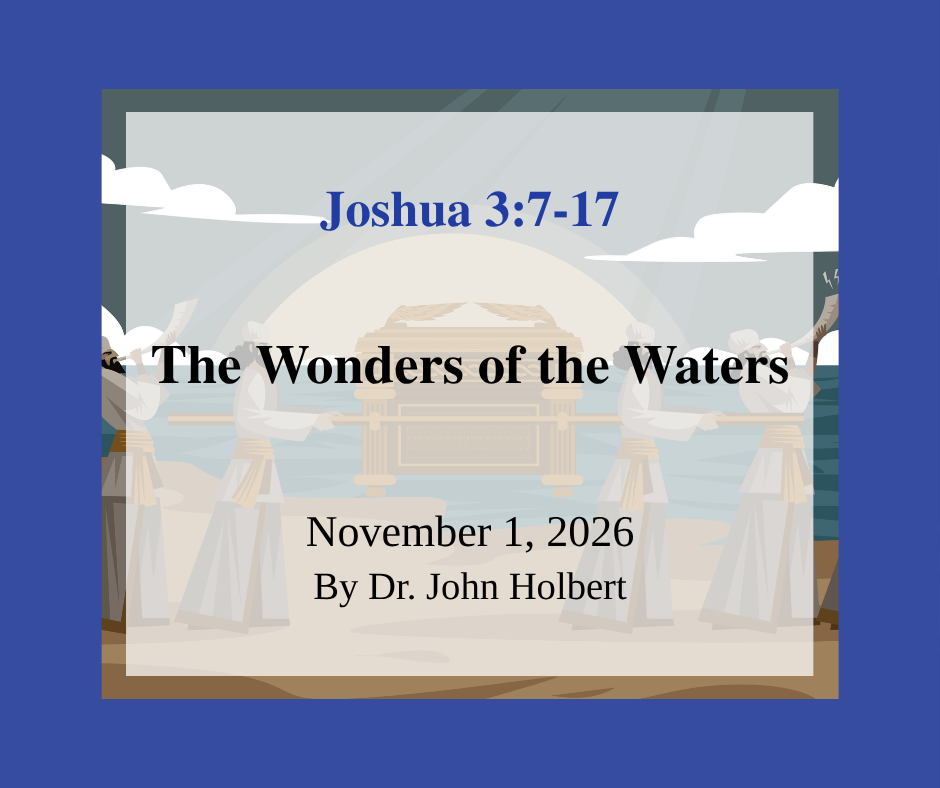
And in our text for today, God is still at it. This time the added feature is the Ark of the Covenant, that mysterious chest or box that accompanied the former slaves through their desert wanderings. Joshua, who has replaced the now deceased Moses as leader of God’s people, is told by YHWH, “Today I will exalt you in the eyes of all Israel, so that they may know that I will be with you as I was with Moses” (Joshua 3:7). Once again, the people of Israel approach a body of water, this time the River Jordan that stands between them and the land of promise. Joshua reminds them that the land they are about to enter is far from empty, but is filled with any number of peoples. He names these peoples with a traditional list, some of whom we can know something about (the Canaanites, long-time inhabitants of the land) and others about whom we know little or nothing (the Girgashites?).
The ark is a sacred and a terrifying object, and the people are warned to stay at least 2,000 cubits away from the ark (perhaps 3,000 feet) as it is carried toward the Jordan. In later tales of the ark, the chest is stolen by the Philistines, but then finds its way back to Israel, but upon its return many Israelites are killed, simply by looking inside of it! (So 1 Samuel 6:19). In our story today, however, the ark represents the presence of YHWH, and it will serve as the object that works the miracle of the waters, echoing the staff of Moses that parted the waters of the Sea of Reeds to save his people.
The priests hoist the ark and bring it into the Jordan. “When the soles of the feet of the priests who bear the ark of YHWH, YHWH of the whole earth, rest in the waters of the Jordan, the waters of the Jordan that flow from the north (“from above”) shall be cut off; they shall stand in a heap” (Joshua 3:13). This rather odd locution attempts to picture the flow of the Jordan stopped, its waters now piled up behind the ark. That portrait, however, is not quite the same as the one given a few verses later. Now in vs.16 “the waters flowing from above stood still, rising up in one heap far off at Adam, the city near Zarethan, while the waters flowing toward the sea of the Arabah, the Salt Sea, were completely cut off” (Joshua 3:16). Now the picture is rather more grand, the Jordan’s water stopped much further north than the place of Israel’s crossing, while no waters at all flow into the Dead Sea. We should also note that the word for “heap” (ned) is used at Ex.15:8 and Ps.78:13, a clear reference to the event at the Sea of Reeds.
Just as in the creation and at the Sea of Reeds, so here at the Jordan, YHWH manipulates the waters in order to offer miraculous delivery of God’s chosen ones, this time for their safe entrance into the land of promise. Of course, later in the New Testament waters will again play a central role, in Jesus’s baptism and in his many miracles performed in and around the Sea of Galilee. And we recall in the fulsome poetry of 2-Isaiah 43:1-2, YHWH promises “Do not fear, for I have redeemed you; I have called you by name, and you are mine. When you pass through the waters, I will be with you; and through the rivers, they shall not overwhelm you.” Isaiah thus reiterates and repurposes both the event at the Sea of Reeds and the event at the Jordan River. The Bible, birthed in a desert world, focuses much attention on the presence and wonder of water.
Water covers nearly 70% of the earth’s surface, and thus is crucial for all of human and animal life. In our use and abuse of the resource of water, we participate or hinder God’s constant concern to provide resources for God’s people. In our day of climate dangers, too often characterized by the lack of water, as well as a super-abundance of water, we are witnessing the crucial element of water both as a means for the possibility of life on our planet, as well as a mode of destruction for others. Here in the west, we see a lack of water, while in other parts of the world water becomes a source of disaster and horror for millions. We would do well to take with far more seriousness the gift of water and help to discover ways we may help those who need water as well as those who fear its unpredictable dangers.