
The Vision of the Transfigured Jesus - Reflections on Matthew 17:1-9, Second Sunday in Lent, Year A
by John C. Holbert on Sunday, January 4, 2026
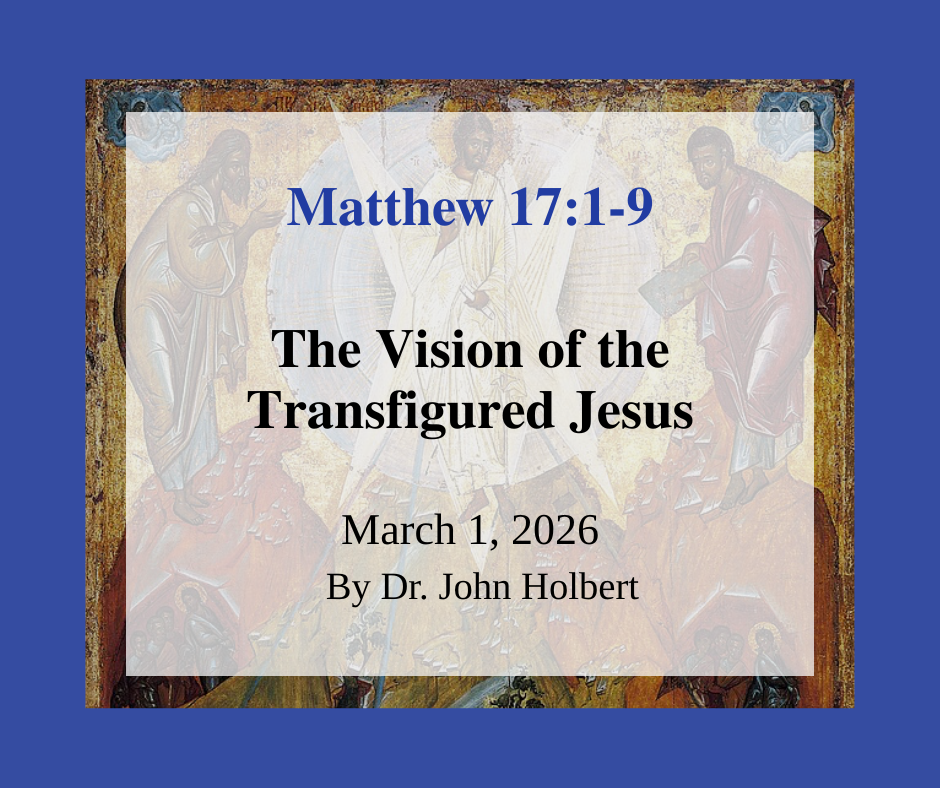
I have long imagined that tales of the Transfiguration of Jesus on a mountain belong rather more to the contexts of Halloween than a Sunday in Lent. After all, Jesus in this Matthean version of the story invites Peter, James, and John, the inner circle of his disciples, up to “a high mountain apart” (Mt.17:1). Trips up onto mountains in the Gospels regularly imply times of special teaching where Jesus imparts insights that his disciples all too often fail either to understand or act upon. But this mountain hike is an altogether different one.
“And he was transfigured before them, and his face shone like the sun, and his garments became white like the light” (Mt.17:2). The Greek metamorphothe does not imply here some sort of interior transformation, though that idea is surely found elsewhere in the New Testament (see Rom.12:2 and 2 Cor.3:18), and I imagine more than a few preachers have used such a notion as a springboard for a sermon. Matthew, however, has something quite distinctive in mind by his use of the Greek word: the fact is in his tale Jesus has quite literally undergone a change in form. He provides for the three disciples nothing less than a preview of the glory that Jesus will possess in the fullness of the realm of God, that is after his resurrection. This is why Matthew employs the word “vision” (horama) to warn the disciples against telling anyone of what they have witnessed “until the Son of man has been raised from the dead” (Mt.17:9). The Transfiguration account for Matthew is a foretaste of the glorification of Jesus in his resurrection.
Well, then what are we 21st century teachers and preachers to do with this uncanny tale? First, I think we have to get the genre of the story right. If we decide the story is somehow a factual one, however, peculiar that may sound to modern scientific ears, we may focus on the wrong things, and miss the rich symbolism of the account. Our search for which mountain is mentioned here, why these three disciples are chosen, why Peter makes his (absurd?) request to build booths for Moses, Elijah, and Jesus (Mark 9:6 has Peter babble out these words, “since he did not know what to say”), and other “factual” pieces of literary information could easily get in the way of what Matthew’s deeper intent for the story may be.
But then again if we focus too narrowly on the symbolism of the text—its visionary emphasis, its connection to Jesus’ baptismal experience (Mt.3:17), its prefiguring of the resurrection—it can readily devolve into allegory: e.g. the story means the supersession of the Old Testament by the New by the disappearance of Moses and Elijah, leaving Jesus alone, or Jesus is recalling Moses’s own shining face event in Ex.34:29 and is thus a new and better Moses. Any of these notions have played roles in the traditional interpretations of this strange scene.
However, for Matthew I would suggest that the Transfiguration tale is the linking story between the early ministry of Jesus and the beginning of Jesus’ final journey up to Jerusalem, a journey that will end in his great suffering and his glorification in the resurrection. The Transfiguration is another in a series of Passion predictions which always include calls to those with ears to follow Jesus in his sufferings. And right there is its appropriate connection to Lent. Lent is that particular time in the church year when we focus on introspection, looking deeply at ourselves and our relationships to God and Jesus, while at the same time examining our relationships to a world with desperate needs and our convictions in trying to do something about that reality. In Lent we look both inward and outward all at once, becoming more honest than we have been about who we are as sinners, and what we are called to do to take our shortcomings seriously, so seriously as actually to do something about them. Giving up chocolate or Facebook is hardly what Lent asks of us; rather we are demanded to look deeply and act boldly.
The Transfiguration of Jesus on the mountain revealed to the disciples and to us just who it is we are dealing with, the vision of the glorified Jesus, whose suffering we are called to share, and whose ministry of healing and compassion must become our own if we are able to call ourselves his true followers.