
The Struggle of Faith - Reflections on John 20:19-31, Second Sunday of Easter, Year A
by John C. Holbert on Thursday, February 19, 2026
John’s Gospel presents to us a story arc rather like the three synoptic gospels, albeit with clearly different vocabulary and timeline. He begins by telling us precisely who Jesus is, namely the word of God, indeed God in the flesh (John 1). Mark does something similar by the summary of Jesus’s preaching in Mark 1, but he does not directly connect God and Jesus as John does. But each gospel’s story arc gives the reader Jesus’s identity, and then uses the story’s characters to present how faith in this Jesus may, or may not, occur. Indeed, Mark ends his tale with the shocking statement that the first witnesses to the resurrection, the three women at the empty tomb, rush from that tomb, “and say nothing to anyone for they were terrified” (Mark 16:8). Well, if those women said nothing about the great event, then somebody has to, and those somebodies are us; we need to start talking about and living into the resurrection of the Christ.
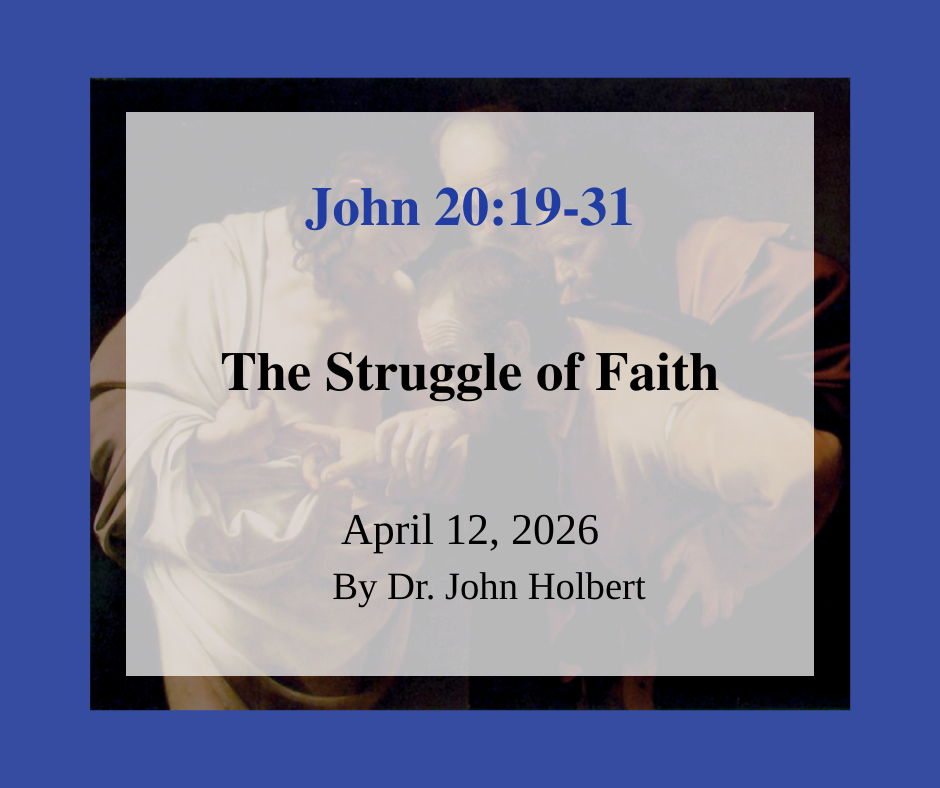
John offers his own struggles with faith, but moves in a rather unique direction. Both Mary Magdelene and Thomas anchor their faith in the physical presence of Jesus. Mary in that famous garden wished to “cling” to him after having lost him in the empty tomb. Jesus refuses, saying that “I have not yet ascended to the Father” (John 20:17). This apparently is John’s way of saying that fixating on the body of Jesus is not in the end the correct way to maintain faith in him. Likewise Thomas, that famous “doubter,” simply will not believe what the disciples say—“we have seen the Lord” (John 20:25)—unless he is able to put his fingers into the nail holes and thrust his hand into the place where the soldier’s spear had pierced Jesus’s side. That, for Thomas, is the only way he will finally believe that his beloved friend is in fact alive.
Thus, both Mary and Thomas represent those who must have proof on the physical plain of Jesus’s resurrection: is this figure really the same one that we heard and loved while he was alive? All well and good, says John; belief in resurrection is without doubt a large pill to swallow. Clinging to that body and jamming fingers and hand into the actual wounds inflicted by the killers are needed to assure conviction and belief. But here is the real problem: what about those now searching for faith, a few generations after these narrated events? Or what about those now in the 21st century seeking faith? What are they/we to do in the absence of that body?
Little wonder that throughout Christian history people have sought remnants of that body, along with the body parts of many saints, to venerate in order to ground faith in actual physical manifestations. It is hardly surprising that the infamous Shroud of Turin continues to fascinate with its supposed mirror image (photographic?) of a Jesus-like figure imprinted on the cloth. Here, some say, is proof of the resurrection, an actual likeness of a man passing through the cloth on his way to heaven. But, again, that is not a physical reality of the bodily Jesus. The issue for us is how do we come to faith without the body of Jesus.
And that was John’s issue, too. That is what makes John 20:29 so very important for all who search for faith in this Jesus. Thomas’ famous doubt is apparently assuaged by the reappearance of Jesus to the disciples, among whom now is Thomas, the one who demanded physical proof before he will believe. Note, however, that it does not say before Thomas’s loud declaration of belief—“My Lord and my God,” the envelope of the gospel that began with that central claim of Jesus’s oneness with God—that Thomas actually did touch Jesus. He merely announces his faith when Jesus bids him touch him. This fact, I think, emphasizes what John really wishes to say to those of us now reading his account. “You have believed because you saw me” (note: not “touch” but “saw”). Blessed are those who have not seen but believed” (John 20:29). That, of course, is the reality for all those of the past 2000 years who cannot see Jesus, but who are asked in any case to believe in him anyway. John asks his readers, both in the 1st century and in the 21st century, to stretch their religious imaginations beyond their material needs, beyond the traditional demands of scientific proof, and to connect their lives and actions to this Jesus, this living one who calls us to follow his will and way in our own lives.
We are all “doubting Thomases,” as it has been said, in that we would be glad of a certainty we simply cannot have. But, like that Thomas, we may still be able to say, “My Lord and my God,” despite the lack of absolute physical certainty, risking the fact that we may be barking up a chimerical tree by so saying. Two millennia have shown that many have been willing to take that risk; faith is indeed possible in the face of scant physical proof. How else can a modern person find faith?