
The Results of Peter's Sermon - Reflections on Acts 2:14a, 36-41, Third Sunday of Easter, Year A
by John C. Holbert on Friday, February 20, 2026
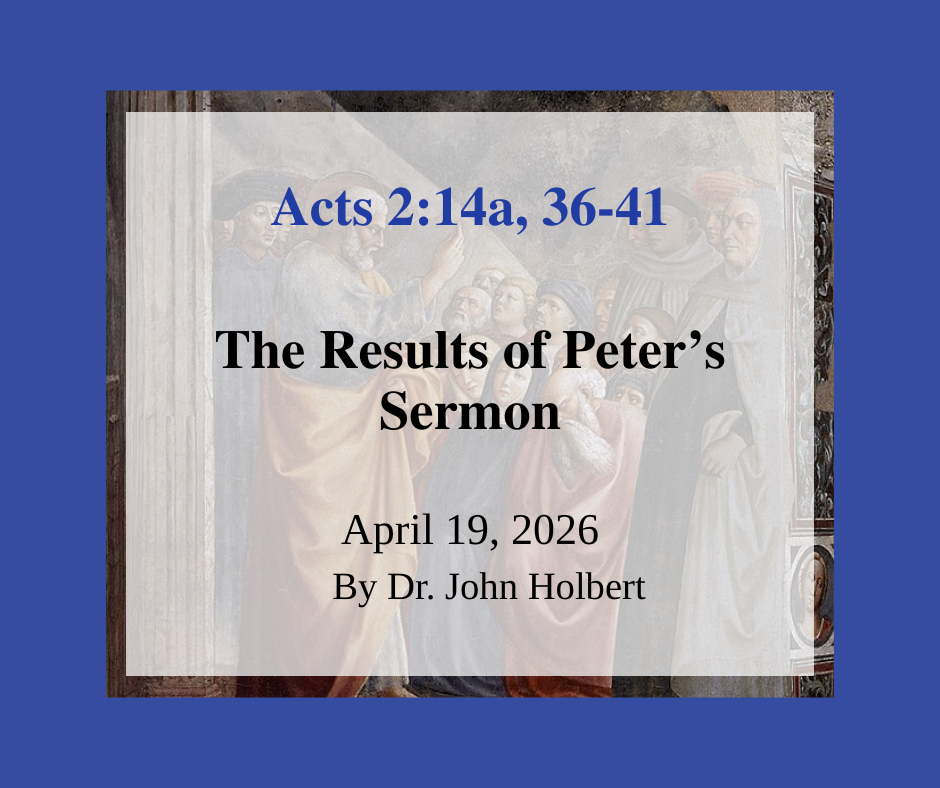
During this second of three weeks, devoted to Peter’s famous Pentecost sermon, we focus on the immediate results of the preaching event. It is without doubt described to us as one of the most successful Christian sermons ever given, evidenced by the baptism and conversion of 3,000 souls (Acts 2:41). Of course, it has a long way to go to equal the astonishing preaching of the prophet Jonah, who with a 5-word sermon converts the entire city of Nineveh, including all the animals of the city! Now, that is preaching! Then again, Jonah’s word was hardly Christian, but it sure was effective.
Nevertheless, Peter’s preaching was without doubt supremely effective, based as it was on the conviction that Jesus’s murder and resurrection were all part of God’s plan (Acts 2:23), though it was carried out by religious authorities with the collusion of the local government officials, and was, as we saw last week, predicted far in advance by the Psalms of David the king, primarily in Ps.15:8-11. Peter’s sermon, as I have discussed in several other of my essays on this seminal chapter, is laced with anti-Jewish slurs, accusing the Jewish authorities of the time quite directly and harshly with the murder of the Messiah, indeed the killing of their own Messiah, claims Peter, as he was foretold in their scriptures. History has proved just how effective this anti-Jewish bias was; it was not until 1965 of our own era that the Roman Catholic Church removed from its official doctrine that Jews were “Christ killers.” The dark power of Peter’s words, through the literary skills of Luke, thus impacted Christianity in this way for nearly 2000 years—effective and terrible preaching indeed!
Hence, the resulting mass baptisms are based both on Peter’s positive portrayals of the life and work of Jesus Messiah, as well as the divisive claims of Jewish guilt for the Messiah’s death. That reality should never be overlooked whenever this text is addressed from our pulpits. These positive and negative realities in the sermon are well summarized by the first verse of today’s lectionary: “Therefore, let the whole house of Israel know for certain that God has made him both Lord and Messiah, this Jesus whom you crucified” (Acts 2:36). Jesus has become, under the power of God, both Lord and Messiah, even though, or even because, you crucified him! That is a stark indictment of the “whole house of Israel.” The entire verse is worth a closer look.
“The whole house of Israel” is perhaps an unusual phrase in this context. It is a sweeping indictment of the entire Jewish population as the people of God; all of them are included in the accusation of Jesus’ death. Peter quite clearly challenges them in his sermon to admit their monstrous guilt. Also, the phrase I have translated “know for certain” is an adverbial form of the Greek asphaleia, a noun form meaning “safe, secure” (Phil. 3:1). There can be no doubt concerning the truthfulness of Peter’s words. Peter makes it plain that the “Lord” they need to call on to be saved is Jesus (Acts 2:20). One of the earliest confessions in Christianity is “Jesus is Lord,” and Peter implies it here. In addition, this same Jesus is Messiah (Christ), the one long-expected by the Jews. However, they, instead of receiving him as the one they have awaited, murdered him on a cross. As a result of that terrible act, they, the listening Jews, are in need of repentance.
And some listeners are ready for such a “turning around” (metanoeo). But first Luke says they were “stunned” by Peter’s words. NRSV reads “cut to the heart,” attempting to take account of the word “heart” (ten kardian) in the text as well as the unusual word katanyssomai, a word found only here in the New Testament. It does occur in the Septuagint several times with meanings ranging from “anger” to “struck silent” to “stung” to “humbled” to “sorrowful.” However we are to hear it here in Acts, it implies a powerful emotional response to Peter’s word. Immediately, Peter says to them, “Repent! Let each of you be baptized in the name of Jesus Messiah for the forgiveness of your sins, and you will receive the gift of the Holy Spirit” (Acts 2:38). From that straightforward sentence has arisen the full measure of Christian preaching and action down the ages: repentance leads to baptism leads to forgiveness leads to the coming of the Spirit of God. And this promise is “for you and for your children, and all those far off,” continues Peter, suggesting that in these actions the church will find its basic call to community. As Acts 2:42 says, after the baptism of the 3000, “They were constant in their attention to the teaching of the apostles, the fellowship, the breaking of bread, and the prayers,” a memorable summary of the practices of the early communities of Jesus Messiah, and, one hopes, the practices of true Christian communities today.
Peter’s Pentecost sermon has served as a model for much Christian proclamation through the long ages of Christianity, both for its positive aspects and unfortunately for the lingering anti-Jewish claims of that proclamation. As we approach the holiest days of the Christian year, Good Friday and Easter, let us always be on guard against that terrible whiff of anti-Jewishness that taints our witness to the truth as it did in Peter’s day. But also let us proclaim with boldness the reality that “Jesus is Lord and Messiah,” and that we live and act under that central conviction.