
The Necessity for Forgiveness - Reflections on Mt. 18:21-35, 16th Sunday after Pentecost, Year A
by John C. Holbert on Sunday, June 21, 2026
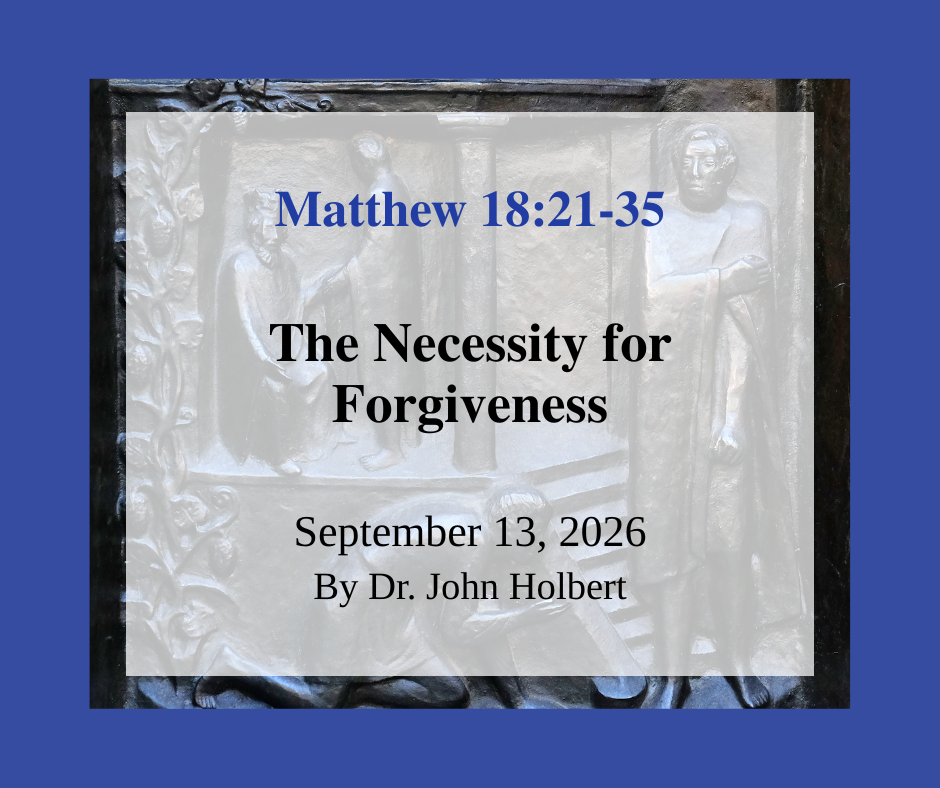
In many respects, the parable contained in today’s lectionary is about as straightforward as parables get. Often, the stories attributed to Jesus are strange, rife with possible meanings, replete with mysterious possibilities. Less so in Mt.18. The issue is clear, and has to do with the need for forgiveness in any community. Without forgiveness, communities and nations are doomed to strife, contention, and ultimate disintegration.
The parable is introduced with a bit of funny self-aggrandizement by the spokesperson for the disciples, that loud-mouthed fisherman, Peter. “Lord, how often shall my brother (sister) sin against me and I forgive him? As many as seven times?” (Mt.18:21) Note that Peter does not consider in his question the possibility that he might be the one sinning against another, but merely assumes that he will be the one sinned against. Because he thinks that, he “magnanimously” (at least according to him!) suggests to Jesus what must sound quite ludicrous—“seven times,” he chokes out, implying that such seven-time forgiveness of a sin would instantly qualify him for sainthood and a one-way flight to paradise! But Jesus quickly one-ups his disciple by replying “I do not say to you ‘as many as seven times,’ but as many as seventy times seven times’” (Mt.18:22). You think you are being saintly Peter, asks Jesus, but I tell you unless you are willing to forgive an eternity of times—what else can 70x7 mean?— you do not know what real forgiveness means at all. These outlandish numbers may refer to that place in Genesis 4:24 where the repulsive Lamech—a man who demands vengeance on anyone daring to “touch” him (the literal meaning of the Hebrew there)—expects vengeance far beyond that of the murderer, Cain, in fact seventy-seven-fold.” The figure is absurd on its face, hyperbolic in the extreme.
However, to make the point more than obvious, Matthew has Jesus tell the parable of the king and his servants. It is a memorable tale, but note the issue of the number of times one must forgive is not the question of the story. Rather, it is the reason why such human limits on forgiveness are ridiculous in the presence of a God who finally places no limits on forgiveness whatever. If God places no limits on forgiveness, then neither can we.
A king calls his servants to him to “settle accounts,” that is tally what each one owes to the state. Though the word for “slaves” is used, it is plain that the story implies they are high officials in the king’s entourage. The first official owes the outlandish sum of ten thousand talents. It is always difficult, if not finally impossible, to make plain what a “talent” might be in modern currency. If one assumes that one denarius was the wage for a laborer for one day’s work (see the famous tale in Mt.20), though that is the only place where we learn that “fact,” making it tenuous at best, and if a talent was worth somewhere between six thousand and ten thousand denarii, then what this poor servant owes is astronomical, something like a billion dollars today, a sum he could simply never repay. Once the king realizes that this hapless servant hardly has the cash to pay, he orders “that he and his wife and children and all that he had be sold” in order to attempt to pay the huge debt (Mt.18:25). Both king and servant know all too well that even all this tragic sale will not begin to dent the insurmountable debt. There are places in the Hebrew Bible where children could in fact be sold into slavery to make up for a father’s debts (see 2 Kings 4:1; Is.50:1; Neh.5:5), but there is no indication that such terrible procedures were still active in Jesus’ day. The king’s harsh demand was surely a punishment in itself.
In horror, the servant “fell down, paid him homage (a worshipful posture), and said, ‘Be patient with me, and I will pay everything back to you’” (Mt.18:26). This plea is, of course, nonsense; he could not pay back such a debt in a thousand years! The master’s reply is astonishing! “The master had pity on that servant and forgave him the loan” (Mt.18:27). Note that the master has changed the “debt” into a “loan,” using the only New Testament occurrence of the word daneion, implying that the enormous sum need not be returned at all.
Amazingly relieved, no doubt, the servant, now free of an unrepayable debt, heads out of the master’s house, but goes right to one of his fellow servants, who owed him the paltry sum of 100 denarii; he grabs him and chokes him, screaming, “Pay back whatever you owe” (Mt.18:28). This servant, struggling under the physical abuse of the forgiven servant, echoes precisely what his assailant just said to the master: “Be patient with me, and I will pay you back” (Mt.18:29). But instead of forgiveness, such as he received, he has his debtor tossed into prison “until he should pay back what was owed” (Mt.18:30). Of course, he will have a very difficult time coming up with any money while languishing in prison!
Unfortunately for the forgiven servant, some others of his fellow servants witnessed his harsh behavior with the servant who owed him the small debt, and went to tell the master what the wretch had done. The master calls him, and now naming him “wicked servant,” reminds him, no doubt with much heat, how he had forgiven him an unpayable debt, when he begged to be released from it, but he refused to show mercy in the same way (Mt.18:32-33). And the tale ends in tragedy and horror. “The master grew angry and handed him over to the torturers until he might pay back everything owed to him,” (Mt.18:34), knowing full well that the tortured servant will not be able to pay him back anything. And the lesson? “So also my heavenly father will do to you, unless each of you forgive his brother (sister) from your hearts” (Mt.18:35). The tale becomes a dramatization of the famous lines from the sermon on the mount, Mt.6:14-15.
We live in a time when anger and cruelty rule the day, and genuine forgiveness is too rarely seen. True forgiveness is hard, while getting even, playing the bully, is easy. God is infinitely merciful, says Matthew, and because Jesus has come to show us God in human form, his forgiveness must be matched by our own. It is a simple lesson to understand, but a most difficult one to practice.