
The Mystery at Jabbok - Reflections on Genesis 32:22-31, Tenth Sunday after Pentecost, Year A
by John C. Holbert on Tuesday, May 26, 2026
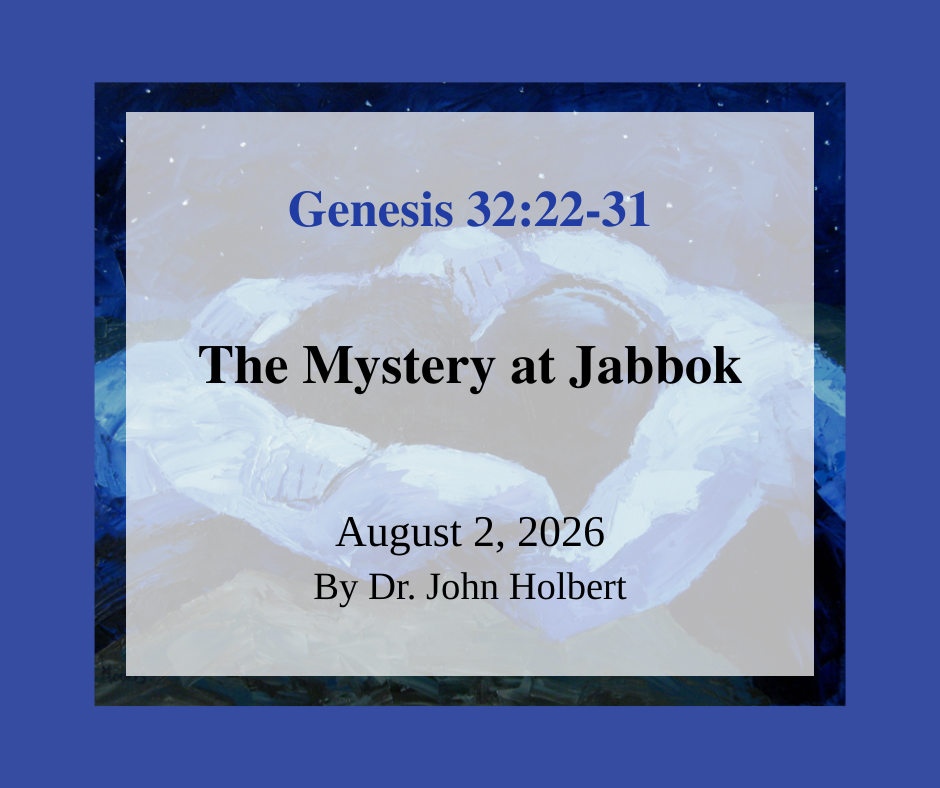
This strange encounter between Jacob and an unnamed man at the Jabbok River, a tributary of the Jordan, flowing east to west, has been heard in many different ways. The text is often headed, “Jacob wrestles with an angel,” but there is exactly no indication that an angel is Jacob’s adversary. The being is called only “man,” though to be sure there are elements of magic in this man during the encounter as I will try to show. Countless sermons have been constructed from this enigmatic story—I have preached a few myself—but I do not believe that the tale can be separated from the encounter between Jacob and Esau that follows in Gen.33. The two stories are inextricably linked, and the full meaning of the former cannot be discerned without attention to the latter.
Jacob has escaped the clutches of his father-in-law, Laban, and has headed home, accompanied by his two wives, two concubines, and eleven children, along with untold numbers of fine livestock, taken from Laban’s stalls through some clever magic Jacob performs with poplar sticks. As they approach Jacob’s homeland, he sends his entire retinue across the Jordan, and he remains completely alone. Suddenly, out of the darkness, he is accosted by a man, who “wrestles with him until dawn” (Gen.32:24). No reason is given for the man’s actions; the two wrestle for hours. However, given the long tale of Jacob that has preceded the scene, it takes little imagination to conclude that Jacob, the Grabber, has been wrestling to gain the upper hand in every situation he has faced—from his birth grab at his brother’s heel to his clever theft of that brother’s birthright and blessing to rolling away the huge stone off the well’s mouth in the attempt to win the favor of the beautiful Rachel to his multiple confrontations with the wily Laban, who first bests Jacob at the business of weddings until Jacob finally tricks Laban and escapes with a huge family and vast wealth. This wrestling match may then be seen as a culmination of a life given over to striving for success, no matter the means of achieving it.
But this match is a very difficult one. “When he (the man) saw that he could not win against him, he touched his hip socket, and Jacob’s hip socket was wrenched as he wrestled with him” (Gen.32:25). Though most translations claim that the man “struck” Jacob on the hip joint (NRSV), in reality this form of the verb always means “touch,” a reading that adds something of magic to the tale, as I suggested above. A mere touch by this man is enough to wound Jacob seriously. The man, in some desperation, demands that Jacob “Let me go, for the day is breaking” (Gen.32:26). Just who might this man be, some sort of river demon, a kind of Dracula of the ford, who will melt when the sun rises? Magic indeed! Yet, despite Jacob’s hip pain, he will not release the man “unless you bless me” (Gen.32:26). Now that sounds like the Jacob we know! Always struggling to win, always wrestling to defeat any adversary. Blessing, he thinks, may only be gained in struggle, in victory.
Oddly, at this moment, the man asks, “What is your name?” (Gen.32:27). He replies simply and truthfully, “Jacob.” That surely is his name, the Grabber, the struggler. The man responds, “Your name will never again be Jacob, but Israel, because you striven with Elohim and with humans, and you have won” (Gen.32:28). This is a grandly enigmatic statement by the unnamed man. He builds the name Israel upon the verb “to struggle, strive,” and announces that Jacob has been wrestling with “Elohim and enoshim” and has in every case won! What might that mean?
Elohim is a decidedly complex word in the Hebrew Bible. It does, of course, often mean “God,” as one sees in any number of texts throughout the scripture. However, it on occasion may mean “gods,” since it is a plural, masculine noun (see, for example in the famous Ten Words at Exodus 20:3). And in at least one place, it may mean “ghost” or “spirit” (see 1 Samuel 28:13). With what or whom then does the man claim that Jacob has been wrestling his whole life? God, gods, ghosts? He surely has been wrestling with humans, but in all these matches, says the man, he has won! He may limp away from the Jordan (Gen.32:31), but he does not limp away defeated. I know well that fine sermon by Frederick Buechner, “The Magnificent Defeat,” a sermon that has been borrowed and adapted countless times, perhaps even by some of you reading this essay! But I would argue that Buechner has not heard the full range of this text. No, he limps away victorious, not in any way defeated, and that leads to his next confrontation with his long-disaffected brother, Esau.
In Gen.33, Jacob, in typical Jacobian behavior, attempts to buy off his brother with vast quantities of goods and servants, because he is convinced that the brother he left furious so long ago, remains just as enraged now. Jacob’s own servants tell him that Esau is coming to the meeting with 400 men, and Jacob is unsurprisingly terrified, imagining that his last day is upon him.
But now comes the story’s great and wonderful surprise. After dividing his huge company into three separate groups, perhaps hoping that at least one of them may survive Esau’s coming onslaught, Jacob himself bows deeply in abject contrition before Esau, treating his brother as a regal figure if not some sort of god. But Esau is not angry at all. “Esau ran to meet him, fell on his neck, and kissed him, and they wept” (Gen.33:4). But the tears are surely for very different reasons! Esau weeps for he is glad to see his long-estranged brother; Jacob weeps because he is glad to be alive! Jacob simply cannot believe the actions of his brother, and because he is Jacob after all, demands that Esau take all that stuff he sent to him. Esau refuses, saying he has more than enough stuff of his own, but Jacob will not have it, because Jacob is a transactional man—you scratch my back, and I will scratch yours, is Jacob’s creed. But then Jacob, even Jacob, says far more than he has ever said about a possible different way of seeing the world: “for truly to see your face is like seeing the face of God, since you have received me with such grace” (Gen.33:10). For the first time in his life, Jacob has been confronted by grace, the astonishing grace of his brother.
Have you ever received such grace? From whom? When? Cannot the gift of such grace turn a life from wrestling and winning to one of acceptance and joy?
Artwork by Mike Moyers, https://www.mikemoyersfineart.com, permission granted for non-commercial use.