
The Judgment - Reflections on Matthew 25:31-46, 26th Sunday after Pentecost, Year A
by John C. Holbert on Saturday, September 19, 2026
This grand story of the judgment of the nations has become over the years a kind of basic statement about the call of Jesus in the world. I begin with a few observations. The story does not begin with the familiar “the kingdom of heaven is like…,” Matthew’s device to tell his readers that the story they are about to encounter is his way of exploring what the rule of God either is, or may be, or ought be. This narrative begins more grandly, more explosively. “When the Son of Man comes in his glory,” an apparent announcement that this tale will describe something of the coming of the Son of Man, a title ascribed to Jesus in the Gospel, his awesome glory, his army of angels, his “glorious throne.” The title, “Son of Man,” is rooted in a famous passage from Daniel 7:13-14, that 2nd century BCE primarily apocalyptic text from the Hebrew Bible. In Daniel, one like “the ancient of days” (a euphemism for God) hands power and glory to this Son of Man. In Hebrew (and in Aramaic) one might translate “Son of Man” into “the Human One,” because the grammar suggests this “Son” is a part of the class “man,” or humanity. However one is to understand the image, the scene appears designed to overwhelm the reader with visions of vast glory.
The word rendered “nations” has caused considerable discussion. The Greek is panta ta ethne, usually read as here “all the nations.” However, it has been noted that ethne in Matthew 4:15; 6:32; 10:5,18; 12:18,21; 20:19,25; 21:43; 24:7,9,14; 28:19 refers to nations other than Israel, hence Gentiles. If that is so, then is the scene limited to a judgment of the Gentiles, that is, those non-Jews who now are confronted with Matthew’s central question: who among the Gentiles will find their way into the rule of God, and thus into the community of followers of Jesus? As we have been reading Matthew’s Gospel for these many months, we have seen just how important this issue is for Matthew. Though he speaks and writes mainly for Jews, among his readers are certainly Gentiles; are they welcome or are they not? I admit to being a bit torn about this reading of ethne, since I have long thought this tale was about the judgment of all the nations, and many Christians I know have heard it precisely like that. In fact, this has become so important to many as to announce themselves as “Mt.25 Christians” to distinguish themselves from others who claim to be Christian, but do not, in fact, pass the test of Mt.25. Let us now examine just what that test may be.
The test proves to be both simple and very surprising. The Son of Man gathers all the Gentiles (or “all the nations”) before him, “and separates them one from another, as a shepherd separates sheep from goats, the sheep on the right and the goats on the left” (Mt.25:32-33). The deep prejudice in favor of right vs.left is in play here; no surprise that in Latin the left is sinistre, from which comes English “sinister”. Because my wife is left-handed, I am always careful to note this ancient bias, that clearly has no basis in any actual reality.
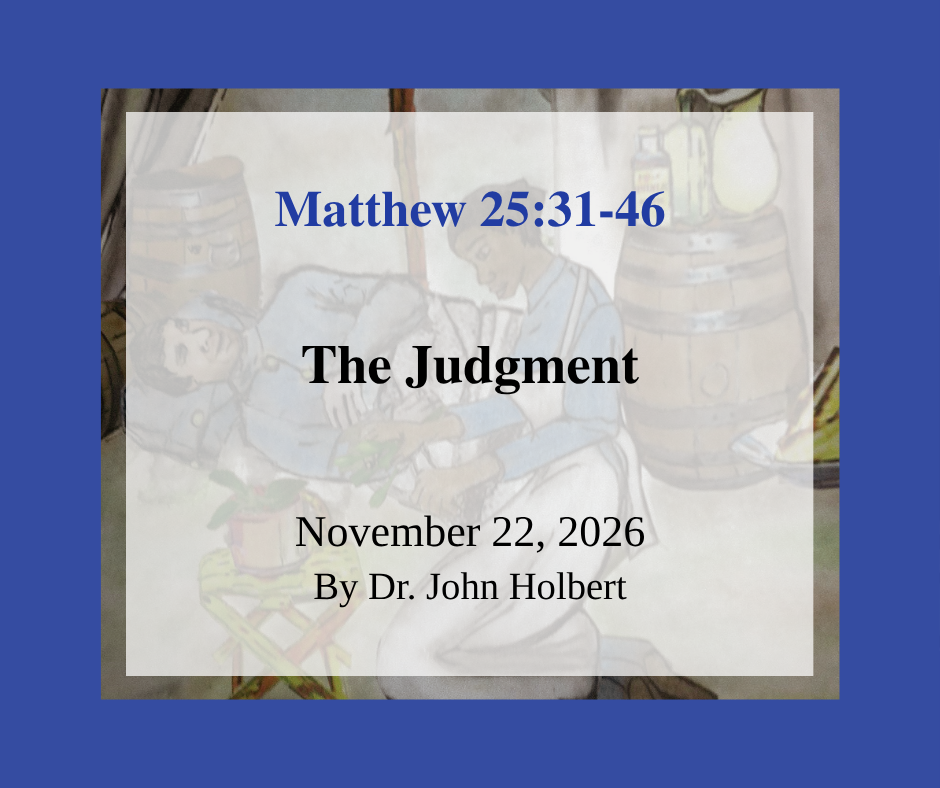
“Then the king (I.e. the Son of Man) will say to those on the right, ‘Come, you blessed of my Father, inherit the kingdom prepared for you from the beginning of the world” (Mt.25:34). Then begins the litany of human actions that include feeding the hungry, offering drink to the thirsty, welcoming the stranger, giving clothes to the naked, visiting the sick and those imprisoned (Mt.25:35-36). Note that the king uses the pronoun “I” through this list, making it all quite personal. And the sheep on the right are astonished! They say that they never saw this one, this king, this Son of Man, in any of those conditions, namely hungry, thirsty, alone, naked, sick, in jail. What in the world is he talking about? “And the king will answer and say to them, ‘Amen, I say to you, as long as you did it to one of these least brothers (and sisters) of mine, you did it for me’” (Mt.25:40).
And there is the test of inclusion in the rule of God: actions of mercy and generosity toward the “least of these” comprise the final judgment of God. The Greek “least” is elachistos which is the superlative of “little one” (mikros). Matthew in several earlier places in the Gospel has used this term to refer to members of Jesus’ followers (Mt.10:42; 11:11; 18:6,10,14). If the term ethne means Gentiles, then the story describes how Gentiles ought to treat members of the early Christian community, and thus find their way into that community. I admit I rather like the wider reading where the point is that all nations will be judged in this way, not only the Gentiles.
And the story ends in darkness for the goats on the left. They too are told about the hunger and thirst and aloneness and nakedness and sickness and imprisonment of the king, but did absolutely nothing to help. The goats are just as astonished as the sheep! They never saw the king in any of these desperate states, with the implication that if they had, they surely would have acted on his behalf. Too late, shouts the king. “Amen I say to you, as long as you did not do it to one of these least, you did not do it for me” (Mt.25:45). And their fate is dark indeed! “And these will go away into everlasting punishment, but the righteous into everlasting life” (Mt.25:46). This ending arises from the classic Jewish apocalyptic scheme of “this age/world” over against “the age/world to come.
There has been considerable debate about just what sort of thing this tale is: parable, judgment scene, independent logion about the end of days? However it is to be called, it stands in a crucial place in Matthew’s narrative. It follows the two remarkable parables of the ten maidens and the wealthy and cruel master and precedes the announcement of the plot to kill Jesus, a plot that proves all too successful (Mt.26:1-16). It could well be said that here, at last, it is made plain just how one may be a follower of Jesus. Feed and clothe and house and visit and heal the very least of these, those in desperate need of all of those actions. Even if the tale is to be seen as an actual scene of “final judgment,” how it is regularly described, the story says this: we will not be judged on our right theology, or our correct denominational choice or even on whether or not we approach worship in this way as opposed to that. We are and will be judged on the ways we aid God’s people in need right now, not in some rosy future, but now. This story is finally the tale of the daily judgment, and it is operative as I write and as you read. I think my Christian friends who claim to be “Mt.25 Christians” may well have this Christian thing rightly. We all would do well to emulate them, and thus emulate God and Jesus in the bargain.