
The Famous Tale is Political - Reflections on Luke 2:(1-7), 8-20, Christmas Day, Year B
by John C. Holbert on Wednesday, November 11, 2026
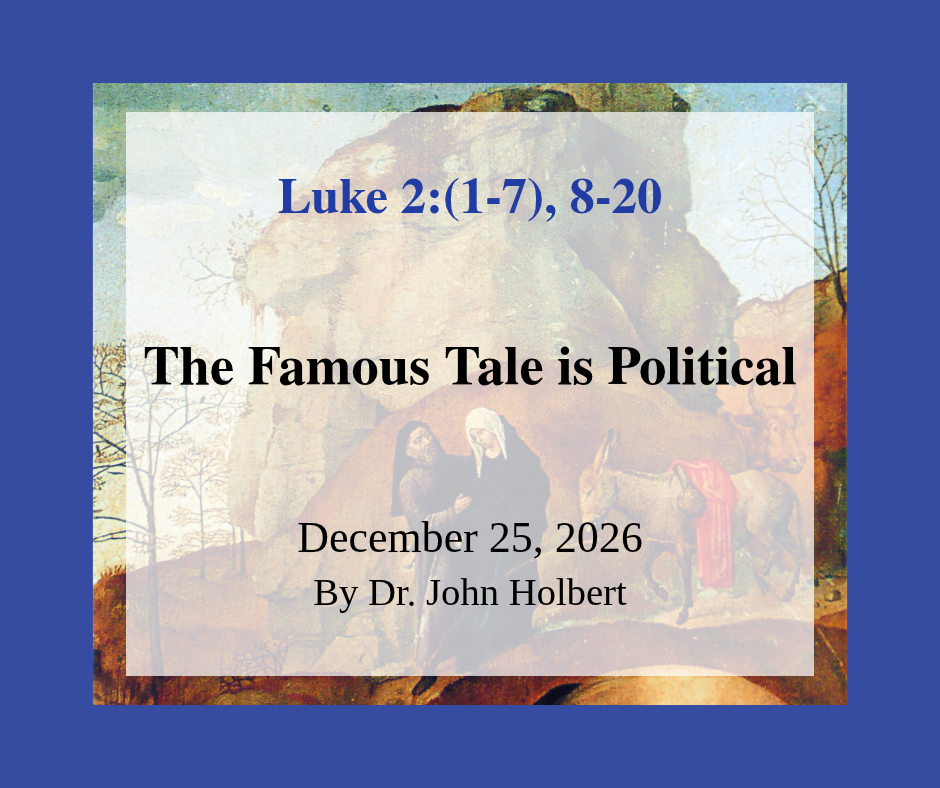
Many of us know that the Bible is far more overtly political than numerous readers of its pages care to understand or admit. In an America where the separation between church and state is enshrined in our Constitution, in the First Amendment, (however much Christian Nationalists and others want to argue that it is not implied there), it has been dogma for many Christians that politics must be kept far away from the Bible and the church. Indeed, there used to be laws, now weakly, if ever, enforced, that said any endorsement of a political candidate from the pulpit or Sunday School classroom risked the revocation of that church’s tax-free status. Of course, such endorsements have been made quite openly for many years, and I know of no churches that have been taxed as a result.
How ironic it is then that this very famous story from Luke’s Gospel revolves around a question of the levy of taxes by the Roman authorities, and the necessity of the young couple from Nazareth to return to their home city of Bethlehem to fulfill the demands of that government with regard to taxes. The tale begins with an astonishing series of sentences. “In those days a decree was issued by Caesar Augustus to have the entire empire registered. This was the first registration. It happened while Quirinius was governor of Syria. Everyone went to be registered in one’s own city” (Luke 2:3). And because Joseph “was from the house and lineage of David,” he and Mary leave Galilee, and head south to “the city of David called Bethlehem” (Luke 2:4). Thus, of course, Jesus is linked directly with David, the great king of Israel’s days of glory.
After the birth of the baby, which occurs very soon after their arrival in Bethlehem, Mary wraps her child in “cloth strips,” and lays him in a cattle trough, “because there was no place in the lodging area” (Luke 2:7). The “lodging area” is hardly the “inn” of fancy; it is a space in a house (see Luke 22:11), or possibly an area where travelers and their animals gathered in the open. The animals at the crib, replicated in numerous creches down the centuries, is merely apocryphal, perhaps based on Is.1:3. However many accretions have attached themselves to the story, the appearance of the angel of the Lord to the shepherds, accompanied by the heavenly army, seals the sharply political nature of the narrative. They all loudly proclaim that This baby is nothing less than “savior” and “Messiah” (Luke 2:10). These titles ascribed to Jesus have been used in Roman literature to describe the emperor; hence Jesus is said to be the genuine savior and Lord, over against the ruler of the empire who can now only be seen as a false savior and Messiah. Augustus may “rule” over his earthly empire, but the true ruler of the world is Jesus, the baby of Bethlehem.
Because Mary and Joseph are forced to move many miles from north to south, even though Mary is heavily pregnant, due to Augustus’s command, it is made plain that the Roman emperor has full authority to force all subjects to travel wherever he says. He controls “the whole world” (oikoumene)which can mean the “known world,” thus the empire of Rome. But the baby, according to the angels, is the real ruler of the known world; he is savior and Lord, not Caesar. Of course, there is also irony in the choice of those who hear the truth of the real world ruler—shepherds. These were hardly high on the social scale of 1st century Palestine, ranking very low in power and privilege. But it is not to Caesar, or even to Quirinius of Syria, that God sends news of the birth, but to shepherds, suggesting that the power of the world may not reside where most people think it does. In fact, the angels come to a farm near Bethlehem, not to the temple in Jerusalem, where God has traditionally been accessed. God and humans thus meet in an unlikely, yet common, place. Good news comes for all, and the result of its coming is praise.
A direct physical confrontation between Jesus and Caesar never really occurs, but as we read the story the confrontation has in fact happened. Jesus is Lord, not Caesar; Jesus is savior, not Caesar. Caesar may order his empire as it pleases him, but he is unaware that that empire is now under dire threat by the genuine ruler of heaven and earth. Thus is this tale profoundly political, as is the ongoing work of Christianity in the world. All world rulers are made lesser in power in the face of the power of God and Jesus, and we Christians must always acknowledge that our struggle is not merely with our individual souls, our need for individual salvation, but we are called always to attend to the ways that the rulers of this world are called to account by the one who has come at Bethlehem. In short, our Christian work is always political, and we must act as if we know that to be so.