
The Crucial Role of Humanity - Reflections on Genesis 2:15-17, 3:1-7, First Sunday in Lent, Year A
by John C. Holbert on Saturday, January 3, 2026
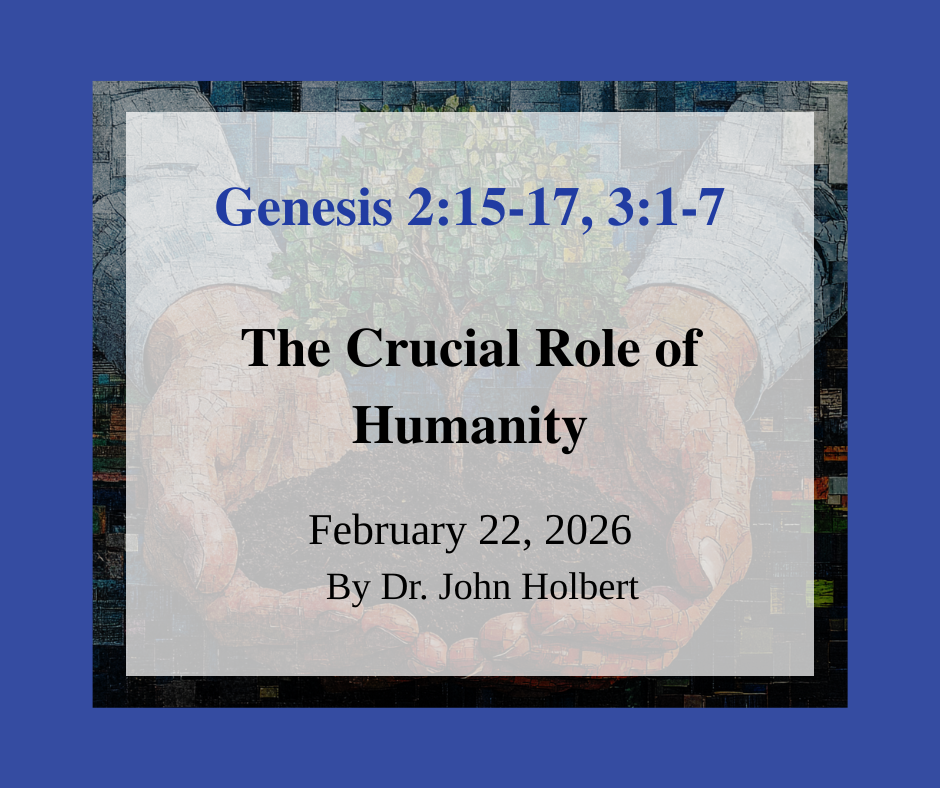
It is unlikely that anything I say about these famous verses will offer anything really new, but so it is with most texts of our Bible. Still, we regularly find insights from these very ancient texts that continue to surprise and enlighten those of us who continue to believe that in these particular words we find nothing less than the word of God. I wish to focus my attention on the verse in chapter 2 that speaks, perhaps somewhat unemotionally, about the role that God gives to God’s human creation, as that role relates to the garden of God just created in the story preceding the creation of humanity. Of course, it has long been recognized that Gen.2-3 is the second story of creation the book offers to us, following the story of Gen.1-2:4a, a grand poetic tale, quite different from the campfire story portrayed in Gen.2-3, a story by most accounts far older than that of Gen.1. Yet, despite the story’s simplistic appearance, I wish to suggest that this one verse introduces to the world among the most important visions for our human relationship to the planet on which we live.
Climate change is a very real, and very scary, a reality that all of us face. Despite what the current administration in Washington continues, falsely, to announce, climate change is happening, and is perhaps happening at a rate we have yet to conjure with. No matter how often President Trump and his uninformed colleagues continue to proclaim, that climate change is a hoax—“the greatest hoax perpetrated on humanity” Trump recently claimed—he is unfortunately completely wrong. Temperatures are rising, as are the oceans, with carbon dioxide levels also rising to alarming levels in the atmosphere, moving the earth ever closer to unavoidable climate catastrophes: melting Arctic and Antarctic ice, disappearing glaciers, dissolving permafrost, releasing huge waves of methane, once locked in, but now free to add its heating to the world. With the warming oceans come coral reef bleaching, increasing difficulties for fish who cannot adapt to the new temperatures, and increasing losses of beaches and coastlines world-wide. Unless measures are taken, and soon, by the end of the century, if not earlier, the world we have known will be unrecognizable with fewer and fewer places safe to live in. Those are the facts, and no presidential bloviating can change them.
We need a new and more effective way to understand our human relationship to the planet. Unlimited drilling for oil and gas, coupled with unlimited economic growth based on those increased uses of fossil fuels—in short the ways we have operated over the past 150 years—is no longer possible. That way will lead to disaster. If we continue to imagine that we humans have the right to do as we please with our earth, that earth will ultimately no longer support us. However, in Gen.2:15 lies the seeds of a new way of thinking. Here is the text:
“YHWH Elohim took the ‘adam’ (not “the man;” the word means “human”) and placed it in the garden of Eden to serve it and to guard it.”
The more familiar translations of the two verbs used to describe the roles of the human beings: “to till” and “to keep” are to me a large problem that has led to many of the issues we face with respect to our global home. The traditional reading “till” of the verb commonly meaning “serve” is a holdover from an agricultural model, generated primarily from a 17th century translation, implying that we humans are in control of the earth. The more accurate reading “serve” suggests what the writer may have had in mind, namely that we first “serve” the earth, we do not work it over. It is our partner, not our underling. And also we “guard” the earth, protecting it from those who would despoil it, rather than “keep” it (though that is a possible translation of the Hebrew, I admit). I like “guard” far better, because it conveys the notion of protection: to “serve” and “protect” is our proper stance in relationship to our earth.
I believe that these simple but profound changes in this seminal text would begin the process we need to undergo if we are to avoid the very worst effects of climate change. In short, we need a conversion away from our foolish and disastrous idea that we control the earth only to our economic advantage, while in fact we are partners and protectors of it to its and our advantage, and to all the other creatures that live on and in it at the same time. We desperately need this conversion, and we need it very soon. I urge you to preach about our collapsing climate which is for us the single most important problem that our whole world faces. Without addressing the climate, the fate of earth, all other problems become essentially unimportant or moot: war, poverty, immigration, and all the other vast issues of our day pale over against the existential threat of a changing climate.
As Christians, we believe in hope, and so we do when it comes to the climate. It is not too late to act, but it is indeed becoming very late indeed.