
The Beginning of the Gospel of Jesus Christ - Reflections on Mk 1:1-8, 2nd Sunday in Advent, Year B
by John C. Holbert on Thursday, November 5, 2026
I write this reflection the day after the Milwaukee Brewers won the 2026 World Series over the Tampa Bay Rays 4 games to 1. It is the Brewers’ very first World Series win in their entire franchise history. As a Texas Rangers fan, I recalled with real pleasure the feeling of a first World Series win in 2023, when I witnessed my team doing exactly the same thing in Phoenix, a 4-game-to-1 win over the Arizona Diamondbacks. I can fully appreciate how Brewers fans must feel today. For a baseball fan—I have been one nearly my entire life—there can be no better feeling.
Because the Brewers won 103 games during the regular season, more than anyone in the Major Leagues, there was a certain inevitability to their Series victory; more than a few fans thought they would win it all, and they certainly did. (My Rangers possessed no sort of inevitability when they won it all in 2023, having in effect barely sneaked into the playoffs, and then went on a very surprising run to the championship). The Brewers were in a certain sense a “team of destiny,” and their victory was, however sweet for their fans, in many minds nearly assured.
I am sure by now you are wondering what in the world all this baseball talk has to do with the Markan text for today. I hope to show that in the same way that the Brewers’ championship was well-nigh inevitable, given expectations for the team and their fine play throughout the season, after a reader engages with Mark 1:1, the course of Mark’s gospel is equally inevitable, carried on the choices he has made in the very first words of his narrative. (I am greatly helped in this reading by Wes Allen’s recent volume, The Gospel of Mark, a superb commentary on the text that I heartily commend to each of you, just published by Westminster/John Knox.)
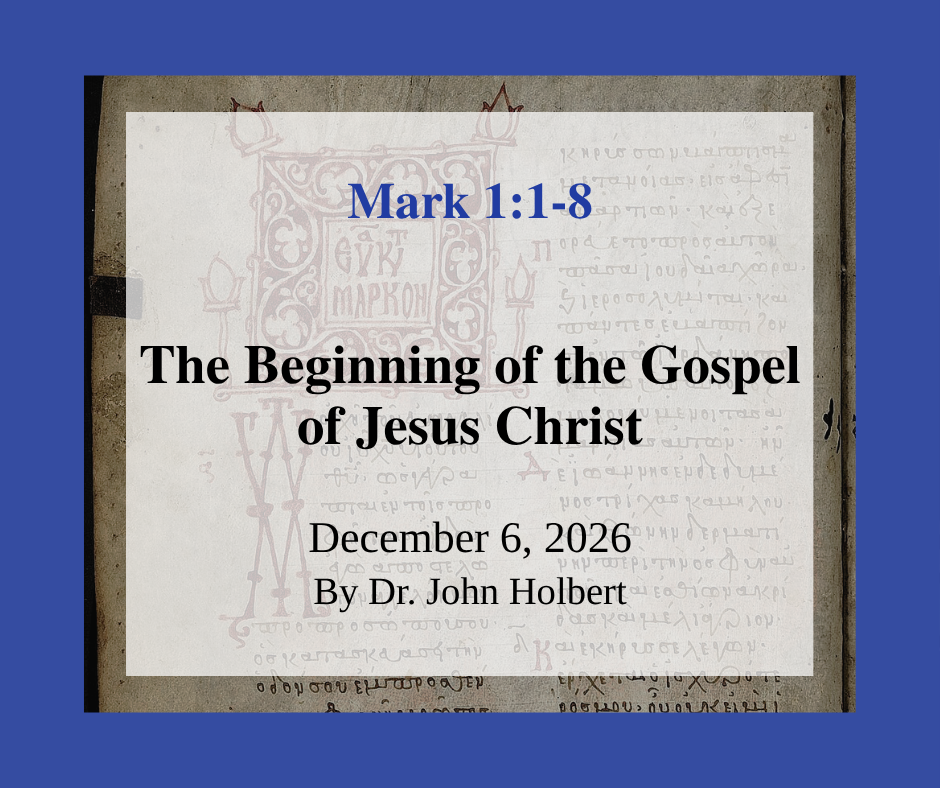
The opening words of the Gospel are simple enough: “The beginning of the good news (or “gospel”) of Jesus Christ, the Son of God” (Mark 1:1). The sentence is not a complete one—there is no verb supplied. It could be that the author assumed that the hearers would automatically supply a simple verb “is”, but there may be another explanation for the lack of a verb: Allen suggests that vs.1 “functions as a title for the entire narrative” (Allen, The Gospel, 33). He makes the intriguing, and to my mind persuasive, claim that this beginning points to the very basic stance that Mark makes for his entire gospel story, namely that Mark focuses his account of the tale of Jesus parabolically. That is to say that this particular gospel emphasizes throughout the surprising and disorienting nature of what Jesus has come to do in the world. And furthermore, this gospel is only the “beginning” of the story of Jesus. And that explains to a certain extent the abrupt and shocking ending of Mark’s story when the women leave the empty tomb of the risen Jesus, “and say nothing to anyone, for they were terrified” (Mark 16:8). This astonishing ending announces many things, but the primary claim is surely: if they said nothing about this event, then somebody needs to speak about it! And that somebody must be those who are reading/hearing the story—you and me.
The other words of the opening half-sentence are equally freighted with important meaning. The word “gospel” (euangelion in Greek), was a well-known word in the first century, but hardly a uniquely Christian one. It was a genuinely celebratory locution, announcing the joy of the emperor’s birthday, elation at a military victory, or even religious as in God’s saving acts at the Exodus. For Mark, the word now implies that we are about to read of the proclamation of God’s great actions through Jesus Christ for the renewed wholeness of the world.
The word “Christ,” Greek for the Hebrew mashiach, or “anointed one,” is regularly used for the anointing of kings in the Hebrew Bible, but by the time of Jesus is used for a special ruler who arises from the line of David to reign eternally. Mark is intent on demonstrating that Jesus was in fact that ruler. Allen points out that whenever Mark uses the term Christos with the definite article, ho, he makes it clear that there is the danger of misunderstanding the term, most especially when Peter blurts the term out, and is roundly rebuked by Jesus for doing so at 8:29. Peter hardly knows what the term means in the case of Jesus, and because Mark makes us identify with these clueless disciples in his story, neither do we understand what the term means. But we will learn, if we are attentive to Mark’s way of telling.
Finally, the words “Son of God” (not found in all early manuscripts and the subject of much debate) play a similar role as does the term Christ. No human in the Gospel announces Jesus as the Son of God until the centurion who crucifies Jesus, that Roman pagan, that craven killer, loudly proclaims the title in the face of Jesus’s death. The demons know that Jesus is Son of God (Mark 3:11; 5:7), but the disciples never gain the knowledge of Jesus’s identity. But we, the readers, are told right at the beginning exactly who Jesus is, Christ and Son of God. Yet, we will not learn the meaning of those terms until we have encountered the entire tale in its surprisingly twisted ways.
Thus, in this second Sunday of Advent, as we wait for the birth of the Christ child, Mark 1:1 warns us not to be too sanguine about just who this child may be. Just as many fully expected the Brewers to win the World Series, so we think we know all too well who the child is: Christ and Son of God, and we will sing glad songs of joy in honor of his coming. However, Mark 1:1 bids us to be careful. Do we really know just how Jesus is both Christ and Son of God? It could well be that a careful reading of the whole of Mark’s account might deepen our understanding of his identity, might sharpen our minds about jus who he is, might help us see how this particular Christ and Son of God is calling us to join him in the work of bringing the rule of that God at last to the earth.