
Sowing the Seed - Reflections on Matthew 13:1-9, 18-23, Seventh Sunday after Pentecost, Year A
by John C. Holbert on Monday, May 18, 2026
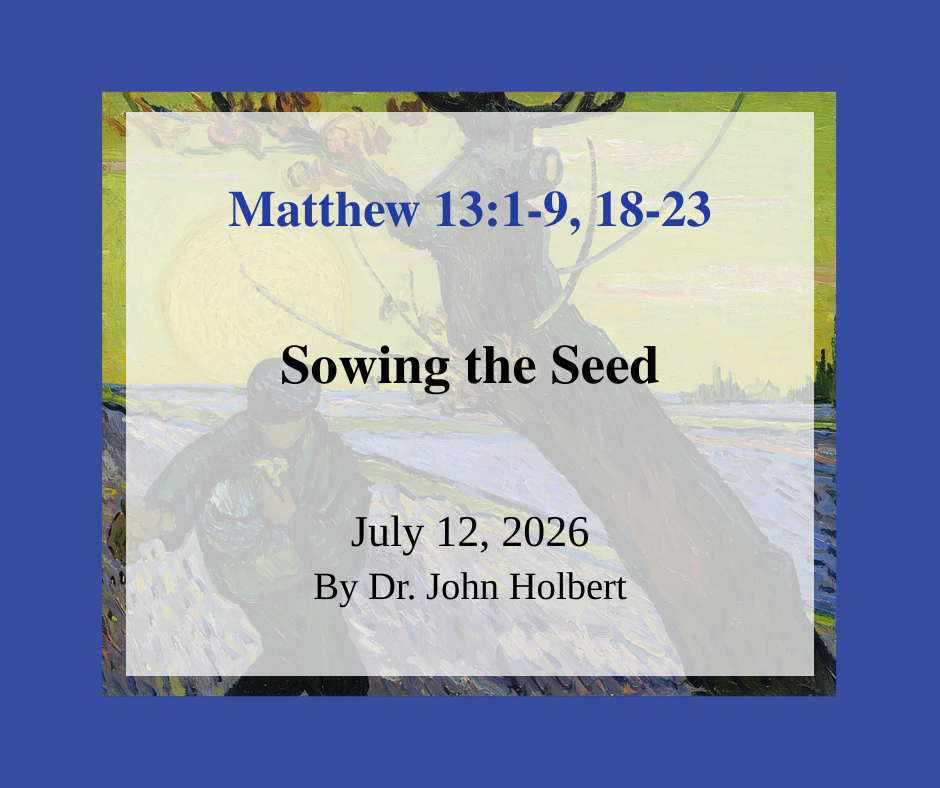
On the one hand, this famous parable of a farmer who sows seed is quite easily understood: the seed sown is the gospel which is spoken in all times and in diverse circumstances with the result that in only 1/4 of the time of its preaching and it teaching is it successful. In other words, any who preach and teach faithfully the word of Jesus’s gospel can expect to have it heard only in one out of four occasions by only one out of four persons who hear it. For those of us who preach and teach I think that a 25% success rate may be a bit high! And, of course, it is important to get clear more exactly what is meant by success.
It is of value to try to understand the actions of this farmer in the parable—is he foolishly profligate with the seed or is he merely following the practice of first-century CE farming techniques? Joachim Jeremias, a famed mid-20th century commentator, was adamant that this farmer was representative of farmers of his time. When he tossed the seed on paths, rocky soil, thorny edges of the field, and on promising soil, he fully intended to return to his sown seeds and plow them in to create the possibility of wide success; in that he was a good farmer. I do not think Jeremias has this correctly. I think this farmer is precisely profligate in his sowing, tossing the seed willy-nilly, hither and yon, hoping against hope that some would in fact actually grow into healthy plants. And some in fact do.
I suggest that Matthew had a huge problem in his community, the same problem that Paul had in his a few decades earlier (Rom.9-11): why do some Jews receive the message of Jesus and some do not? Matthew’s earliest listeners, the ones to whom he directed his Gospel, were primarily Jews, hence his constant reference to the Hebrew Bible (or more accurately the Septuagint Greek version of it) to demonstrate that the original texts of Judiasm themselves spoke of the coming work and life of Jesus and in fact predicted, or at least prefigured, Jesus’ coming into the world, announcing the rule of God. This parable is an accurate depiction of the fact that some Jews heard the truth of Jesus, and some did not. Why that was the case is in my mind not Matthew’s central concern, though it is an important one. He simply wanted to portray that facts as he saw them; some Jews heard and some did not.
That Jesus spoke in parables is crucial for Matthew, far more than it was crucial for his model Gospel of Mark. CH Dodd’s definition of what a parable is remains valuable after nearly 75 years: “it is a metaphor or simile drawn from nature or common life, arresting the hearer by its vividness or strangeness, and leaving the mind in sufficient doubt of its precise application to tease it into active thought” (Dodd, The Parables of the Kingdom, 5). I wish to focus in this superb definition on “strangeness” and “doubt.” The farmer is here strange; he tosses the seed about in foolish ways and on hopeless places: on the paths where people walk, where the dirt is compacted and unyielding; on the rocky ground of which there is plenty in the land of Israel, a land suffused with stones; on thorny spots, perhaps the edges of a field where spikey bushes are planted to divide field from field and to keep animals away from the plants. Finally, there is some good soil, conducive to the seeds, but it represents the distinct minority of the possibilities of good growth. Thus, the farmer is strange, and would have been seen so by the farmers listening to the story. And because the farmer is strange there would necessarily be doubt among those hearers—what exactly is the story-teller saying?
Mt.13:18-23 offers an interpretation of the parable. I imagine this interpretation arises from the early church which sought an explanation about exactly why some hearers just would not hear. Hence, they allegorize the story, thus removing, they think, some of the strangeness and doubt. The seed sown on the foot path becomes seed sown in the heart, where the “evil one” snatches it away (Mt.13:19). The seed on rocky ground is one who hears the word with joy at first, but has no root in himself, so when “persecution or tribulation” comes, “he stumbles” (Mt.13:20-21). The seed sown among thorns is the one who hears the word, but “the care of this age and the deceitfulness of wealth choke the word, and it is then unfruitful” (Mt.13:22). But the good soil seeds represent those who “hear the word and understand it, who bear fruit, yielding in one case a hundred, in another sixty, in another thirty” (Mt.13:23).
Note the common Matthean themes: the evil one (the devil) is always around to take away those who are not fixed in their convictions; some claim to hear the word but because they are not well-rooted in it, cannot withstand the persecutions that are sure to come; and always there are for many “this age’s cares,” that is anything that gets in the way of true following of the call of Jesus, along with that eternal issue of the “deceitfulness of wealth,” ready with its siren call away from the more difficult road which Jesus calls us to. These explanations of the meaning of the random seeds are useful and familiar, yet perhaps blunt somewhat Dodd’s concern that parables “tease us into active thought."
The story focuses its attention not on the sower but on the seed. The parable ought to be named the Parable of the Seed. If the seed is the gospel, the good news of Jesus and his announcement of the reign of God, it must simply be sown everywhere, indiscriminately, regardless of any hope for its reception. There may be success, we are promised, but we may not see it ourselves. Note the end of the story: the good soil produces good fruit, but the farmer is not around to witness it. The farmer’s role is to sow, and so is it ours, too. One of the hard truths of the gospel is that it majors in the long view; none of us today may see much success in our sowing efforts. We live only in the promise that some seed will grow. And that must be enough.