
Some Doubted - Reflections on Matthew 28:16-20, Trinity Sunday, Year A
by John C. Holbert on Wednesday, April 1, 2026
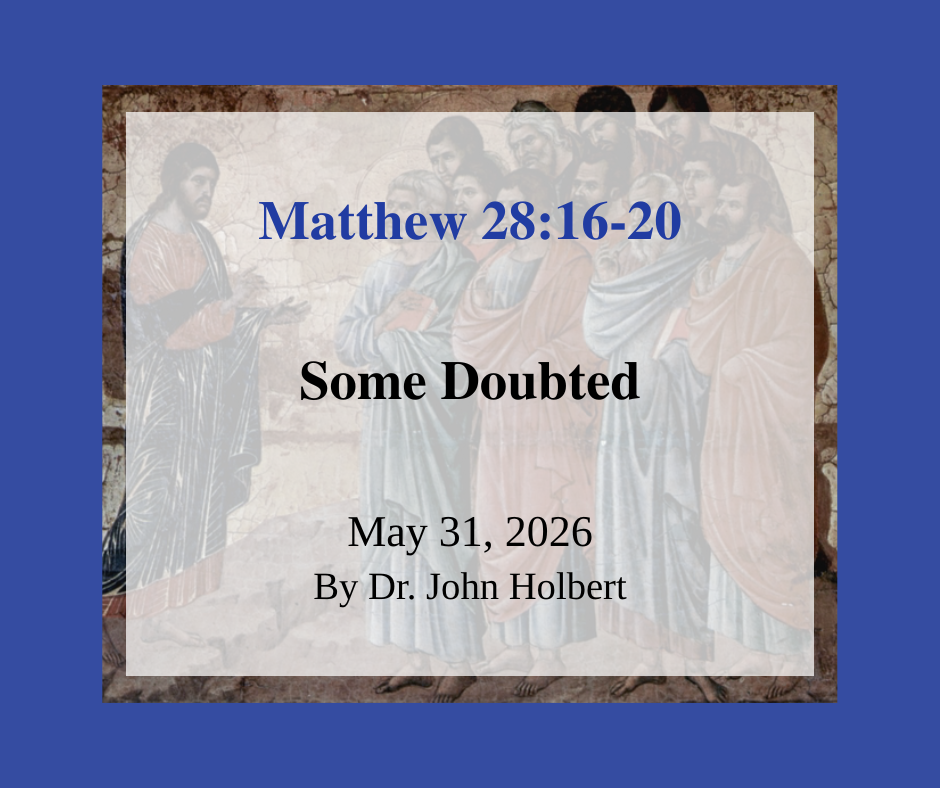
We begin today in this Year A of our lectionary in the season after Pentecost, a long exploration of the Gospel of Matthew. For the next 26 weeks we will have the opportunity to look with as much care as brief essays allow at this particular Gospel and thereby, I hope, give to our congregations a fuller understanding of how Matthew answers the central question of all the Gospels: just who is this Jesus, anyway, and what has he to do with me? In myriad ways Matthew will probe at this question with considerable literary and theological skills. We begin on this Trinity Sunday, the first Sunday after Pentecost, with a look at the very end of Matthew’s work, Mt.28:16-20. The passage is usually titled “The Great Commission,” and has served for centuries as the impetus for the worldwide Christian mission, the call of Jesus to “make disciples of all the Gentiles” (the usual reading is “all the nations,”—NRSV— a translation that depends on a broader understanding of the Greek panta ta ethne). Clearly, the reading “nations” has been assumed by all those who have undertaken a Christian mission to the world. Though that is an interesting and important debate concerning Matthew’s meaning in vs.19, my interest today lies elsewhere in the pericope.
I have long been fascinated, and given considerable comfort, by the enigmatic vs.17. “And on seeing him (the risen Jesus), they paid him homage (or “they worshiped him” NRSV), but some doubted.” I have regularly been deeply struck by that tiny note in this Gospel. Jesus has called his eleven disciples (Judas is now dead) into Galilee to “the mountain to which Jesus had directed them” (Mt.28:16). They have been called to this specific spot by the prophecy of Mt.26:32 and by the angel and Jesus at Mt.28:7, 10. Jesus has been resurrected in a highly cinematic event, accompanied by earthquake, a white-clothed angel, entranced guards, terrified women, and, most astonishing of all, an empty tomb (Mt.28:1-10). And now the disciples, thinking that their leader and Lord is dead and gone, are bid to come see him alive and among them on a Galilean mountain. So, they “worship him,” which seems completely appropriate, yet “some doubted,” which seems nothing short of ludicrous! In the very face of the resurrected Jesus, who assures his closest followers that he has been given “all power in heaven and on earth,” and who then commands them to “go, make disciples of all nations (or Gentiles), baptizing all of them,” and “teaching all of them to observe all I have commanded you” (Mt.28:18-20), but “some doubted.” What did they doubt? And which of them doubted—all of them, or only some of them? Which ones? I find this incredible, and yet, as I said above, for me quite comforting.
Before I try to explain why I find comfort here, let’s try to understand what the text is actually saying. The Greek verb is quite rare, and can mean either “doubt” or “hesitate.” It is used at only one other place in the New Testament, Mt.14:31, where Jesus chides the faltering Peter, who first steps out of a boat to join Jesus on top of the water but begins to sink, causing Jesus to say, “You of little faith, why did you doubt?” That scene has always struck me as at least understandable: Peter’s reckless attempt to walk on water was probably doomed to failure; human beings do not in fact walk on water, and cartoon-like, are destined to sink. So, the word here must mean “doubt;” Peter’s faith, says Jesus, is not up to this task.
But here at the Gospel’s ultimate scene, some or all of the disciples either hesitate or doubt, though the call of Jesus is as clear as crystal: go, baptize, and teach! Are some worshipping Jesus, while others doubt, or do all of them both worship and doubt? The grammar of the sentence appears to suggest that some worshipped and others doubted, but the sentence has long been the subject of intense debate. I choose to believe that it means that all of those eleven disciples both worshipped Jesus and at the same time doubted or hesitated in the face of the enormous demands that their Lord is about to make on them.
Of course, the other four Gospels also register various tenuous human reactions to the resurrection of Jesus. Mark presents us with three women, confronted by a man in white, telling them that the dead Jesus is in fact alive, and demanding that they go and tell this amazing tale to the disciples, especially Peter. Their reaction? “They said nothing to anyone, for they were terrified,” a decidedly surprising end to a story that needs telling! (Mark 16:8) Luke gives us a story of two despondent followers of Jesus who had hoped “he was the one to redeem Israel,” but whose death had taken that hope away. Suddenly, Jesus appears walking with them to a local village, but they do not recognize him until they break bread together. But just as they see who it was who has been walking with them and teaching, he vanishes! (Luke 24:13-35). And in John, poor weeping Mary witnesses the death of Jesus, and after his resurrection, sees a man in a garden, whom she imagines is really the gardener, though he turns out to be Jesus! (John 20:11-18). Each Gospel in its own unique way suggests that the initial reaction to the tale of resurrection is less than immediate acceptance and enthusiasm.
And in those places in the story of the four Gospels, I find comfort. What each writer suggests is that human hesitation, doubt, and suspicion in the face of this astonishing Good News is to be expected and is not in the end surprising. I have made it quite clear in earlier essays that I simply do not believe in the literal resurrection of Jesus, but I very much believe in a story of the defeat of death and the human attempts to grasp what that might mean for my present and future and the present and future of the world and all its creatures. And, quite personally, my reaction to the story, wherein I am called to live a life centered on Jesus and his demands, is often terror, fear, doubt, hesitation, confusion, and suspicion. I understand all too well those disciples on that Galilean mountain, those women at the empty tomb, those two followers on the road to Emmaus, and Mary in the garden. All of them, each of them, are me, the real me, the doubting me. And in those parts of the tale I indeed find comfort; I am not alone in my doubt and hesitation. Others in the story itself have experienced the same, and in that I find true Good News for my life.