
Sheep without a Shepherd - Reflections on Matthew 9:35-10:8, Third Sunday after Penecost, Year A
by John C. Holbert on Monday, April 6, 2026
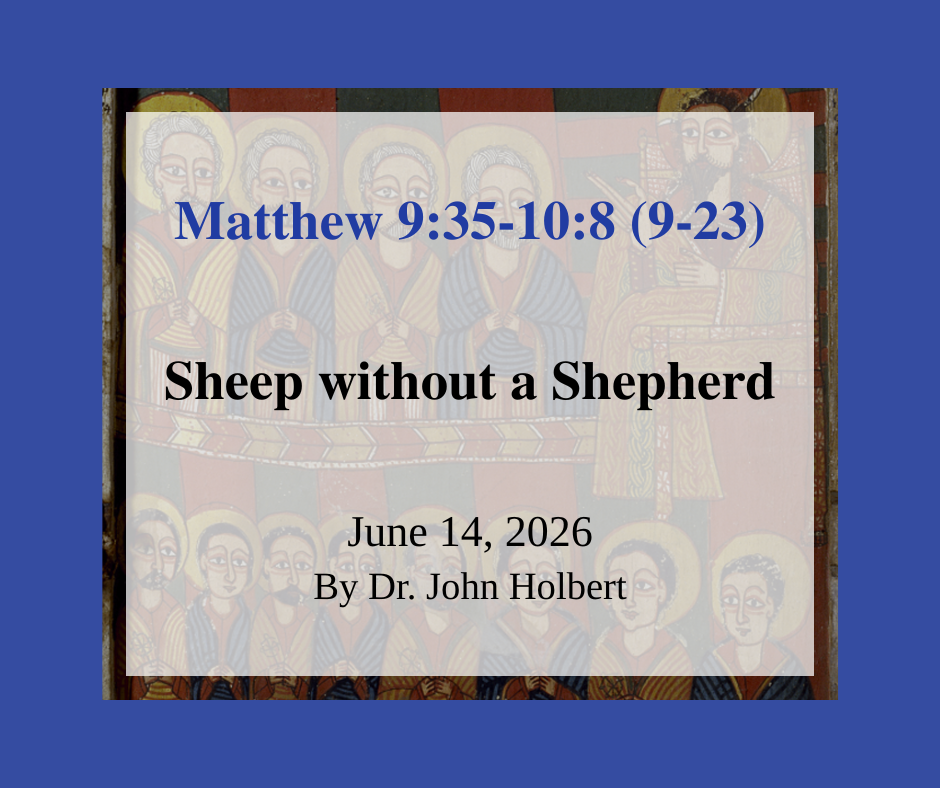
In this section of Matthew’s Gospel, he makes very clear the focus of his unique narrative of the story of Jesus; that story’s audience is the people of Israel, the Jews of Matthew’s day. Of course, he too is a Jew, as are the great majority of his followers. Matthew sees himself as the interlocutor between Israel and its ancient tale, and the Messiah of Israel, Jesus of Nazareth. The great ingathering of God is imminent for Matthew, and Israel needs to be prepared for that crucial time when God will finally rule on the earth as in heaven. That famous scene in Matthew 25 when “all the nations will be gathered before him” (that is “the Son of Man”) is the pictorial description of that coming day of God’s rule. But before that glorious time, preparation is needed, and Matthew proposes to offer Jesus and his disciples as the ones who will make Israel ready for that day.
The central image Matthew uses to describe that preparation is the long-employed sheep/shepherd language that has infused Israel’s life from early days. In numerous places in the Hebrew Bible from very early texts to much later ones this image has played a crucial role in Israel’s ongoing struggle to become the people that God chose them to be. Matthew directs our attention to this metaphor, both in Israel’s historical memory of sheep and shepherd, but also in deeply emotional language, to fix the metaphor into the minds and hearts of his readers/hearers. “When he (Jesus) saw the crowds, he took pity on them, because they were troubled and torn apart (“harassed and helpless” NRSV), like sheep not having a shepherd” (Mt.9:36). Matthew apparently borrows the phrase “like sheep without a shepherd” from Mark 6:34, but adds to that phrase the sharply emotional language “troubled and torn apart” to emphasize the desperation that the people of Israel surely feel in his own time.
If we may assume that Matthew has written his Gospel after the fall of Jerusalem to the Romans in 70CE, the image of “sheep without a shepherd” takes on a renewed power and poignancy. The flock of Israel has been quite literally harassed and troubled and torn apart by the Romans, and has been forced into another exile, this time an exile that includes an increasing part of the known world. From this terrible time, Jews will appear nearly everywhere, having been expelled from their sacred city and land. They are indeed sheep without a shepherd, and Matthew offers to them the new shepherd, the good shepherd, Jesus, as their Messiah and savior.
Such language is of course readily familiar to any Jew of the first century. Mt.9:36 refers quite directly to Numbers 27:15-17: “Moses spoke to YHWH, ‘Let YHWH, God of the spirits for all flesh, appoint a man over the community, who shall go out and come in before them, who shall lead them out and bring them in so that the congregation may not be like sheep without a shepherd.’” The man chosen is clearly here Moses, the great teacher and leader of Israel, but Matthew, with reference to this text, suggests that the new Moses is at hand; Jesus is now the one who will ensure that the flock of Israel will have a shepherd whom they can trust. In addition, Matthew’s emotional addition of the harassment and dangers of the flock of Israel may come from 1 Kings 22:17 (partly repeated at 2 Chronicles 18:16): a prophet of Israel, Micaiah be Imlah, was a thorn in the side of king Ahab of Israel, warning him that his desired military foray against his enemies will result only in disaster—“I saw all Israel scattered on the mountains, as sheep that have no shepherd.” And even the exile itself, that most horrifying event in Israel’s history, the exile into Babylon in the 6th century BCE, brought forth this same language. Ezekiel 34:5 describes the exile he has witnessed: “they were scattered because there was no shepherd.”
Finally, the prophet Zechariah at 13:7 describes the “Day of YHWH,” that fearful day when God appears to punish the wayward people, employing once again this familiar verbiage: “Strike the shepherd that the sheep may be scattered,” he intones, suggesting once again that Israel in the face of calamity has no proven leader. Matthew announces to Israel that now they have such a leader. But he goes on to say that this leader Jesus knows all to well that “the harvest is huge, while the workers are few” (Mt.9:37). Hence, he asks his disciples to “beg the Lord of the harvest to send out workers to the harvest” (Mt.9:38). And then Matthew names the twelve disciples/ apostles who are directed by Jesus to go and do the work he commands them to do, namely “to cast out unclean spirits and to heal every disease and every infirmity” (Mt.10:1). In other words, they are to do what Jesus has been doing.
There are exactly twelve figures called, because twelve has long been the number known by Israel as the original configuration of the first tribes of Israel. This number twelve is so rooted in the literature of the time that even when that ancient tribal idea no longer had any real political meaning, when the community is said to be restored in the Book of Revelation 21:12-14 that twelve-tribe structure will once again possess powerful and eternal significance. Thus does Matthew ring important changes on an ancient metaphor, claiming to the Israel of his day that the true shepherd for the tortured sheep has appeared, and his name is Jesus.