
Religious Leaders Under Attack - Reflections on Mt. 21:23-32, 18th Sunday after Pentecost, Year A
by John C. Holbert on Monday, July 6, 2026
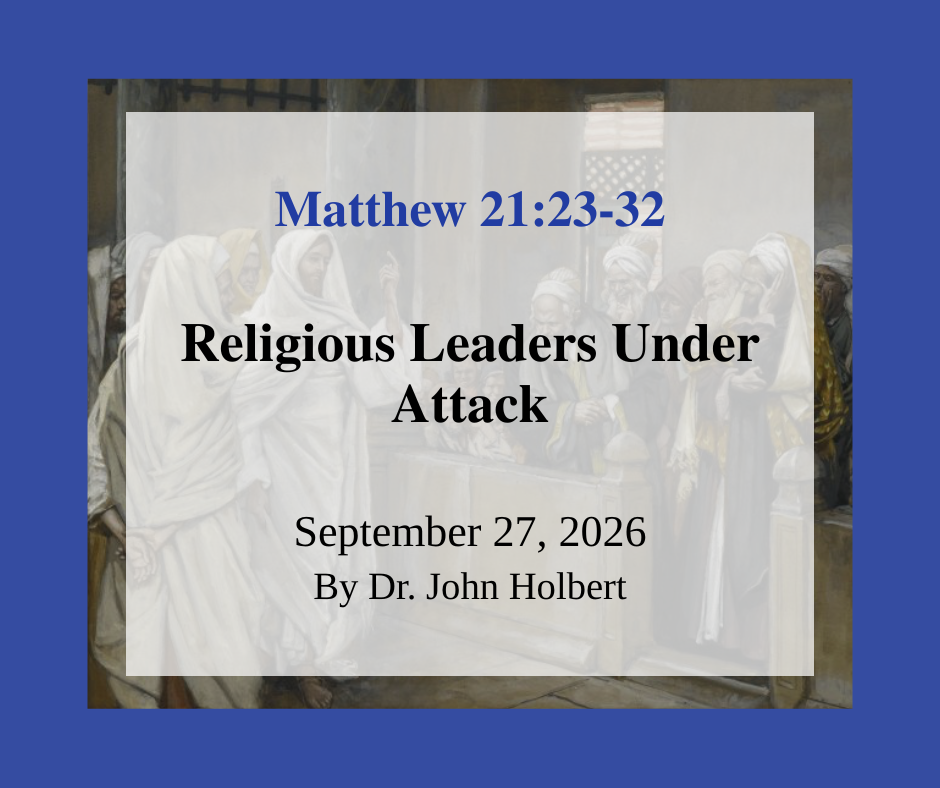
Matthew’s Gospel moves toward its inevitable end. We all know that Jesus will die at the hands of the Roman authorities, but under the instigation of the leaders of the Jews, especially “the chief priests and elders” (Mt.21:23). The complex question of Matthew’s relationship to his own Judaism, to the fact of the overwhelming number of Jews in his community who now follow the Jew, Jesus, and the unremitting antagonism that the Jewish leaders bring to Matthew’s claims about Jesus, make his attack on these Jewish leaders both plausible and very dangerous. It will lead directly to the terrible “blood libel” speech of Mt.27:25, where the crowd responds to Pilate’s announcement of his own refusal to deal with Jesus, having found no crime in him, by accepting the blame for the man’s coming death by referring to well-known biblical formulae (see Lev.20:9-16; Josh.2:19-20; 2 Sam.1:16; Jer. 51:35). Matthew plainly indicts the Jewish religious authorities in this pericope in Mt.21, but his anger and frustration at those Jews who will not receive Jesus as the Jewish Messiah forces him to include all too often other Jews in his accusations. And it is those accusations that led later Christian followers to exclude and finally hate Jews in their midst, which resulted in Jewish expulsion from nearly every western country in the ensuing centuries and to the horrors of the Shoah (Holocaust) of the second world war. No reader of Matthew’s Gospel may avoid the underlying anti-Jewish polemic that makes up so much of Matthew’s writing.
That polemic is in full array here in Mt.21. Matthew presents the religious leaders of Judaism, the chief priests and elders, as seeking to trap Jesus in a theological debate about John the Baptist. The debate occurs in the “temple area,” in some location on the vast temple complex constructed by Herod the Great some decades earlier. They demand where Jesus claims his authority comes from: “by what authority do you do these things?” (Mt.21:23). The “these things” are apparently his entry into Jerusalem and especially perhaps his angry cleansing of the temple. Instead of answering directly, or refusing to answer at all, Jesus asks a counter-question. This is a familiar rabbinic argumentative style. “I too will ask you a question, which if you tell me, I will say by what power I do these things” (Mt.21:24). He asks after the origin of John’s baptism: “from heaven or from humans?” (Mt.21:25). Jesus places them on the horns of a dilemma: “If we say ‘from heaven’ (i.e. “from God”) he can say, ‘Then why not believe in him?’ But if we say ‘from humans,’ we will fear the crowds who think John a prophet” (Mt.21:25b-26). They are stuck, so they say, rather sheepishly, “We do not know” (Mt.21:27). So Jesus says to them that he will not reveal the source of his authority.
And then Jesus adds a parable about two sons, and how the father asks his first son to go to work in the vineyard; but he flat refused to go. But then “changed his mind” and went to work (Mt.21:28-29). The father went to the other son, asking him to work in the vineyard, and that son said immediately, “I will, sir,” but in fact did not go at all (Mt.21:30). “Which of the two did the father’s will,” Jesus asks the chief priests and elders. Obviously, and confidently, they all reply, “The first” (Mt.21:31).
Jesus quickly pounces on their reply. “Tax collectors and sinners will enter the realm of God ahead of you, for John came to you in the way of righteousness and you did not believe him, while tax collectors and prostitutes believed him. When you saw it, you did not repent afterward to believe him” (Mt.21:31b-32). Tax collectors and sinners, more particularly prostitutes as representative of the category of sinners, are prime examples of Jews who work closely with the occupying forces of Rome. The former took money from their own people to pay off the oppressive power, while the latter regularly sold their sinful services to Roman soldiers. These at last, however, repented of their problematic relationships to Rome and joined the emerging Christian community, while the chief priests and elders of Judaism refused any change. Thus, they are negatively contrasted with the most despicable members of Jewish society in their denial of both John’s and Jesus’ origins from God. Hence, it is they, those outcast ones, who will precede the religious leaders into the realm of God. The Jewish leaders are in the parable the son who said yes to the father but failed to carry through with their initial positive reply. Little wonder that the religious leaders of Jesus’ time were regularly enraged at what the wandering rabbi had to say about and to them.
Matthew’s constant debates with his Jewish siblings were born in their outright refusal to accept what he was saying about John, Jesus, and by extension the early Christian community. Like Paul before him, Matthew simply could not imagine why those leaders would not see Jesus as the long-expected Messiah of Judaism, a refusal that led to antagonism and hatred that festered down the centuries. It is a tragic reality that these first-century debates became the origins of anti-Judaism and anti-Semitism in our own time, still being played out on the world stage. We Christians must always be aware of this latent anti-Jewishness in Matthew and other New Testament writings lest we add to the horrors that have been perpetrated on the Jews throughout western history.