
Reasons for the Season - Reflections on Luke 1:26-38, Fourth Sunday of Advent, Year B
by John C. Holbert on Friday, November 6, 2026
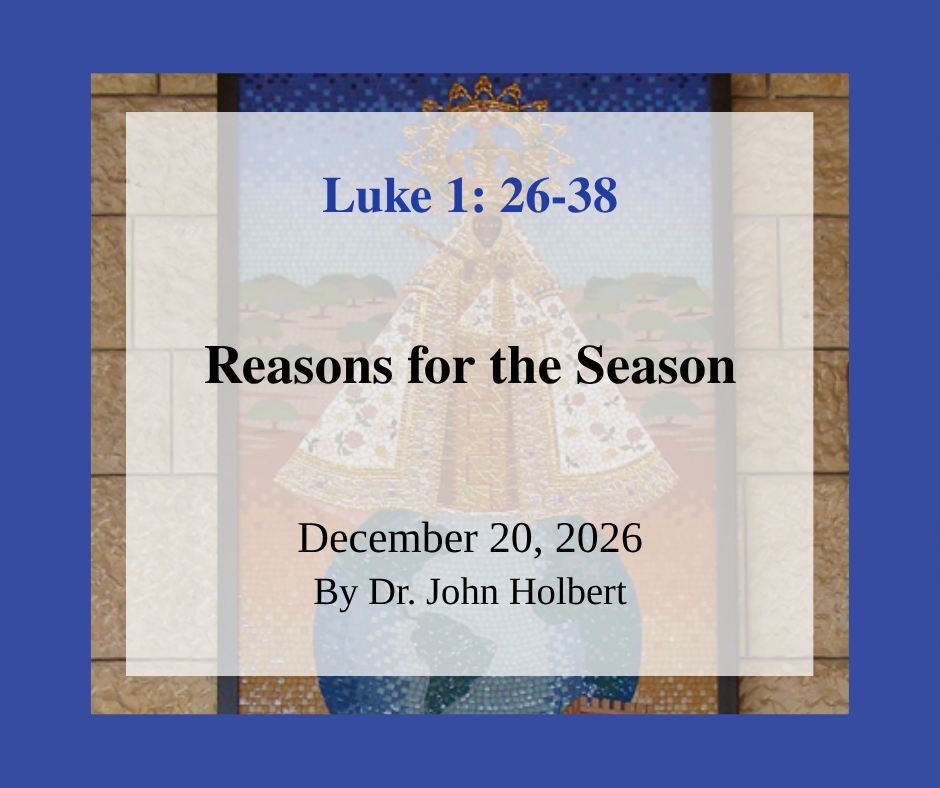
One can hardly celebrate the fourth Sunday in Advent without this magical text from Luke’s Gospel. It is the prophecy of the birth of Jesus, as seen through the eyes of a very young, unmarried, virgin named Mary, at least as seen through those eyes as envisioned by the master storyteller, Luke. The story has been so long recounted, from Luke’s first readers through the touching account from Linus in the “Peanuts” cartoon, shown numerous times during the Advent season. If the most non-churched person in your congregational orbit, that one who comes only at Christmas Eve services each year, were asked to name a favorite Bible passage, this one might well be it.
Yet, as Mark Twain so memorably said—and he was given to memorable phrases—“familiarity breeds contempt—and children.” He was of course right on both counts, but familiarity also breeds indifference or boredom or “I’ve heard it all before,” said with a weary sigh. What can we possibly say that is fresh about this fabulous tale? Well, it could be that is the wrong question to ask. Do we need to say anything absolutely fresh about this story, or is the story so good, so fresh already, that it hardly needs our feeble attempts to extract something new from it? I tend to think the latter. We are not called to find a new angle, a unique plot twist, an eye-popping revelation, brought forth from our brilliant biblical mind, our dedicated profound analysis of a Greek subtlety, unseen by any exegete in all of history. We need, I think, only to tell the story to those who think they have heard it, but in a way that is supremely honest from our own lives and hearts. There are so many rich veins of truth in this tale that a lifetime of sermons will not suffice to illuminate it, but because there are so many such veins herein, this year’s proclamation can still be fresh from the center of our own truth, directed straight to the center of our congregants’ truth. Each year brings forth its own unique element that speaks to us, and thus, we hope, to those who have come to hear the old tale once again.
This year, I am struck by the sheer femaleness of this story, written, uttered, in the midst of a decidedly male world. Matthew told his account, focusing finally attention on Joseph, the heir of David, the supposed father of Jesus, however much he sheds his Isaianic light on the virgin who shall conceive. Is. 7:14, with its Hebrew word that means “woman of marriageable age,” rendered in the Greek Septuagint, Matthew’s Bible, as “virgin,” leading to no end of theological wrangling, was Matthew’s main miracle of the story. Not, I think, for Luke. Oh, Mary is a virgin all right, but Luke says she was “betrothed to a man named Joseph,” referencing Deut.22:23 where it is made plain that “betrothal” is already a binding commitment; one might well call Mary a wife in this context.
With all that out of the way, Luke proceeds to give us an astonishing dialogue between the angel Gabriel, “sent by God,” not to a person of power, not to a wealthy and respectable member of polite society, but to “ a virgin betrothed,” named Mary. Gabriel greets her fulsomely: “Hail, Gifted Lady! The Lord is with you!” (Luke 1:28—this is Luke Timothy Johnson’s translation from his 1991 commentary). He attempts—and fails, he admits—to capture a Greek alliteration: chaire kecharitomene, the latter word a perfect passive participle of charitoo. It is a genuinely formal address: “Hail, Lady,” Johnson suggests. He wishes to avoid the far more traditional word of “grace,” fearing that such a reading overloads the theology here. After all, the Latin Vulgate reads gratia plena, “full of grace,” which has lead later readers to make Mary out to be quite unique indeed, a notion that has lead the Roman Catholic Church to venerate Mary in amazing ways.
But the simple sense of the greeting is given by Gabriel: Mary has found favor with God. Mary was completely confused by this greeting—Johnson suggests that “terrified” would not be far off the mark—but the result of this Godly favor is that she is enabled to bear the Messiah of God, despite the huge problem of her virginity, saying to Gabriel that she “has had no knowledge of a man” (Luke 1:34). Not a problem, replies Gabriel! “The Holy Spirit will come over you and the power of the Most High will overshadow you” (Luke 1:35). Then Gabriel points to the miracle of Elizabeth, Mary’s kinswoman, being herself six-months’ pregnant in her old age, and concludes, “Nothing is impossible for God” (Luke 1:37). Mary’s reply is hugely instructive: “behold the servant of the Lord” (Luke 1:38). The common reading “handmaiden” should be avoided, because it tends to obscure the echo from Isaiah’s Songs of the Servant of YHWH (see especially Is.49:3; 50:4,10; 52:13). Mary is without doubt God’s servant, ready and willing to perform this task God has called her to do. “Let it happen to me as you say,” she concludes, and Gabriel then leaves her to the work.
This story is built in part on another story of a birth by a formerly barren woman, the unnamed wife of Manoah (Judges 13:2-7). The child to be born is Samson, the famously strong judge of Israel. However, the story in Judges offers only the barest outline of the Lukan tale. In Judges, when Manoah’s wife tells her husband of the angelic visitation, Manoah is suspicious and unbelieving. Mary is both accepting of the task from God and completely ready to act. For Luke, Mary is the driver and center of the whole story, and appears as nothing less than the servant heroine of God.
What may we then conclude for this year’s telling of the story? Mary found “favor with God,” and was “highly gifted,” and fully willing and ready to do what God has asked of her, despite the obvious human limitations she presents. Once again, we may conclude that God’s activity is surprising, even enigmatic, perhaps absurd in our eyes, frequently reversing completely our human expectations. And that is not a bad summary of one way to hear what we have come to celebrate this Advent: a God beyond our hopes, a God beyond our assumptions, our suppositions, our human imaginations. A baby, but so much more!