
Rascals Do Sometimes Rule! - Reflections on Genesis 25:19-34, Seventh Sunday after Pentecost, Year A
by John C. Holbert on Monday, May 18, 2026
In this year of 2026, the Bible is having an odd, and potentially dangerous, resurgence. Our current president, the champion of many evangelical Christians, who by some counts propelled him to victory over Kamala Harris in the most recent presidential election, appears publicly on rare occasions to tout his love of and acquaintance with the Holy Scripture. He famously held the Bible, at first upside down, in front of a DC Episcopal church, after clearing a crowd of protestors, to demonstrate that his actions were grounded in Holy writ. He also, when asked about his favorite Bible verse, referred to “two-Corinthians’ in reply. More recently, as a participant in a reading of the entire scripture, he read from 2-Chronicles, bidding God, after serious repentance, to “heal our land.” The Bible is apparently having a public moment.
Of course, the most notorious recent use of the Bible came from the lips of the Secretary of Defense (or Secretary of War, as he prefers), when he supposedly quoted something from the prophet Ezekiel as a way of reinforcing his brutal war against Iran scripturally. Unfortunately, apparently unbeknownst to him and to his aids, his quote came not from Ezekiel but from Quentin Tarantino’s mash-up of Ezekiel in his bloody and deeply profane movie, “Pulp Fiction.” The Bible has its angry and furious passages, but nothing quite like that spewed from Hegseth’s mouth that day.
Quite often, the Bible has been seen as a compendium of ancient and holy figures, mostly men, whom we should strive to emulate. “Be like faithful Abraham, “we are admonished; “dedicate your whole lives to God like Jonah;” “stand your ground against the giants like David.” These moralistic requests ring from Sunday school rooms, and echo off flannel boards, from Maine to California. Unfortunately, the Bible rarely, if ever, offers to the careful reader characters that serve as models for modern behavior. It is more often the case that the Bible’s well-known figures tell us with rich and hilarious clarity that we are already too much like the lying Abraham, the faithless Jonah, the treacherous David.
And today’s Bible lesson provides one of the scripture’s most notorious sleazeballs, the patriarch Jacob. We all know Jacob all too well; in reality we are all too much like him already! His tale is grand and glorious, and riddled with comic gems too wonderful to miss. His origin story sounds all too familiar. His mother Rebekah is barren, and waits 20 long years to conceive a child with her husband, Isaac. And when she is finally pregnant, the experience is decidedly painful. “The children clashed together within her” (so Robert Alter’s reading of Gen.25:21; the verb generally means “to crush,” hence the NRSV’s “struggle.” However one reads, it is a difficult pregnancy!). She goes to receive a divine oracle in an attempt to understand “why me,” as she says in the same verse. The reply is rather Delphic, and might be read in at least two ways, given the ambiguity of nouns and verbs: “Two nations—in your womb, two peoples from your loins will issue. People over people shall prevail; the elder the younger’s slave” (Gen.25:23). This might be understood to mean “the elder shall serve the younger’ (so NRSV) or “the elder, the younger shall serve,” suggesting exactly the opposite. In other words, what the oracle suggests is less than clear.
When the boys are born, they were indeed twins, the first emerging “ruddy, like a hairy mantle all over, and they called him Esau” (Gen.25:25). Two puns are at work here: “ruddy” is ‘adom in Hebrew, close in sound to another name for Esau, Edom (Gen.25:30), and “hairy” is se’ar in Hebrew, referring to Esau’s territory in the story, Seir. Jacob’s name is also built on Hebrew punning. He is said to be “grabbing Esau’s heel” at birth, so they named him Ya’aqob, a sound relationship to Hebrew “heel,” ‘aqeb. I like to call these two boys, Hairy and Grabber; Jacob, Grabber, as we will soon see, is well-named.
The boys grow up (the Bible wastes little time here!), and Esau becomes a skilled hunter, while Jacob is described as a “simple (or “innocent”) man” (NRSV reads “quiet,” a poor translation, I think). The word “tam” does regularly have moral connotations (Job is said to be an ish tam, a highly moral man in Job 1:1). The word use here appears to be an antonym of the Hebrew for “crooked,” the same root as Jacob’s name. Hence, to say that Jacob is somehow “innocent” or “pure” is deeply ironic, given what he is about to do. Esau is said to be “beloved of his father for the game he brought to him” (Gen.25:28), a rather thin way to earn the love of a father, while “Rebekah loved Jacob,” for no stated reason at all.
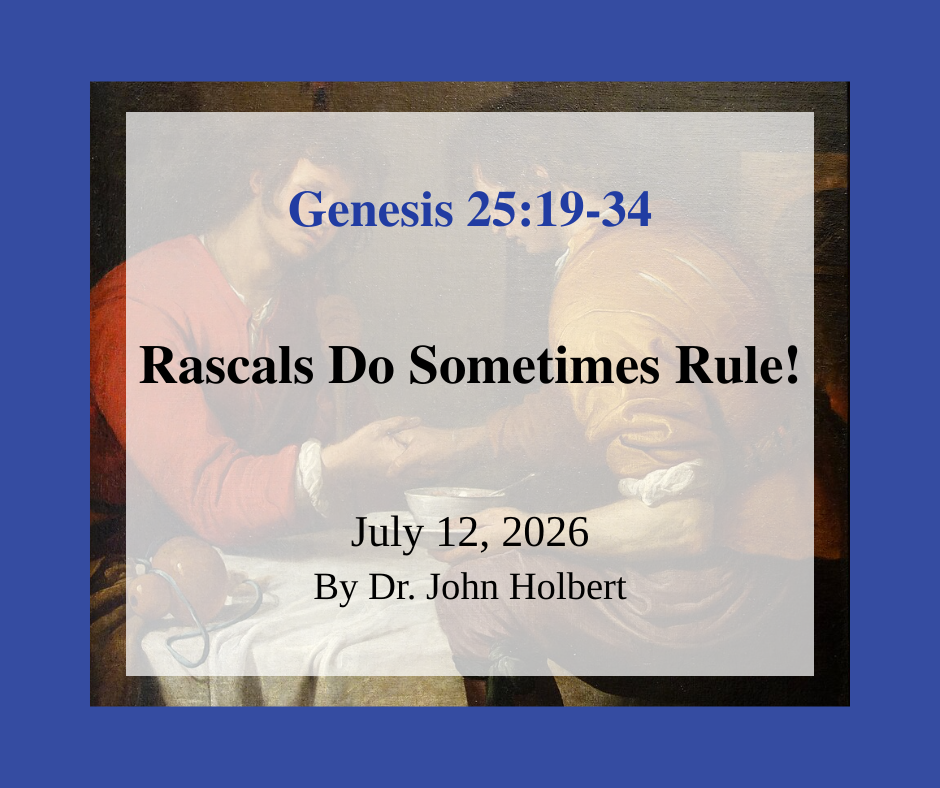
Soon a starving Esau rushes into Jacob’s tent, and rudely shouts, (in Alter’s rich reading), “Let me gulp down some of this red red stuff, for I am famished” (Gen.25:30). The verb translated “gulp down” is used no where else in the Hebrew Bible, but in later rabbinic Hebrew it is used for the feeding of animals. In addition, Esau cannot find the usual word for stew, nazid, but instead in his supposed starving state, can only bumble out “red red stuff.” He really is a very rude and crude fellow! If Jacob really were an “innocent/pure” brother, he would have given his poor brother some stew. But not one to miss the opportunity, he proceeds to drive a bargain. “First sell me your birthright” (Gen.25:31). In contrast to the crude and hasty language of his brother, each word of Jacob’s reply is calculated with legal intent. If Esau sells his birthright, his legal rights as firstborn to his brother, for a bowl of “red red stuff,” his future as Isaac’s heir is forfeit. Idiotically, and without thought, Esau replies, “Look, I am about to die; why do I need a birthright” (Gen.25:32). One pictures him reaching for the steaming bowl of stew, but Jacob is not done with his legal gambits. “Swear to me now,” sealing the bargain with his impetuous and foolish brother, who wolfs down the stew, and in a rash retreat, “ate, drank, rose, and left,” without further words. The narrator concludes, “Esau thus spurned his birthright” (Gen.25:34).
Jacob represents here the very opposite of that well-known Samaritan in Jesus’ most famous parable, who saves the injured man, brings him to an inn, pays for his upkeep, and checks to make sure that he is fully recovered. Jacob manipulates his reckless brother, goads him into selling his future to him for a bowl of stew, and makes sure the whole sorry transaction is done with a thin veil of legality. In this story the rascal reigns, the clever one wins. It is true that later in the tale, Jacob will himself be tricked by a clever relative, Laban, who will pawn off his elder daughter to Jacob, who is mad for the younger, a possible fine comeuppance for the rascal. These stories are hardly models for our behaviors, but narratives that hold up a mirror to our true selves. I would urge our president and his secretary of defense to read the Bible, but to read it not to give them scriptural bases for their dubious behaviors, but rather to provide for them prophetic words to curb their excesses, and to look deeply into ways they might become persons of justice and righteousness for all peoples.