
Patience and Tolerance - Reflections on Matthew 13:24-30, 36-43, 8th Sunday after Pentecost, Year A
by John C. Holbert on Tuesday, May 19, 2026
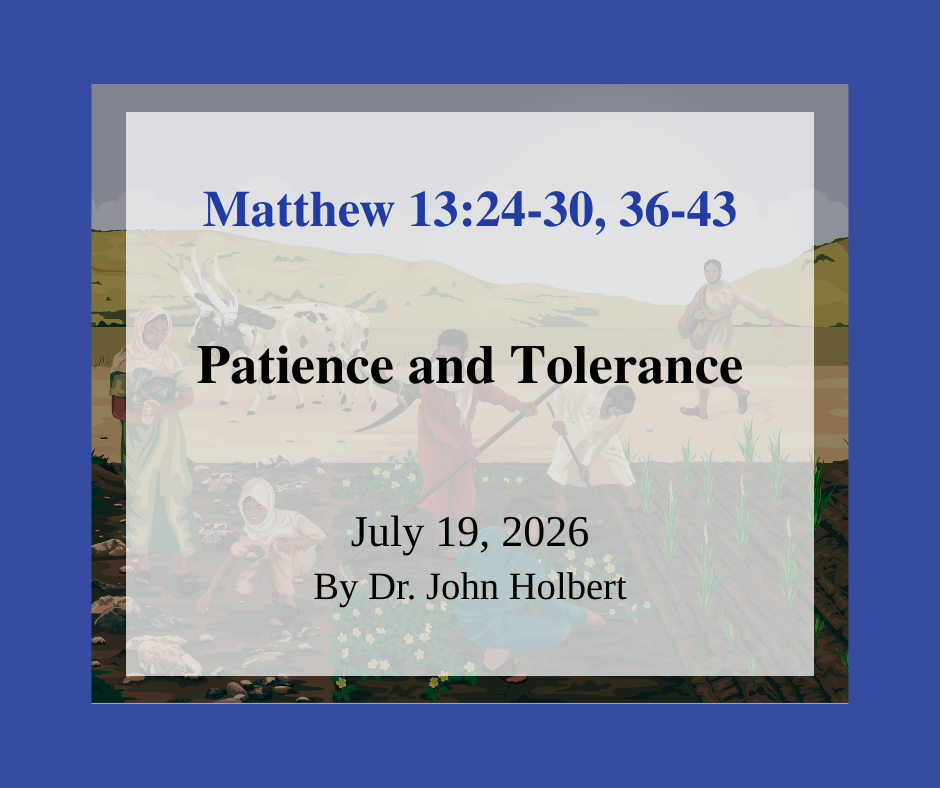
Matthew 13 presents a long string of parables, either seven or eight, depending on how one counts, some brief, some narratively fuller. Today we look at one of the longer tales, that of the “wheat and the tares,” as it is often referred to. I find it a rather peculiar story, and I also find the allegorical explanation of it likewise peculiar. Though many prominent commentators are convinced that Matthew provided his own interpretation in vss.36-43 (see especially Joachim Jeremias in his book on the Parables), I am less convinced that the interpretive work comes from Matthew himself. Then again, any allegorical reading of a parable, which is a story designed expressly to “tease us into active thought,” is bound to limit the mind’s activity by pinning the meaning down to one notion only. In this particular case, I think the parable’s major claim is completely avoided in the allegory based on it. That claim is the need for patience and tolerance in the face of conflict and confusion concerning how we are to discern in our time just who is “in” and who is “out.” It is one of Matthew’s central concerns to figure out why some Jews receive the Gospel eagerly and with gladness, while others plainly do not. As we saw in the parable of the sower, earlier in this chapter, the Gospel’s seed falls on all sorts of ground, but only in the best soil will it find lasting root and success. Matthew ponders this issue again and again.
The question of the two kinds of growth in the field, good seed sown by the man, and weeds sown by an unnamed “enemy,” leads to both kinds of plants growing up together. The servants note the problem and wonder why the weeds appeared when the master sowed only good seed. “An enemy has done this, “he says. Well, the servants reply, “Do you wish that we go and gather them up?” Shall we rid the field of these foul weeds? “No,” the master quickly responds, “lest in gathering up the weeds you uproot the wheat along with them. Let them both grow together until the harvest; and at harvest-time I will say to the harvesters: ‘Gather the weeds first and tie them into bundles to burn them, but the wheat gather into my barn’” (Mt.13:28-30).
Once again, the issue for Matthew is the mixed reception given to Jesus’ word of the kingdom of God, the rule of God that he has come to proclaim. And the charge to the first-century community is to be careful: do not too quickly decide just who is in the community and who is out. Matthew implies that it is not so easy to determine who has heard the word and followed it as some members of the community seem to assume. The time before the harvest is one of patience and tolerance.
This parable echoes central ideas from the Qumran community where the “sons of light,” who perform deeds of light, are contrasted with the “sons of darkness,” bent on deeds of darkness. These two groups walk their distinctly different ways until God visits the community “to set an end to the existence of perversity,” when “truth will rise in the world forever” (see the Manuel of Discipline 4:25). Just how are those who imagine themselves insiders of the community to act in the face of what they deem perversity? Wait until the certain harvest of God, who will determine for all time what is right and what wrong. Meanwhile, patience and tolerance are called for.
Such a story bears obvious corollaries to our own time. How many religious institutions are convinced that they are the righteous ones while all others are unrighteous? How many assume that they are the ones to speak for God, while all others have no such access to the divine? I have long hoped that prayer is finally effective since I have many fervent Christians praying for me; they have heard me and judged me deeply unrighteous, if not fully heretical, in what I say. May their prayers work for me! Yet, I often reflect: just how are they so certain that God has received them and rejected me? What is it about me and my words and actions and beliefs that lead them to know all too clearly that I have fallen away from God’s call to me? And what is it about them that makes it possible for them to judge me so easily? Just how are they able to make such sharp distinctions between us?
Matthew says plainly that for the present, while the message of the Gospel is proclaimed, and while those who hear it are attempting either to live their lives by its precepts or at least to struggle to find meaning within it for their lives, the best stance for all is patience for all and tolerance for all. Only God at the harvest will make things right, and what God may do at that harvest is known to God alone. There can be no absolute certainty about the way of God when it comes to the reception of and actions for the Gospel. I am reminded of that hilarious episode of the old “Archie Bunker” TV show, when the deeply bigoted Archie falls into a coal bin, and upon awakening, sees first his black neighbor. Thinking the neighbor to be God, Archie tries in his usual bumbling way to beg forgiveness for all the bigoted language he has directed at his God/neighbor in a vain attempt to keep his spot in heaven. When he finally realizes he is not dead, and that his neighbor is not God, he quickly reverts to his grossly bigoted self. Yet, the point has been made: it is God alone who decides who is in and who is out, if any are out, and we can only wait with patience and tolerance, with a large dash of humility, for God’s final word.
We find a hint of that word elsewhere in Matthew, chapter 25, where we learn that even tiny acts of love for the “least of these” are acts of love for Jesus himself. That may help us discern in our patience and tolerance something of the ways God will perform for us at the harvest. Still, it is never ours to make such easy judgments about the ways of God. After all, we are decidedly not God, a fact for which we may be truly grateful!