
Opening Wide the Eyes - Reflections on Luke 24:13-35, Third Sunday of Easter, Year A
by John C. Holbert on Monday, March 9, 2026
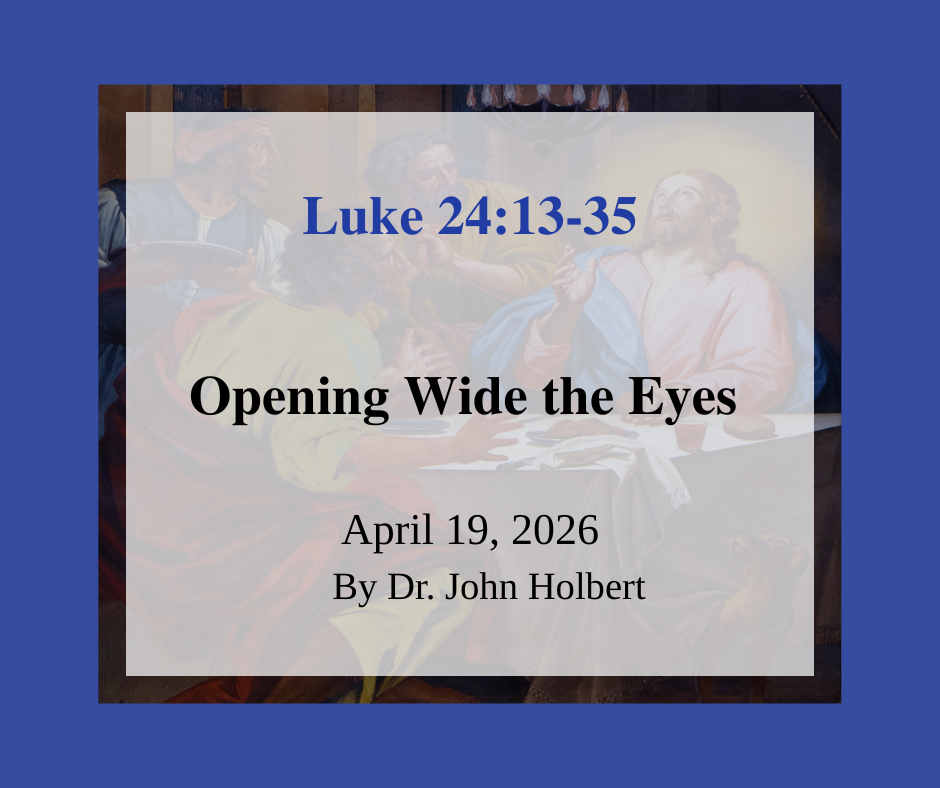
The wonderful tale of two despondent disciples, trudging down the road toward the village of Emmaus after the horrors of Jesus’ crucifixion, then meeting Jesus himself, first disguised to them as a stranger, and then revealed to them in the breaking of the bread, is a classic example of brilliant first-century storytelling. Luke’s skill at narrative has been justly rewarded by the many millions who have read and treasured this account over the centuries. No single brief essay can begin to do full justice to the rich language and careful plotting displayed by Luke in this story. Still, I will attempt at least a passing appreciation of what Luke has done here.
Luke’s account of the empty tomb on the Sunday following the terrible events of the previous Friday ends rather oddly in 24:11-12. The women—Mary Magdalen, Joanna, and James’ mother, Mary—have witnessed the empty tomb and have “reported all these things to the eleven and all the rest” (Luke 24:9). In addition, they “began to tell these things to the apostles” (Luke 24:10). In other words, the news is moving rapidly through the community. “But these words seemed in their view to be so much nonsense. They (the apostles? the rest?) refused to believe the women” (Luke 24:11). Much can be made of all that! The first witnesses to the wonders of Jesus’s resurrection have told the tale widely, but have been discounted completely by disciples and apostles alike. As women, perhaps it was common to discount what they had to say, and especially such an absurd story about a dead man come back to life. Peter rushes to the tomb to see for himself, but looking in he sees only the burial cloths, but no body and no angel and no Jesus. “He went away marveling to himself,” a distinctly different reaction to the women’s anxious desire to tell what they have seen. Peter’s self-marveling is a silent and ineffective response to the empty tomb. Hence, Luke has another story to tell, a story completely unique to him.
Two of the unbelieving number leave for Emmaus, a small village some seven miles (Greek: 60 stadia) from Jerusalem. “They were talking together about all these things that had happened. As they were talking and discussing, Jesus himself drew near and walked with them” (Luke 24:14-15). The two are described as trying to understand what had happened by an extended conversation and examination of the terrible events of the past days. Jesus suddenly joins them, but “their eyes were held in order that they might not recognize him,” to translate quite literally (Luke 24:16). This focus on their “held eyes” will be reversed later in the tale (vs.31).
The unrecognized Jesus breaks into their conversation by asking a simple question: “What are you talking about?” (Luke 24:17). In sorrow, the one called Cleopas, answers in some astonishment that this stranger must be the only person around Jerusalem who is unaware of what has happened, how Jesus was murdered on a cross, handed over by “the chief priests and our leaders.” “Now we had hoped that he was the very one who was going to liberate Israel” (Luke 24:21). Israel here apparently means the restored people of God, the community of Jesus’s followers. Then Cleopas recounts the recent facts of the case: some women startled us by saying that they had gone to Jesus’s tomb, but not seeing the body, claimed to us that they had seen a vision of angels who had said that Jesus was alive. “Some of those with us (Luke says it was only Peter) went off to the tomb and found it just as the women said. But Jesus they did not see” (Luke 24:24).
Now the unrecognized Jesus explodes with some heat. “O, you foolish people, so reluctant to believe everything that the prophets said! Was it not necessary for the Messiah to suffer these things and enter into his glory?” (Luke 24:25-26). And Jesus proceeds to teach these two dunderheads, along with us, just what “Moses and all the prophets” said about himself. It must have been a long and rich interpretation! As they approached Emmaus, Jesus looked as if he were continuing down the road, but the two urge him to stay with them, “since the day is almost over” (Luke 24:29).
And now Luke adds his special insight into this tale, a tale that will serve the Christian community for as long as that community shall exist. During the meal at the table, “Jesus took bread, blessed and broke it, and gave it to them” (Luke 24:30). As a result, “their eyes were opened and they recognized him. And he disappeared” (Luke 24:31). As we saw earlier, when Jesus joined them on the road, they were prevented from recognizing him, but now, in the breaking of the bread, their eyes are opened and recognition of just who has been walking and talking with them is made plain. And the fact that Jesus immediately disappears (literally “he became invisible from them,” the adjective aphantos occurring only here in the New Testament) emphasizes that Jesus is found uniquely in the breaking of the bread at the table of the community. Only now do the two recall how “their hearts burned” as he spoke to them on the road.
They got up and rushed back to Jerusalem to find the eleven (minus Judas), and those gathered with them, and shout, “The Lord has truly been raised,” and “he has appeared to Simon” (Luke 24:34). But lest we imagine that they have in fact actually “seen” Jesus, a reality that enabled them to believe that he was alive, Luke reemphasizes the unique way in which they have in fact “seen” him: “they recognized him in the breaking of the bread” (Luke 24:35). So it was with Cleopas and his companion, and so it is with us: we over and again recognize Jesus fully in the breaking of the bread. There at the table, our eyes are opened wide as we see the Lord, our master, our interpreter, our savior made real to us.