
Of Sheep and the Shepherd - Reflections on John 10:1-10, Third Sunday of Easter, Year A
by John C. Holbert on Tuesday, March 10, 2026
John’s Gospel always troubles me in at least two ways. It invaribly uses slippery metaphorical language to confront the reader; seldom does it provide straightforward prose. Now don’t get me wrong; I enjoy metaphors as much as the next reader, but metaphors that change in front of your eyes, and that possess dire, broader implications, make the discernment of meaning difficult. Second, John cannot avoid denigrating “the Jews,” his catch-all term for all those religious authorities who stood over against Jesus and his ministry. I have written in other essays about this gospel just how uncomfortable all this anti-Jewish language makes me as I try to navigate what John is trying to say. It is, I fear, this gospel’s assault on “the Jews” that led the early Christian church to attack, revile, and finally separate from the Judaism of that time, and that led to the centuries-long struggle between Jews and Christians that led to the Shoah of the second-world war. And I am sorry to say that our text for today is one more example of this painful problem.
John 9 and its long and beautifully written tale of the man born blind (John 9:1-41) uses the metaphors of blindness and sight to make the point that the Jews are blind to the reality of the Messiahship of Jesus of Nazareth. That is why John 9 ends with these startling and accusatory words: “For judgment I came into this world, that those who do not see may see, and that those who see may become blind.” Some Pharisees overhear this comment, and ask, “Are we also blind?” And Jesus’s rather nasty reply is, “If you were blind, you would have no guilt; but now that you say, ‘We see,’ your guilt remains” (John 9:40-41). In other words, the bland man now sees, while the supposedly sighted Pharisees, even though they can physically see, are in fact blind to the truth about Jesus. This is hardly an interchange designed to win friends among those perceived as enemies!
Now John shifts the metaphors to those of sheep and shepherds. He has much Hebrew Bible context, along with the prevailing contemporary occupational contexts, to bolster what he is saying. In the Hebrew Bible (as mediated through the Greek Septuagint), there are many memorable and important sheep/shepherd metaphors that provide a literary framework for John’s construction. Several prophets speak disparagingly of certain unfaithful leaders of Israel who are “bad shepherds” who too often consign their flocks to wolves. Jer.23:1-8, Ez.34, Zeph. 3:3, Zech.10:2-3, 11:4-17 offer extended remarks on the dangers of poor shepherds who do not lead their sheep in ways that lead to their flourishing. Most specifically, Ez.34:23-24 reads: “I will set over them one shepherd, my servant David, and he shall feed them; he shall feed them and be their shepherd. And I, YHWH, will be their God, and my servant David shall be prince among them.” This, and similar passages, offer the literary environment for John’s sheep/shepherd language.
However, John cannot seem to avoid negative words about “thieves” and “robbers” who do not enter the sheepfold by the door, but “climb in another way” (John 10:1). The true shepherd of the sheep is the one “who enters by the door” (John 10:2). It is to that one that “the doorkeeper opens the door,” and when the sheep hear his voice (that is, the true shepherd’s voice), the sheep follow him, because they know his voice. “A stranger they will not follow, but they will flee from him, for they do not know the voice of strangers” (John 10:5). But, the Pharisees “do not understand what he was saying to them” (John 10:6).
So, Jesus then attempts to get clear about all this sheep/shepherd talk. “I am the door of the sheep. All who came before me are thieves and robbers, and the sheep did not heed them” (John 10:7-8). This is a dangerously comprehensive claim. Is John actually saying that “all who came before,” that is all those in the long history of Israel—the patriarchs, matriarchs, prophets, and other righteous ones—are finally nothing more than thieves and robbers? Or is John’s reference to those who came before the Pharisees listening to his discourse now? Whichever it may mean—perhaps both?— John’s delineation of them as thieves and robbers is decidedly divisive.
In sharp contrast to the thieves and robbers who preceded him, Jesus says, “I am the door; whoever enters by me will be saved (made whole), and will go in and out and will find pasture” (John 10:9). Salvation comes only through Jesus, says John, while “the thief comes only to steal and kill and destroy” (John 10:10). From language like that, Christianity has become for many of its adherents an exclusive and potentially bigoted club, denying a full access to God to those who will not or cannot agree with John’s complete and total reliance on Jesus as the only way to God. In other words, the door that Jesus represents is a very small one, a very narrow passage that leads to God.
This is a famous and much beloved passage, of course, but I simply cannot find an easy acceptance of the implications of the metaphor. There are plainly billions of human beings who know nothing of Jesus and who never will know anything of him. How exactly can he be a door for them? How may they become his sheep? Are there not other doors to God, other sheep, other pastures? John’s legacy of anti-Judaism and exclusive theology presents difficult questions for those of us who treasure the words of the gospels but who long for a more expansive way of speaking of the full meaning of Jesus Messiah.
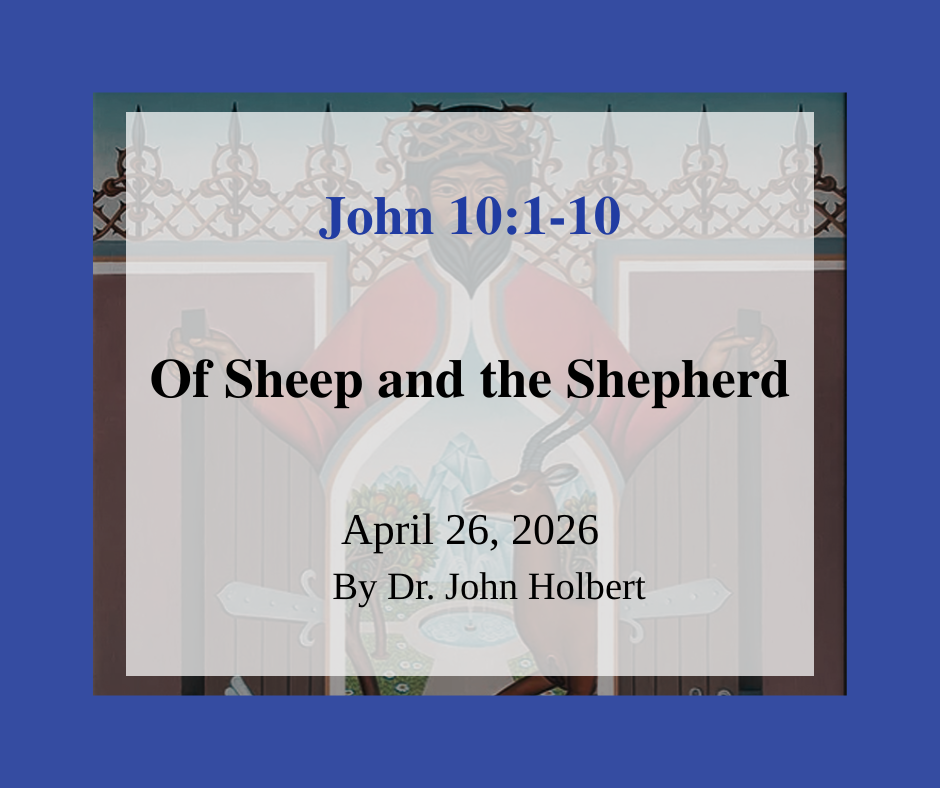
The artwork is by Peter Koenig.