
Of Clay and Potter - Reflections on Isaiah 64:1-9, First Sunday of Advent, Year B
by John C. Holbert on Tuesday, November 3, 2026
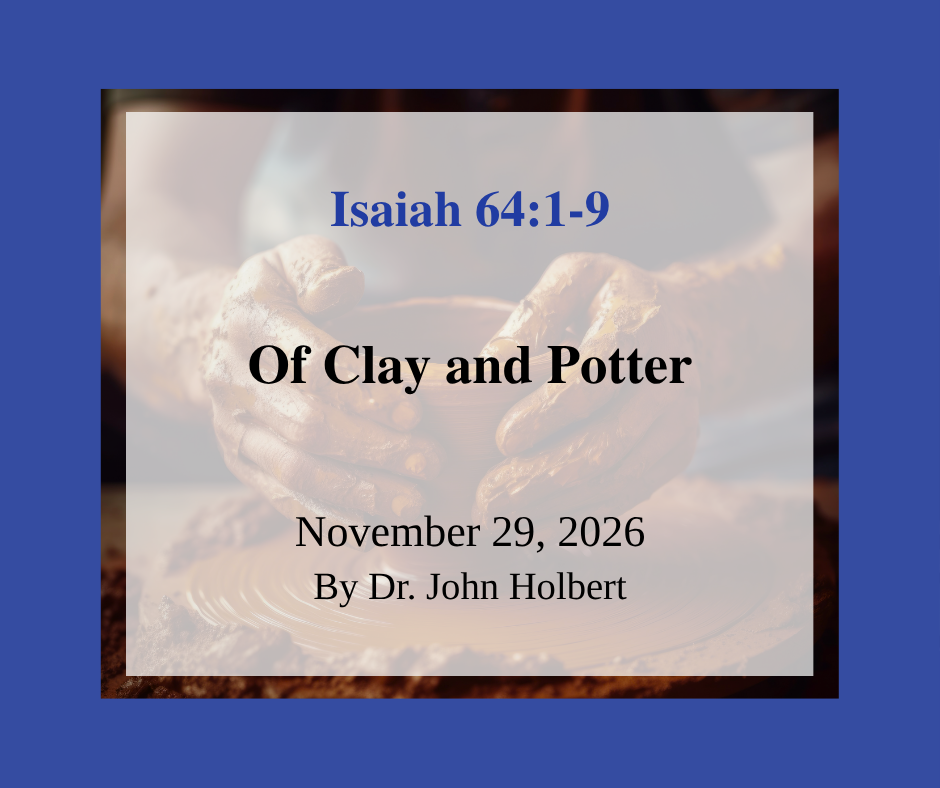
Each time the metaphor of clay and potter appears in our texts, I immediately recall that old hymn, “Have thine own way, Lord,” #382 in the 1989 United Methodist Hymnal. The words of that hymn are by Adelaide A. Pollard and were composed in 1902. Though Ms. Pollard was a writer of over 100 hymns, this one is the only one of hers to appear in the UM Hymnal. The first line includes the words “thou art the potter; I am the clay.” The immediate biblical reference is listed as Jeremiah 18:6, the famous scene in that prophet’s life of a visit to a potter’s house which leads the prophet to liken the actions of the potter to the work of God with human beings. Just as the potter again and again begins the work of creating a pot, and fails to complete it, starting over multiple times, so God molds the chosen people of Israel more than once, given their propensity toward evil actions, always in need of a fresh start. It is an unforgettable metaphor, rich with potential for envisioning the continuous work of God with God’s people.
In this first Sunday of Advent, the image of clay and potter appears again in the later chapters of the complex book of the prophets of Isaiah. I say “prophets,” of course, since the 66 chapters that encompass the book of Isaiah clearly include more than one prophet’s work. In fact, as many as three or four separate prophets’ words may have found their way into the book we now read in our Hebrew Bible. Today’s text, chosen for the first Sunday of Advent, appears in what some have named 3-Isaiah, chapters 56-66, but even that designation is far from certain. There is surely little doubt that these chapters were composed by someone other than the more famous 2-Isaiah, whose well-known words comprise Is.40-55. the final chapters of Isaiah, 56-66, may be a compendium of several authors whose works were collected under the rubric of a sort of Isaianic school of prophets.
Which is to say that we have no genuine and recoverable contexts of these words of Is.64 in which to background what the prophet is saying. To be sure, there is genuine desire, a desperate demand on the part of the author for YHWH to manifest divine greatness and power in order that God might “make your name known to your enemies,” and that “the nations might tremble at your presence” (Is.64:2). This cry would imply that the prophet is in considerable distress due to the apparent absence of any proof of YHWH’s engagement with the people of Israel, causing this prophet to demand a manifestation of God in order to demonstrate that trust in this God’s actions will not be seen by “enemies” of this God as foolish and absurd.
In other words, the prophet anticipates the appearance of YHWH, longs for that presence, urges God to act as God has done in the past: “When you performed unexpected actions; you came down and the mountains quaked at your presence. From long ago, no one heard, no ear perceived, no eye gazed on any God but you, who acts for those who wait for God” (Is.64:3-4). This is a poetic statement of the monotheism of YHWH alone, anticipated throughout the previous book of 2-Isaiah. One should not await any other divine figure, for YHWH stands alone in the universe as the famous Judaic “creed of Deut.6:4 makes plain.
Like those of us who wait for the coming of Jesus at Advent, who hope beyond hope that this year the Christ child will come and bring with him that peace God has long promised, this Isaianic prophet hopes for the coming of YHWH, as YHWH had come throughout the long history of Israel. And, we must note, that this prophet remained fearful that YHWH would return with “exceeding anger” due to the human proclivity for sin (Is.64:9). Thus, he begs YHWH to “not remember iniquity forever.” Perhaps we Christians, as we anticipate the coming of the Christ child, would do well to add our own hopes that the child, in addition to his cooing, his humble childlikeness, would not add to all that a measure of anger, or at least disappointment that we waiting ones cannot seem to move toward the realm of God in our actions instead of finding ever-creative ways of getting in the way of its coming to the earth. Is.64 is thus for us an important warning that while God is gracious, coming to live among us, God is at the same time vigilant to point out that we are far from the people of God we often claim so fervently to be. After all “YHWH, you, are our father; we are the clay, and you are our potter; we are all the work of your hand” (Is.64:8).