
Letdown in the Desert - Reflections on Exodus 16:2-15, Seventeenth Sunday after Pentecost, Year A
by John C. Holbert on Wednesday, June 24, 2026
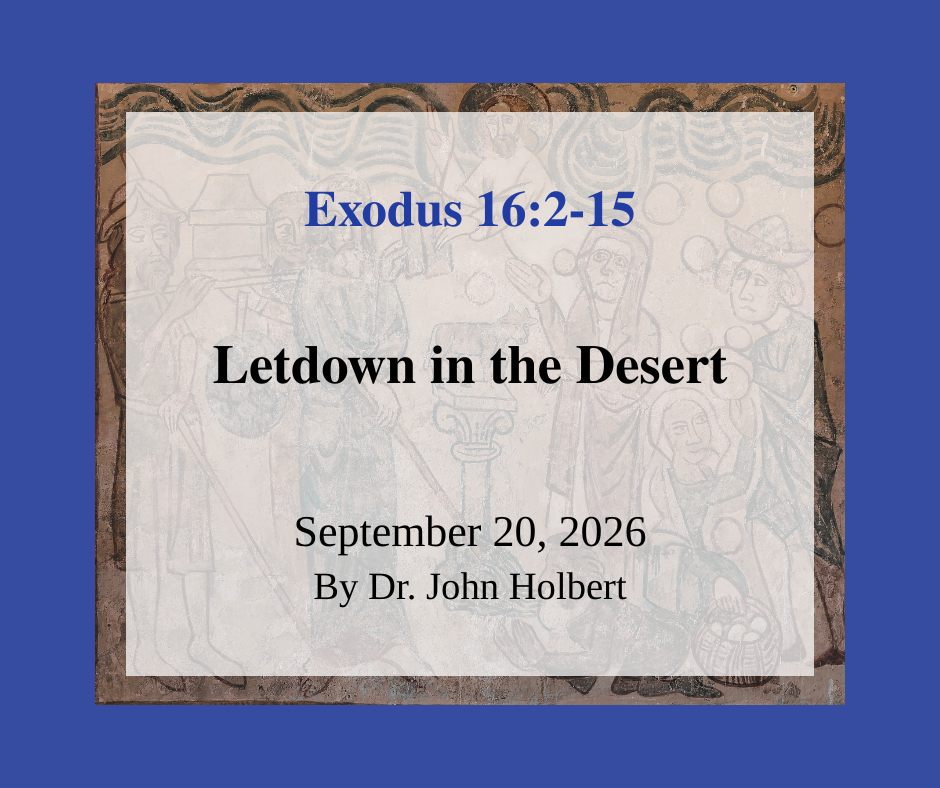
When telling a story, it is always tricky to find a good sequel to the most important event that story has to offer. Just how can a writer find an appropriate follow-up to the miracle at the sea? After the waters part, or after the tide flows back upon the hapless Egyptians, whichever miracle you prefer, and after the forces of the victors sing a long hymn to the power of YHWH, what to do now? Surely, the escaped slaves, free in the vast desert, will go from strength to strength, piling success upon success as they move inexorably toward the land promised by the mighty YHWH. Well, you might think that, I suppose. But, I fear nothing could be further from the truth of what happens in that desert. In many respects, it is a severe letdown.
It takes very little time for trouble to start. No sooner have the glorious hymns died down, no sooner has the memory of the victory at the sea begun to fade, when the Israelites do what they will continue to do throughout their long wilderness journey—namely “murmur” against Moses and Aaron (Ex.16:2) and finally against YHWH. This Hebrew verb, wayilonu, which incidentally means to “complain” in modern Hebrew, can also imply “resentment,” leading to some translations that read “grumble.” NRSV has "complain” here. Just what is it that they are complaining or murmuring or grumbling about? Initially, their complaint is laced with absurdity, filled with the foolishness of children who upon getting what they want are very sorry to have gotten it!
“If only we had died by YHWH’s hand in the land of Egypt, where we sat close to the meat pots, when we ate our fill of food! But you have brought us into this wilderness to kill all of this assembly with famine” (Ex.16:3). This memory of Egypt, espoused by the newly free Israelites, is both ridiculous and completely false. They did not, in reality, “sit by the flesh pots” (the traditional reading), nor did they eat until completely filled (the Hebrew reads literally “satiated.”) Instead, they “made bricks without straw,” trying to survive with pathetic offerings of food while dying by the hundreds in the searing heat of the slave pits. There were no “meat pots” for the taking, no “filling foodstuffs” to assuage their gnawing hunger. Their memories are clouded by fear and anger, their past visions of Egypt made up in the vast desert which now looms in front of them. Erma Bombeck, that 20th century humorist, once quipped that “the grass is always greener over the septic tank,” meaning it is always better somewhere else. These complainers may imagine they want a return trip to Egypt, but such a trip would hardly be advisable.
But YHWH has plans to deal with these complainers, but those plans are not simple ones. The grumblers will have to follow God’s explicit commands to receive the food they need in the desert. However, knowing these people, given over to murmuring against any who will not give them what they want now, you can bet that they will not, in fact, do what God has in mind. If you think like that, you will win that bet hands down.
YHWH, of course, hears their “murmurings,” and has a response ready. “YHWH said to Moses, ‘I have heard the murmurings of the Israelites. You say to them, At twilight you shall eat meat and in the morning shall have your fill of bread, and you shall know that I am YHWH your God’” (Ex.16:11-12). So, first at dusk the camp is covered with quails, while second, at dawn there is a dew on the ground, which when lifted leaves “a fine, flaky, frost on the ground” (Ex.16:14). The people look at this stuff, and say, “Man hu’” (“What is it?”), because they did not know what it was (Ex.16:15). This stuff is the famous manna, as it is called in English, built from the Hebrew phrase which means quite literally “What is it?” So, they have quail at night and manna in the morning to fill their murmuring demands.
But there is a problem. As they gorge on the quail and stuff themselves with manna, Moses warns them that God has certain stipulations about this wonderful bounty. “Let each one gather according to what he/she must eat, an omer for each, for each one in the tent” (Ex.16:15). In other words, do not take too much, only what you need. Do they listen? Of course not! Though clearly warned that any portions that exceed what they in fact need will “rot and stink,” and that any portions more than double before the celebration of Sabbath, will likewise breed maggots and will rot, the people rush out and take more than they need! Or at least they try to take more than they need. In fact, some go out to gather manna on the sabbath, and find nothing, just as YHWH warned (Ex. 16:27). The enormous and grace-filled gifts of YHWH are exploited and misapplied by the greed and self-concerns of the people. These free Israelites are in reality not free at all, but are bound by their avarice and self-concern.
There are obviously lessons for us in these tales. These are not historical stories, despite the claims of many who speak of quail flying in from the Mediterranean and a semi-sweet substance secreted by certain insects on certain desert trees. The quail do not fly in every night, and the sticky substance of trees can hardly sustain a crowd of hungry travelers in the desert. These are tales of God’s power, but they are equally tales of human rejection of that power. The Bible is always intent on warning us that we must concern ourselves with all those in our community, making sure that all have access to the good things God supplies. In our world, where two billion souls try to live on a few dollars a day while billionaires cruise the sea in billion-dollar yachts, it is clear that some of us are taking more than our share of quail and manna. And I include myself in that greedy group, too. The first story of Israel in the wilderness is a distinct letdown from the grand tale of the victory at sea, but those with eyes to see will find in the story ideas that challenge and confront us all about our use and abuse of what God provides.