
John, the Witness - Reflections on John 1: 6-8, 19-28, Third Sunday of Advent, Year B
by John C. Holbert on Friday, November 6, 2026
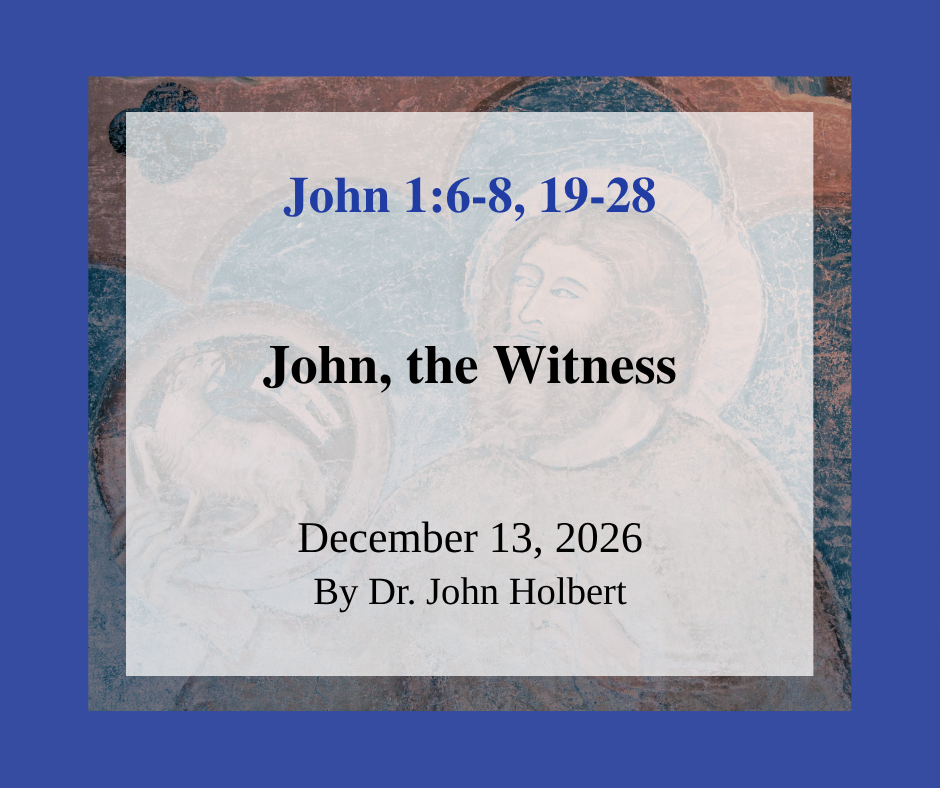
Many scholars have judged the sudden introduction of John into the grand poetic statement of the pre-existence of Jesus as the Word of God, and the light of the world, to be clumsily intrusive. From the heights of lofty theology, the author quite suddenly presents the earthly figure of John, not here ever named the “Baptist,” but is instead portrayed as the essential witness to Jesus who has yet to appear in his earthly guise in the story. I would suggest that John’s role in this Gospel is quite different than his role as Jesus’ baptizer in the synoptic tales (though in Luke it is not said directly that Jesus was in fact baptized by John). John, our author, has begun his Gospel with the notion that Jesus is in fact the preexistent Word of God, and the Light of all humanity. He now uses John as witness to these realities, and the witness who adds much more to the picture of this Jesus. And at the same time, the gospel writer makes it abundantly clear that John is decidedly not the Messiah, but only bears witness to him.
It has often been said, and there are hints here and in the other Gospels, that John may have had his own following of adherents. John goes out of his way to say that John is not in any way a rival of the Christ who is Jesus. John is introduced bluntly: “There was a man sent from God, whose name was John” (John 1:6). The Greek is even more direct: “A man appeared” (egeneto anthropos). In contrast to the “Word (logos) of God,” John is definitely a man, though “sent by God,” the only other character, except Jesus, who is so characterized in the Gospel. And John the evangelist quickly makes it plain that this John is “not the light,” but came only to testify to the light” (John 1:8). For this Gospel, John is never presented as the messianic forerunner as one finds in the other Gospels; his only function for John is to witness to Jesus.
This is made even clearer later in the chapter. The identity of John is the central focus of the evangelist’s concern, and he creates a dramatic scene between John and several significant figures who will recur in the story. “And this is the testimony given by John when the Jews sent priests and Levites from Jerusalem to ask him, ‘Who are you?’” (John 1:19). The Gospel will center its main concerns on the identity of Jesus as the Word, but first we must learn, through the dialogue with these religious authorities, just who John may be.
We should of course note that these questioners have been sent by “the Jews.” It has long been suggested that in this fourth Gospel the portrayal of “the Jews,” as continual antagonists of Jesus, is deeply problematic. In fact, many have determined that a virulent anti-Jewish polemic begins in John’s Gospel. Various means have been tried to soften this polemic, either in different translation gambits, or pointed footnotes to translations, but the problem has remained. Though, of course, many of Jesus’ early followers were themselves Jews, John’s continual use of “the Jews” as those who attack, ridicule, and finally kill Jesus has caused no end of terrible divisions between Jews and Christians through the centuries. We must always be aware of this unfortunate reality whenever we read from this Gospel in our congregations.
In reply to the question of his identity, John answers in a redundant way, using many more words than he needs to make his point! “He confessed, and did not deny, but confessed, “I am not the Messiah” (John 1:20). And he adds neither is he Elijah, sometimes thought to be the Messiah’s forerunner (John 1:21), nor is he “the prophet,” perhaps a reference to the famous passage from Deut.18 where a “prophet like Moses” is promised in some future time. John is adamant about who he is. The priests and Levites demand an answer for the Jews who have sent them, so John replies from the prophet Isaiah, “I am the voice of one crying out in the wilderness, ‘Make straight the way of the Lord’” (John 1:23). He is, he says, the witness to the Lord, who is to come.
And John’s work of witness is not concluded yet, since he adds the next day a series of witness statements that have served to help define Jesus for John’s readers down the centuries. “He saw Jesus coming toward him,” and John explodes with powerful witness claims about this extraordinary man. “Here is the Lamb of God who takes away the sin of the world” (John 1:29). Furthermore, “This is he of whom I said, ‘After me comes one who ranks ahead of me because he was before me,’” emphasizing Jesus’s preexistence with God. In fact, said John, that is why I baptize with water, “that he might be revealed to Israel” (John 1:31). The baptismal scene is not shown to us, but John remembers what happened at that scene: “I saw the spirit descending from heaven like a dove, and it remained on him” (John 1:32). And finally, John says, “He on whom you see the spirit descend and remain is the one who baptizes with the Holy Spirit. And I myself have seen and testified that this is the Son of God” (John 1:33-34). Thus does John the evangelist define Jesus for us in these definitive theological terms from the mouth of his witness, John.
Why is all this theology important for us on the third Sunday of Advent? The birth of the baby at Bethlehem is very near, and lest we get swept up in a sweet goo of nostalgia, or are blinded by the loveliness of the baby, his parents, and the quiet animals at the manger, we must not forget exactly who this baby will be, nothing less than the Lamb of God, the giver of the Holy Spirit, the very Son of God. Our proclamations of the joy of Christmas must always take with the very greatest of seriousness all these theological claims uttered by John, the crucial witness to Jesus.