
Is God with Us - Or Not? Reflections on Exodus 17:1-7, Eighteenth Sunday after Pentecost, Year A
by John C. Holbert on Monday, July 6, 2026
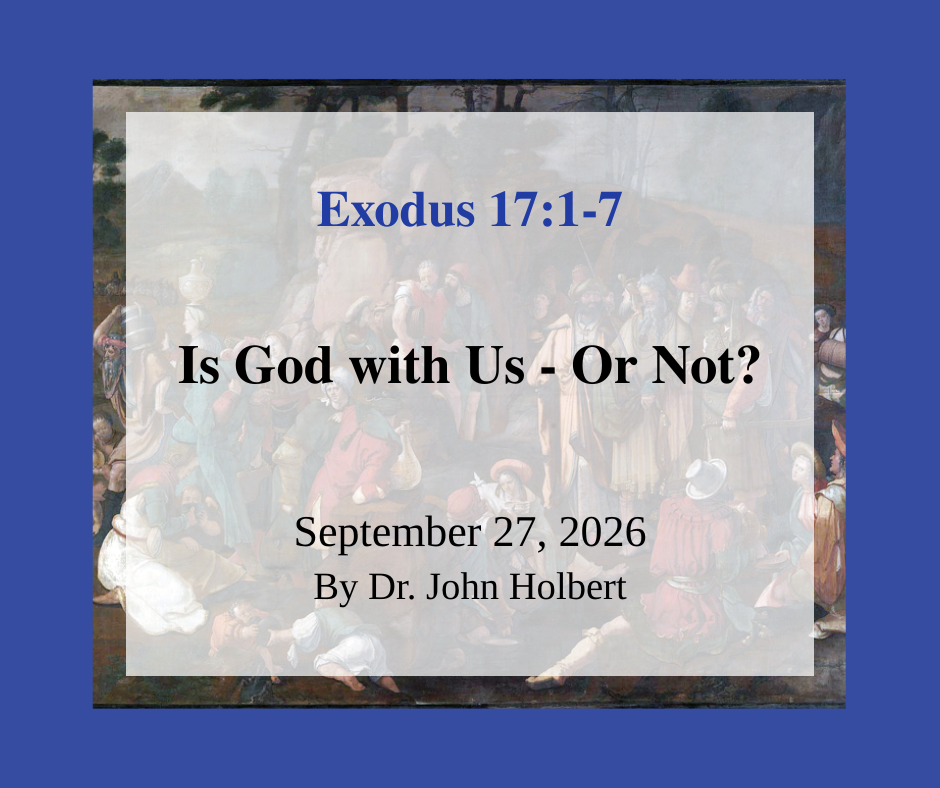
The Israelites, now well into their desert wandering, again find themselves in dire straits, facing the wilderness without any sources of water. At the end of Ex.15, they faced thirst; in Ex.16 the issue was a lack of food; now in Ex.17 thirst is once again the problem, and it is a painful one. Anyone who has found themselves in a place with no source of drinkable water knows well what a terrifying experience that is. I grew up in Phoenix, AZ, a city notoriously hot and dry in the summer, and played baseball in that heat, as a catcher, no less, wearing all that necessary equipment: mask, chest protector, shin guards, as the temperature climbed toward 115 degrees. It was not unusual for me even to catch a doubleheader! I was a tiny boy, weighing perhaps 110 pounds at age 14 or 15; I would lose at least ten pounds of water weight on those days. Fortunately, heavy doses of water, along with great swigs of Dr. Pepper (before the days of the elaborate electrolyte drinks of today) would serve me well. Without water, I simply could not have survived those roasting experiences.
The Israelites faced a similar potential disaster—a desert without water. Though this tale is another of the “murmuring,” or “complaining” traditions, in this case a different set of verbs is used to describe the people’s discomfort. Here the people “disputed” with Moses, due to their extreme thirst. That verb is a familiar one in Hebrew, often found in stories where legal complaints are brought by those who have felt aggrieved against others who have wronged them. The verb is “rib,” and arises from use in courtrooms. The other verb employed for “murmuring,” as we have seen before, seems to imply a general complaint, a vivid crying out for relief from a perceived problem or issue, often arising from a distinct fear of death. Here the use of the more legal terminology sounds rather more formal, a kind of dispute between two parties, where one group debates the actions or thoughts of another group.
In reply, Moses answers directly to them, saying: “Why do you dispute (rib) with me; why do you test YHWH?” (Ex.17:2) Moses is quick to affirm what the story has already claimed, namely that any dispute with Moses is at the same time a direct test of YHWH; Moses and YHWH are in fact together in all things. In the next verse the people up the ante of their discomfort by returning to that familiar verb lin, or “murmuring/complaining,” used in the earlier wilderness stories. They direct their complaint to Moses by saying, “Why in hell (I translate the tiny particle ze, as my first Hebrew teacher did, he of the wry sense of humor!) did you bring us out of Egypt to kill me, my children, and my livestock by thirst?” (Ex.17:3). Note how the text shifts from plural to singular in the sentence in order to make the complaint far more vivid, as if each individual in the group faces disaster. It is as if a spotlight is shone on each struggling member of the thirsty assembly.
So, Moses turns now to YHWH to get him out of this increasingly sticky situation. “Moses cried out to YHWH, ‘What shall I do for this people; in a short time they will stone me!’” (Ex.17:4) YHWH tells Moses to grab his staff, that fabulous staff of power with which he parted the Sea of Reeds, and go to a nearby rock where YHWH will stand near him. Moses is to strike the rock out of which water will gush. And so it does. I find it interesting that YHWH says to Moses, “I am about to stand before you there on the rock of Horeb” (Ex.17:6); the image is a very physical one. YHWH appears to be saying that YHWH will in fact be seen on the rock of Horeb. Seen by whom? Moses alone or all the people witnessing the miracle of the water?
As a result of the story, Moses names the place of the water miracle Massah and Meribah, that is “testing” and “dispute,” picking up on the earlier use of these verbs, enshrining there the “dispute” of the Israelites and the “testing” of YHWH, “saying, ‘Is YHWH with us or not?’” (Ex.17:7) The people both dispute with Moses and test YHWH, the test consisting of that age-old question whether or not one may know whether God is there or not. Is it necessary, asks this little tale, to witness water pouring out of a dry rock to know that God is there? Further, must I have all of my needs met to believe that God is present for me, or is it possible that I can believe in God’s presence despite lack of any physical evidence, any direct answers to my requests and needs?
Is that not the question countless believers and would-be believers and complete skeptics have asked since belief in some sort of God (or gods) first arose in the hearts of ancient people world-wide? Just what sort of proof does one need to believe in God? Or is that the right way to phrase the issue? There are any number of biblical stories that raise such issues in several sorts of ways. Elijah, running for his life from the enraged Jezebel, cowers in a mountain cave while earthquake, wind, and fire threaten him, but we are told that YHWH was not “in” any of these physical events, but only is “heard” in a profound silence (1 Kings 19:11-12). Does that silence mean that Elijah has “seen” or “heard” God, or does his subsequent actions of anointing kings of Israel imply he has been urged to those actions by YHWH—however silent YHWH has been? Earlier in that story, Elijah has confronted the 450 priests of Baal on Mt. Carmel, and has bested them in a contest of sacrifice. After fire falls from YHWH out of a clear, blue sky, licking up all the water around the altar, along with the sacrifice and the altar itself, the people witnessing the miracle all shout, “YHWH is God! YHWH is God!” Well, who wouldn’t? Such miraculous events are designed to elicit faith in the power of God. But do we need such actions to ensure our faith in God’s presence among us?
I readily admit that I have seen no water magically gush from a rock, nor have I witnessed no fire leap from the clear sky. Yet, I believe, as surely as I write these words, that God is present with me now and always. How that presence is manifest is the source of endless dispute among those who struggle to believe, but for me it is certain, without the need for magic water and arcing fire. Still, the question of Ex.17:7 is ever a living one and should be taken with enormous seriousness in the complex and painful world in which we all live. “Is YHWH with us or not?” It is the question of all those who seek to believe and live in the presence of the God whom we affirm both loves and saves.