
Grabber Strikes Again! - Reflections on Genesis 28:10-19a, Eighth Sunday after Pentecost, Year A
by John C. Holbert on Tuesday, May 19, 2026
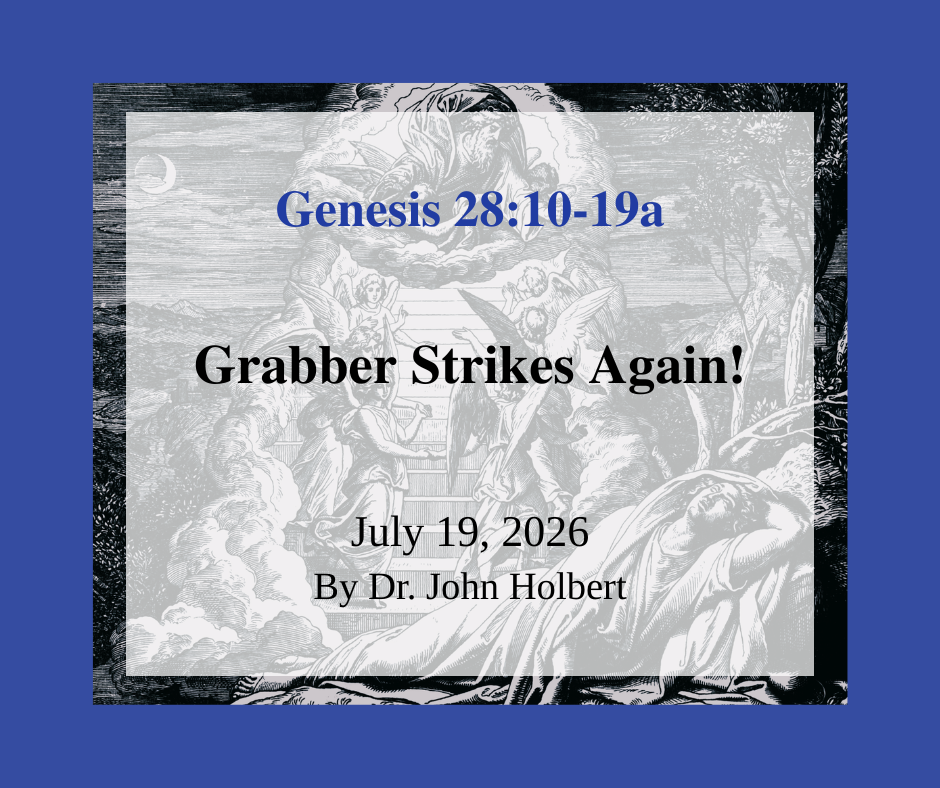
This memorable tale continues the long story of the third member of the patriarchal trio; we have read colorful tales of Abram/Abraham, far less colorful stories of Isaac, and now we continue the most colorful narratives of them all, those of Jacob, or as I wish to call him, “Grabber,” he who was born grabbing his older brother Esau’s heel. No one was better named than this elusive rascal. He tricked his foolish brother out of his birthright as the firstborn by means of a bowl of “red, red stuff” (Gen.25:27-34), and then continued his trickery by stealing that firstborn status once again by pretending to be his brother as the blind Isaac offers the patriarchal blessing, intended for Esau but stolen by Jacob. The result is a furious Esau, who vows to murder his brother, forcing the wily one to flee his home and head back to the home country of Haran (Gen.27).
On the way to Haran, Jacob, alone and fearful for his life, finds himself in a “certain place” (Gen.28:11), a phrase used fully six times in this brief tale. The location is first quite vague and generalized, but will at the story’s end become the sacred site of Bethel, literally, “house of God.” The exhausted Jacob, stops his flight at night, chooses a stone for a pillow, and beds down to sleep. I can only imagine that a stone pillow would be conducive to vivid dreams, and so is that true for the weary traveler. “And he dreamed. Look! There was a ramp set on the earth, its top reaching the sky! Then look! Elohim’s messengers were going up and down on it” (Gen.28:12). The word I translate “ramp” is found only here in the Hebrew Bible, but it appears to refer to a ziggurat, a Babylonian tower, which would be appropriate given Jacob’s final destination in his story. The famous reading “ladder” seems unlikely, if not quite confusing.
“Look! (The third time the Hebrew locution hineh is used in the narrative; it is regularly read as “behold,” but however it is translated it is used as a sharp change in readerly perspective, as well as a sign of significant mystery and revelation.) YHWH stood near (or “beside” or “above”) him (or “stood above it,” i.e. the ramp) and said, ‘I am YHWH, God of Abraham, your father, and God of Isaac. The land you are lying on I will give to you and your offspring. Your offspring will be as the dust of the earth, and you will spread west, east, north, and south, and all the families of the earth will be blessed by you and your offspring’” (Gen.28:13-14). This “certain place” has become the place of a theophany, an appearance of YHWH who reiterates the great gift of blessing given to Abraham back in Gen.12:3. And God here offers Jacob even more. “Look! I am (or “will be”) with you, and I will protect you wherever you go, and I will bring you back to this land; surely, I will not abandon you until I have done what I have said to you” (Gen.28:15). YHWH gives here to Jacob nothing less than a full-throated promise never to leave him alone and helpless, as well as the divine certainty that he need have no fear of God’s abandonment of him in the future.
Jacob’s response is both shocking and telling, given what we know of him in his narrative. He wakes up, and shouts, “Surely, YHWH is in this place, and I did not know it!” (Gen.28:16). This could mean many things, but it does certainly imply that the very last thing Jacob expected was a visit from YHWH. His initial response is fear, though he has been richly assured by this same YHWH that he does not need to fear at all! Yet, “He was afraid and said, ‘How fearful (awesome) is this place! It is none other than the house of God, the very gate of the sky!’” (Gen.28:17).
In response to the spookiness of the place, Jacob gets up, grabs his rock pillow, consecrates it with oil, and sets it up as a sacred pillar to commemorate his meeting with God. Unfortunately, the lectionary collectors stop here in the reading, and thereby miss the best part! He names that place Bethel, though its name was at first Luz (we have no archeological evidence of any such place), and then to complete his ritual actions he makes a vow—and it is a doozy!
“If God will be with me and will protect me on this way that I go, and will give me food to eat and clothes to wear, so that I return again in peace to the house of my father, then YHWH can be my God” (Gen.28:20-21). Well, Grabber, thank you very much! After God has promised the rascal the full patriarchal blessing, and the divine promise of protection and safety into the future, still Jacob Grabber can only do what he has always done and will certainly do again; he bargains with God! If God will give him all that he demands—food, clothing, protection, and safe return home—then he will deign to take YHWH for his God. It is Jacob in a weasely nutshell!
We ought not try to be like Jacob, as preachers have long asked—we are like Jacob, too often praying to God demanding that God give us what we want, and if God does not come through for us, abandoning God as soon as we can. It is crucial that we recognize that it is Jacob who becomes Israel in the tradition, a sly, conniving, tricky man, at times devoid of trust in anyone but himself. That does not mean, of course, that Judaism should be denigrated as Jacob-like in all things. But we should see how careful Jews have been to see themselves as Jacob, far from perfect, far from always faithful, far from the only chosen of God because they are somehow unique and special. Far from it! Lest they always be Jacob-like, they need their God always to remind them to strive for something far better. And we Christians also must learn this lesson as well; bargaining with God is a failure of trust in the one whose promises can be trusted and relied upon always.