
God's Beloved Son - Reflections on Mark 1:4-11, Baptism of the Lord, Year B
by John C. Holbert on Friday, November 20, 2026
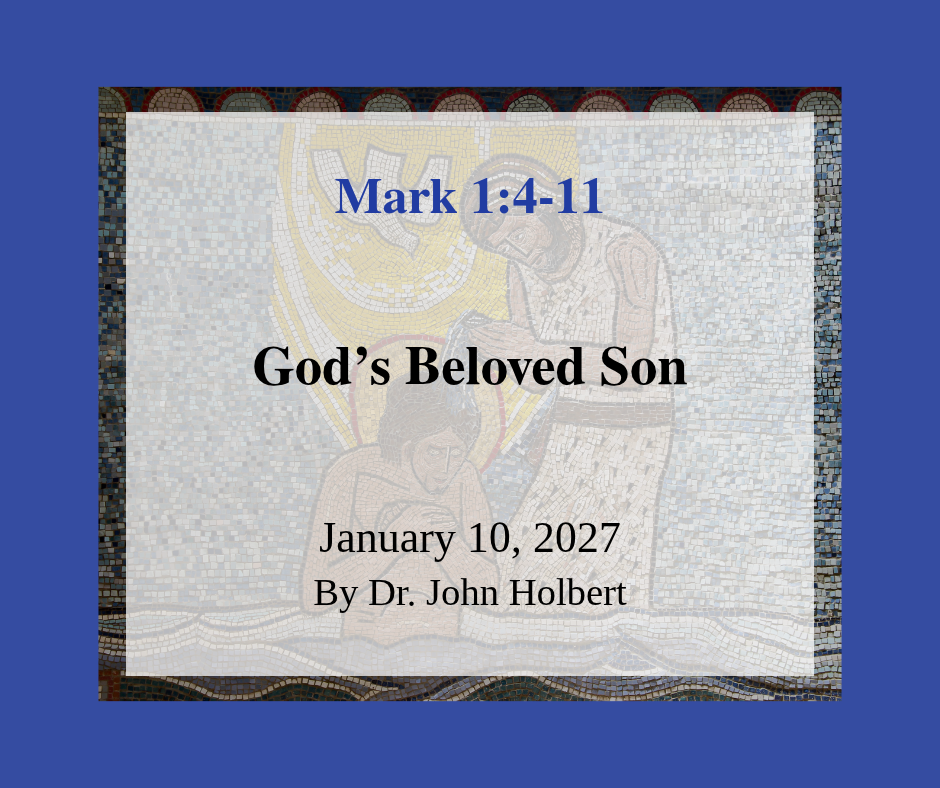
In Mark’s account of the baptism of Jesus, the baptizer is immediately identified as the messenger of Ex.23:20, the one who is to lead Israel into the land of promise, and Mal.3:1, the one sent by God to “prepare the way before God.” Also, John is the famous “voice crying in the wilderness” from Is.40:3. Each of these references to the Hebrew Bible make it plain that John’s role in the drama unfolding is to be messenger, harbinger of someone else. In no way are we to think of John as more or less than that.
The proclamation of this messenger is “a baptism of repentance for the forgiveness of sins” (Mark 1:4). Baptism was by Mark’s time a well-known ritual, either deriving from Jewish ritual washings (the Greek word means “dipping” or “immersing”) from the Hebrew Bible or from Qumran practice, or from a proselyte baptism, a washing for initiation of converts to Judaism. Whatever its origin, John’s baptist practice is for “repentance” (that is a “turning around” or more literally, “a change of mind”). “Repentance” is synonymous with conversion, echoing a prophetic call to return to former right relationship to God. And this repentance is specifically for the “forgiveness of sins,” the Greek word meaning pardon, release from captivity, or cancellation of punishment.
In response to this call of John at the Jordan River, “the whole land of Judea and Jerusalem” appear to him. This, of course, is obviously hyperbolic, and should hardly be taken as history. But Mark regularly universalizes his scenes by using various forms of the Greek word for “all” (pan, pas, etc.) Such a literary style attempts to include all in the tale, both those in the story and those of us reading it. Mark will try in many ways to bring us, the readers, directly into the narrative he is weaving.
“And they were baptized by him in the River Jordan” (Mark 1:5). The Jordan traverses the long rift valley some 120 miles from Mount Hermon to the Sea of Galilee, through the wilderness of Judea, to the Dead Sea. Thus the water of the river flows from 9000 feet in the north down to 2750 feet below sea level, the lowest point on the face of the earth. In addition to this extraordinary geographical plummet of nearly 12,000 feet in barely 100 miles, the Jordan is the barrier between the wilderness and the land of promise in Israel’s theological history. And as they were (all!) baptized, “they confessed their sins” (Mark 1:5). During the late period of the Hebrew Bible, public confession was the standard form of prayer. A good example may be the "Prayer of Manasseh,” written between 100 BCE and 100 CE, describing the stark confession of Israel’s most evil king (see 2 Kings 21:1-18 for a description of his terrible depravity).
“John was clothed in camel’s hair with a leather belt around his waist, and ate locusts and wild honey” (Mark 1:6). This memorable description of a wild prophet, standing in the Jordan, recalls Elijah at 1 Kings 1:8, said to wear a “hairy mantle.” His diet of locusts and honey is fully ritually acceptable, according to Lev.11:20-23 which expressly mentions locusts as winged insects that may safely be eaten, and wild honey may be found among rocks (Deut.32:13) or even trees (1 Sam.14:25-26). Mark plainly presents John to us as a formidable and extraordinary figure.
But what is most important for Mark is what John announces at the Jordan. “The one who is stronger than I is coming after me; I am not worthy to bend down and untie the thongs of his sandals. I baptize you with water; he will baptize you in the Holy Spirit” (Mark 1:7-8). John’s powerful figure, baptizing the multitudes from Judea, Mark now reduces to a forerunner of someone still more powerful, so powerful and awesome that John is not worthy to untie his sandals, an act that even the lowest slave would not perform for a master. As the Babylonian Talmud records, “All services which a slave does for his master a pupil should do for his teacher, with the exception of undoing his shoes.” The mention of the Holy Spirit is rare in Mark’s Gospel. Only here, and in 3:29 and 13:11 do we find references. Perhaps Mark here echoes Ezekiel 36:25-26 where God will cleanse the people with water and will place new spirit within them. John’s baptism is thus only a preparation for the greater cleansing of the stronger one to come.
And Jesus then comes into the scene. He comes from Nazareth of Galilee, a long trip to the southern reaches of the Jordan, and quite simply Mark records that “he was baptized in the Jordan by John” (Mark1:9). There is no dialogue between John and Jesus. Mark’s emphasis is on what happens when Jesus comes upon from the water. “He (Jesus) saw the heavens ripped apart (this same verb is used again at the time of Jesus’s crucifixion where the curtain of the temple in Jerusalem is “ripped top to bottom”), and the Spirit, like a dove, descending on him. Then came a voice from the heavens: ‘You are my beloved son; in you I am well pleased’” (Mark 1:10-11). Mark makes it clear that only Jesus hears these words; no one in the great throng at the Jordan, including John, hears what God says to Jesus.
Why? Mark is forever interested in the question of Jesus’ identity. Now those of us reading his narrative know precisely who he is: he is possessed of the Holy Spirit from God, he is God’s very son, and God is well pleased with him. Not until the very end of Mark’s account will any other human say that Jesus is the son of God, and that will be by, of all people, the Roman centurion witnessing Jesus’s state murder by means of the cruel instrument of torture, the crucifixion. The reference of “son of God” may well come from Psalm 2 which says, “You are my son; today I have begotten you.” The psalm may have been used at royal coronation events, and thus served to tie the monarch to the power and gift of God. Though we may think that we know well who this man may be, since we readers are witnesses to the words of God at his baptism, Mark will have his way with us, through Jesus’s disciples, who are nearly always wrong about their assumptions about Jesus. Might we also be wrong about who this son of God may be? Is it not true that more than one Roman emperor was known as a son of God, or son of the gods? And are not those emperors the very epitome of earthly power? Could it be that this Jesus is stronger than all of them, that he will use his strength to depose these emperors from their thrones, and will take his place of power over them? What then are we to make of his powerless death on that cross? Where is that so-called power then? After all, all who are hearing and reading Mark know this terrible story; Jesus has already died at the hands of the Romans. What might that terrible death mean?
All of these questions, and more besides, remain to be answered as Mark plunges us into the tale of the wandering rabbi, his struggling disciples, and the many who seek to dispose of him. The baptismal scene prefigures many notions that the rest of the Gospel will flesh out. But still, with that enigmatic ending in 16:8, much after the narrative ends remains to be revealed. We must read on if we are to catch at least a portion of what the clever Mark has to say to his first readers and to us.