
God and Politics - Reflections on 1 Samuel 16:1-13, Fourth Sunday in Lent, Year A
by John C. Holbert on Wednesday, January 21, 2026
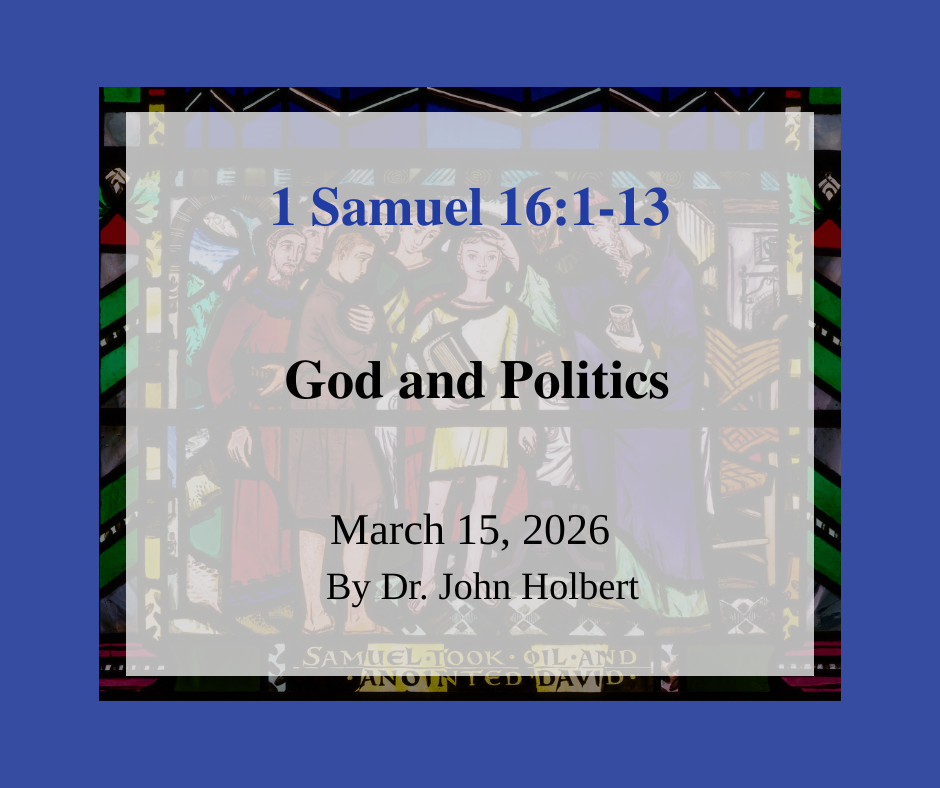
The tales of Saul, Samuel, and David, found in the two books of Samuel in the Hebrew Bible, are rich and complex in their telling; no simple essay can begin to plumb the depths of the stories. My 2014 novel, “King Saul” (Resource Publications, 271 pp.) was one attempt to reimagine these narratives in a fictional portrayal. Still, tales such as these cannot be limited to one version only, and mine, judged by some to be especially hard and brittle, is just that—mine. Many have heard the stories quite differently. However one does hear them, I suggest that the author(s) were struggling as we do today with a huge question: how can we discern the action of God in the rough and tumble world of power politics? It is this question that continues to haunt us in the 21st century, leading to multiple responses, many of which can only be described as dangerous, fatuous, and foolhardy.
In a time where the president of US America proclaims that his use of authority is only limited “by my own morality,” and when that so-called morality leads him to belittle and demean his antagonists from women to the disabled to all Democrats (save those few who would kowtow to him) to any judged weak or unwilling to bend the knee to him in abject loyalty, the issue of what God has to do with any of that is a necessary one. I have long believed that the author of the story had in the back of a literary mind that God’s actions in the tale are not so easily observed or understood, and 1 Sam.16 is a perfect example of that reality.
The context is the terrible confrontation between Saul and Samuel in 1 Samuel 15 which ends with Samuel’s raging denunciation of the first king of Israel, whom Samuel accuses of breaking the commands of YHWH by sparing some of the spoil of the defeat of the Amalekites and most especially, says the sputtering prophet, Saul’s refusal to slaughter their king, Agag. However, Saul has at first calmly replied to the prophet’s howling cries by suggesting that he has spared all these remnants of the battle, expressly to “sacrifice to YHWH, your God” (1Sam.15:15). Why waste wonderful sacrificial possibilities when surely YHWH will relish a vast holocaust on sacred Gilgal? When Samuel gave Saul the supposed divine command to “annihilate” (cherem in Hebrew) the Amalekites, there was no clear demand that the annihilation needed to occur on the field of battle (1 Sam.15:3). So, Saul has decided on his own to make a great celebration of the victory by sacrificing the king and the many unspotted lambs he has spared.
Samuel is having none of it! He claims that the “lowing of the livestock” are a certain sign that Saul has disobeyed, and must therefore be removed from his kingship (1 Sam.15:23). But that harsh judgment is based only the notion that Samuel, and not Saul, has the right to determine the will of YHWH, when that will is not made absolutely plain in all particulars. Does Saul not have the right to determine what YHWH may mean in this instance, and just why is his interpretation unacceptable? I suggest that it is only unacceptable because it does not match Samuel’s interpretation. In earlier parts of the story (see particularly 1 Sam.8) Samuel has demonstrated a tendency to confuse his desires with the desires of YHWH, indicating that what he wants must be what YHWH wants, too. Down that road lies bigotry and authoritarianism; only Samuel has the right to interpret YHWH’s will. But is that in fact the case?
At the beginning of 1 Sam.16, YHWH confronts the prophet and upbraids him for his inactivity after the deposition of Saul from the kingship. “How long will you complain about Saul; I have rejected him from the kingship over Israel?” (1 Sam.16:1). The verb used about Samuel’s relationship to Saul is a bit ambiguous. The NRSV translates “grieve over,” and the verb does often possess the element of mourning. However, there is no indication anywhere else in the story that Samuel is the slightest bit sad about a king he has first created, and then deposed, both with a large measure of regret, despite the direct demand of YHWH. In short, for Samuel, Saul is little more than an aggravation, a pain in the nether parts. Thus, when YHWH calls him again to name a king, he fills his prophetic horn with oil and heads to the village of Bethlehem, where he chooses, most surprisingly, the youngest son of Jesse, to be the new king, though the boy is hardly more than a youth. To be sure, the boy is wildly handsome, fabulously musically talented, and bears every feature to become a great ruler.
Still, the choice of David is really peculiar, and causes his older brothers no end of anger and frustration. And just where is God in all this political maneuvering? And just where is God when this same David, all grown up, kills and lies his way to the throne of Israel, and when on that throne breaks any number of God’s commandments by committing adultery, murder, bearing false witness, among others (2 Sam.11), and then dying alone and cold in the royal bed? What can God possibly have to do with that?
It has been said about the current occupant of the White House that he is “like David,” in that he is an imperfect vessel, being used by God to do the divine will. The man himself, more than once, has implied or said that he has come from God to do some divine bidding. There can be little doubt that he is indeed like David in the fact of his slippery moral compass and his tendencies toward authoritarian power, misuse of women, and abuse of those who would thwart his desires. I must conclude that this biblical story does not offer to us any clear idea about the actions of God in the political world, but it surely does imply that any direct notion that God is doing this particular action, or is choosing that one as God’s agent, or may be seen in that special behavior, needs to be carefully considered. Any attempt to make such announcements about the work of God in such complex actions of sinful human beings is wrong on its face, and can lead some to the most egregious conclusions about this or that leader. The current president is not sent from God, any more than Samuel can separate his own desires from those of his God, nor can David see his way clear beyond his own lascivious and all-too-human lusts. We humans have choices, and we have the call of a God who wills love for all God’s creatures, and urges us all to continue the search for the beloved community on earth. That is our high bar for human activity, and Samuel, and David, and the current president, and I have surely fallen short of that bar.