
Give to Caesar/Give to God - Reflections on Mt 22:15-22, Twenty-first Sunday after Pentecost, Year A
by john C. Holbert on Thursday, July 16, 2026
The text for today is among the more famous passages of the New Testament, and, at least in my judgment, has been seriously misunderstood and thus misapplied in modern contexts. It has regularly been claimed as a requirement from the lips of Jesus that we all must give the government its due, namely that we should pay our taxes. I want to suggest in this essay that the conclusion is precisely the opposite of what Matthew’s Jesus is saying. It may be true that we US Americans should pay our taxes each year, but we receive that requirement not from Jesus but from our own legally constituted government.
We encounter this problem in the context of another conflict between Jesus and his Jewish enemies, here represented by the Pharisees and the Herodians, groups of Jews who are the supporters of the dynasty of Jewish rulers begun by Herod the Great. The more familiar group, the Pharisees, surely the religious leaders of the community, “went and took counsel how they might entrap him in speech” (Mt.22:15). The verb translated here “entrap,” pagideuo, is found only here in the New Testament. The verb clearly implies that Jesus’s questioners are without doubt wicked. Even their opening statement to Jesus that sounds as if they are impressed by this wandering rabbi is in fact a sly way to butter him up before springing the trap they have in mind.
“Teacher, we know that you are true and teach the way of God in truth; yet you care for no one (that is, “you are not concerned what people say about you”) nor do you regard anyone’s position” (Mt.22:16). Because Jesus is not swayed by any other person, the Pharisees expect from him an answer that comes from his own thinking, not a reiteration of familiar or accepted ideas. And that conviction, of course, is exactly why they expect to trap Jesus in his own words, and thereby reveal him as either a traitor to Rome or a supporter of the Roman oppressors; his answer to their question will be what he really thinks about a vexed issue of the day. “So tell us what you think: Is it lawful to pay tax to Caesar, or not?” (Mt.22:17)
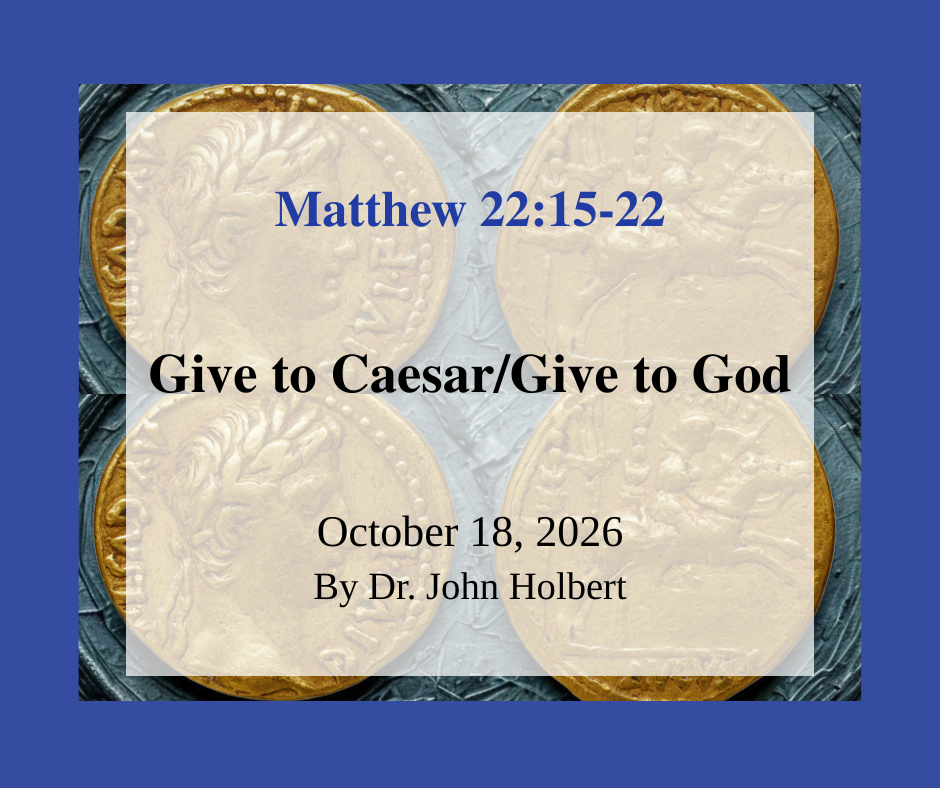
This tax is the Greek kensos, the poll tax demanded by the Romans. Is it acceptable in the eyes of God, they imply, to pay this tax? Jesus, according to Matthew at least, is no one’s fool. “Aware of their malice, Jesus said, ‘Why are you testing me, hypocrites?” (Mt.22:19). Quickly and adroitly, Jesus turns the question of who is the true hypocrite around. “Show me the coin of the tax.” They brought to him a denarius. And he said to them, ‘Whose image is this, and whose inscription?’” (Mt.22:19-20). The tax was to be paid with Roman coinage, so it is important for the story to recognize that these Pharisees are themselves in possession of Roman money, and are thus apparently prepared to pay the tax to Rome. They answer Jesus’ simple and obvious question by saying “Caesar’s.” It is of course Caesar’s portrait and his inscription (Tiberius at this time) on the coin. Well, then, says Jesus, “Return Caesar’s things to Caesar, and God’s things to God” (Mt.22:21).
The implication of Jesus’s sly answer is that the coin is Caesar’s already, so to pay the tax with Caesar’s coinage is merely to return to Caesar what is already his. But when Jesus adds that tiny phrase, “God’s things to God,” the entire scene is given a radical reinterpretation. The issue, implies Jesus, is not the simple question of whether taxes ought be paid. The more important question is what one must do to return things to God who, after all, owns everything.
The Pharisees had hoped to trap Jesus into betraying himself: if Jesus opposes the payment of taxes—which his answer plainly does not suggest—then he gets in hot water with the Romans. But if he states that the taxes must be paid, then he loses face with the more ardent opposition to Rome, the nationalists who fervently desire the disappearance of the detestable Romans altogether. However, Jesus’s answer does not say that the taxes must be paid; he merely says that what is already Caesar’s should be returned to him. He thus neither agrees with the payment of taxes nor does he suggest that they must always be paid. In short, the Pharisees’ attempt to trap him fails utterly.
But I think that is not the end of the implications of this little story. What Jesus does imply is far more radical than even the Pharisees or Herodians might have imagined. If one gives, or returns to God what is God’s, there is precisely nothing left over for Caesar to have at all! If God has created and owns all, then Caesar owns nothing in the end, and the tax question is finally unimportant. Set your heart on what God asks, what God demands, and the question of taxes is set aside. Does this reading suggest that taxes should not be paid? Perhaps, since God owns all. But perhaps not, since society runs on the taxes of the people. Jesus, I think, does not imply that taxes should be paid, nor does he say they should not be paid. The famous answer of Mt.22:21 implies neither conclusion. What he does say is that God’s return swallows all others, since God is all in all. Little wonder that Matthew ends the tale with “when they heard (that answer) they were amazed, and they left him and went away” (Mt.22:22). In the face of one who announces that God is at the center of all questions and issues, their petty concern about taxes pales into insignificance. Their attempt to trap Jesus has in fact trapped themselves into the certainty that their concerns are not paramount after all. They may think that they are representatives of God, but in the light of Jesus, they come off as very poor representatives indeed.