
Facts vs. Ideology - Reflections on John 9:1-41, Fourth Sunday in Lent, Year A
by John C. Holbert on Wednesday, January 21, 2026
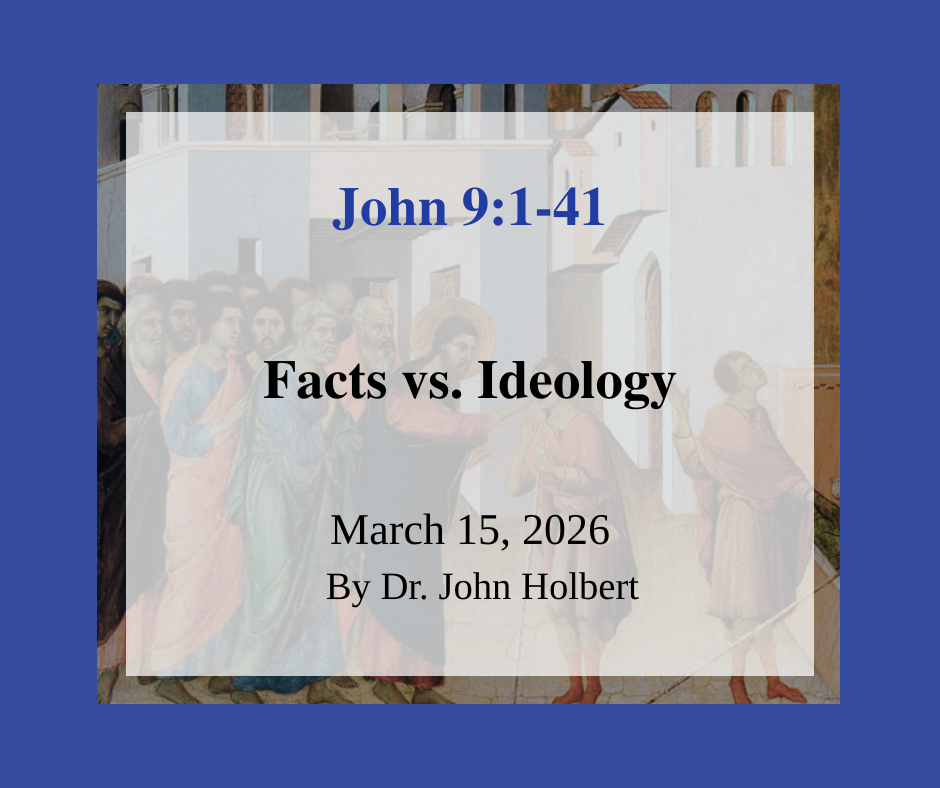
John 9 has long been a favorite passage for those of us who love texts that display superb literary skill in their formulations. I was first attracted to the Hebrew Bible because of its wonderful slices of literature sprinkled throughout its pages. Also, I naturally gravitated toward the Gospel of Mark as my chosen story of Jesus, given that author’s excellent and over-arching expression of narrative expertise, culminating in that thunderous ending where the first witnesses to Jesus’s resurrection stand terrified, saying nothing to anyone! What a way to end a gospel that is supposed to fortify all of its readers precisely to tell what they have seen to all they meet! The irony is rich and strange, just the sort of thing this avid reader of novels enjoyed experiencing.
I admit that John’s Gospel rarely has the same effect on me. I too often find it overly philosophical, deeply theological rather than engagingly literary in formulation. Perhaps this is my own ignorance and inability to appreciate what this author was trying to do (I once had a New Testament colleague accuse me of such ignorance), but when I read John 9, my hesitations are defeated entirely. Now here is a piece that can get the literary juices flowing! It is a delightfully dramatic confrontation between a man born blind and a succession of dialogues he has with Jesus, his neighbors and friends, and a gang of Pharisees, all caused by Jesus’s healing of the man’s blindness. I hardly have sufficient space to address the lovely intricacies of the text, but I can readily say that the narration revolves around the question of facts as they confront an increasingly hardened and recalcitrant ideology. It seems to me that we in 21st-century US America know all too well this problem. Facts in our time are too often trumped (irony intended) by ideology. One example of far too many can make the point.
As I write this essay, our nation is embroiled in another terrible and horrifying case of the abuse of our citizenry by government ICE agents who have been the shock troops of this administration’s literal war on immigrants. These mask-clad, fully armed soldiers have appeared on the streets of many large cities to conduct immigration sweeps, supposedly designed to get dangerous and illegal foreigners off the streets, and either interned in US camps or deported to their home countries, or even to other countries that will take them. These actions have too often devolved into abusive attacks on actual US citizens. And so it happened in Minneapolis, MN in January. A woman who came to protest an ICE roundup in her city, a 37-year-old mother of three, and a US citizen, was shot and killed by an ICE agent who claimed that she was disobeying his orders. The video of the incident, shown world-wide from several camera sources, and also with sound, revealed that the agent was not threatened by the woman’s car; she stated clearly that “she was not mad at you,” but after she attempted to drive away from the scene, was inexplicably shot three times through her car’s windshield and killed. The ICE agent was heard to shout at her, after she was dead, “f..king bitch!” Various high administration officials, including the Director of Homeland Security, and the President and Vice-President, tried to paint the dead woman as the one who brought about her own death. The facts say otherwise, and one may only hope that a more careful investigation will make that clear to all, and that the officer who killed her will face appropriate legal justice.
I find the same issue in John 9. The fact is that the man born blind was made to see by the gift of the Son of Man, Jesus. However, the powers that be are having none of it. The man himself is the proof. Though he is doubted by his neighbors, who foolishly say that he sure looks like the blind man they know, but say instead ‘he may be (only) like him” (John 9:8-12), abandoned by his parents, who under questioning by the Pharisees, say “he is of age; ask him” (John 9:18-23), finally questioned, insulted, and cast out by “the Jews” (John’s dangerously stigmatized religious authorities—he cannot mean all Jews), he finds himself alone, now seeing but isolated, without community, family, or religious support. This man has moved in his understanding about Jesus from believing him to be “a man” (John 9:11), to thinking him to be “a prophet” (John 9:17), to a suggestion that he must be “from God,” for how, he concludes, could any person give a blind man sight unless he had come straight from God. We have already been told that Jesus is the light of the world, and now the man born blind can see quite directly that light. In addition, he has made plain what Jesus said at the beginning of the tale that neither the man himself (in the womb?) sinned, nor did his parents sin, to cause his blindness; rather he was blind “in order that the works of God be made manifest in him” (John 9:3). And so it has happened.
Facts over against ideology. The Pharisees in the story, followers of Moses (John 9:28-29), simply cannot account for the fact that Jesus has given sight to a blind man, and as a result they are reduced to abuse and slander against the newly-sighted man. And finally, as the tale ends, the man is able to see the Son of Man, his healer, and “to worship him” (John 9:38). How often our own ideologies stand in the way of hearing a truth that we simply do not wish to hear. Job is admonished by his supposed friends to accept the “fact” that he must have sinned, thereby leading to the just punishment of God. But Job and we know otherwise; he has not sinned, but rather was the finest human being in the east, “one who worshipped God and shunned evil” (Job 1:1). The fact of Job’s righteousness could not find its way into the friends’ ideology of rewards for the righteous and punishment for the wicked. Our current US government cannot include in its cruel ideology the fact of a brutal killing that one of their own agents has performed, thus unable to admit that they are not acting in just ways in their attempts to “make our streets safe.”
I must also admit how hard it often is for me to include certain facts into my already fixed and tidy system of beliefs and practices. I regularly find it difficult to hear with clarity that some of my ideas and actions may not be altogether just and righteous even though I am convinced that they are, having been carefully reasoned beforehand. However, I am on occasion blind to the facts that would question my ideology. Has this been true for you, too? Examine with care any of your rationales, and open your ears and eyes to some fresh facts, however unwelcome and even painful they might be for your too-tidy world.