
Death, Life, and God - Reflections on Ezekiel 37:1-14, Fifth Sunday in Lent, Year A
by John C. Holbert on Thursday, January 22, 2026
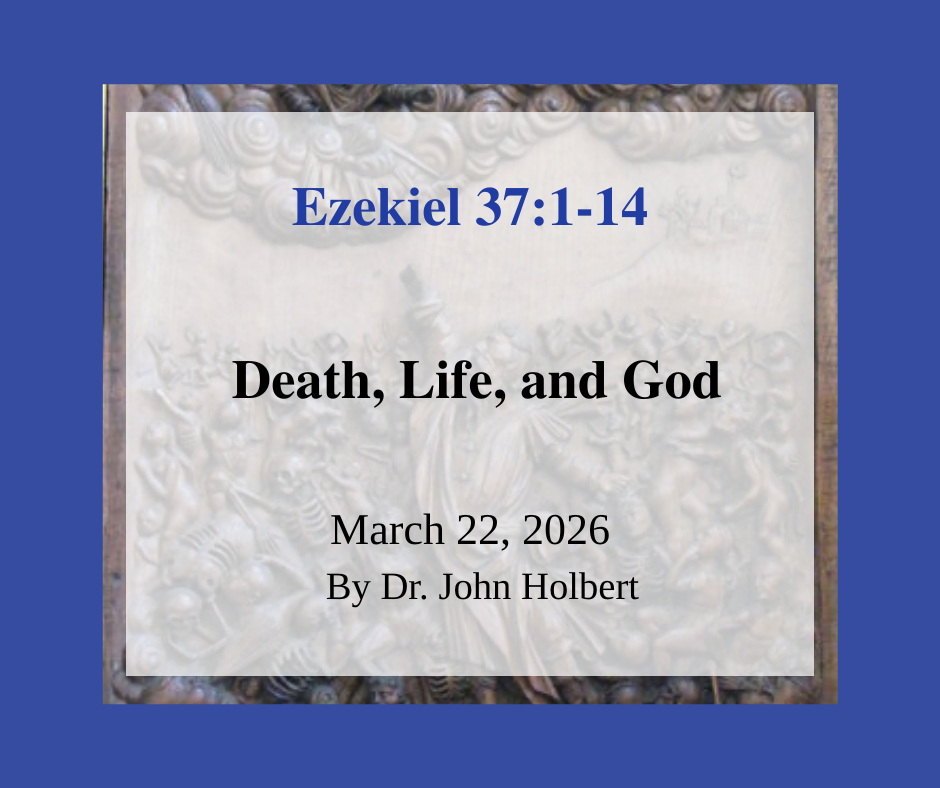
It is on the one hand a great pity that all most people know of the large prophetic book of Ezekiel is this 37th chapter. But on the other hand, if this chapter is all we know, that is no bad thing, since the text is justly famous and richly written. The prophet, at least by tradition, was captured and sent to Babylon during the first deportation in 597BCE. Hence, he witnessed the death throes of Judah as well as spending some time in Babylon, although we will never know how long. Thus, his famous vision of the valley full of dead human bones is clearly reminiscent of the impending and partially realized assault of the armies of Nebuchadnezzar on Jerusalem. It is customary for this prophet to express his messages in complex visions and metaphorical language, and Ez.37 is no outlier in that regard.
The spirit of YHWH leads the prophet into a vast valley, a valley full of bones, and the bones were very dry, suggesting that the bones had been there for a long time (Ez.37:1-2). Once there, YHWH asks a pointed question, a question that has multiple possible meanings: “Mortal (lit. “Son of Man”), can these bones live?” Any person standing among a heap of dry, desiccated bones ought have a quick reply: “Hardly!” But Ezekiel is far more circumspect, or perhaps he is throwing the question back in YHWH’s face. “Lord YHWH, you know!” (Ez.37:3) Why ask such questions of me, a lowly human prophet? How can I know about death and life? That is your field, YHWH, not mine.
Rather than answering the divine question, YHWH becomes directive. “Prophesy to these bones; say to them, ‘Dry bones, hear the word of YHWH’” (Ez.37:4). I imagine that one or two of you preachers have thought to yourselves in the middle of a sermon that the congregation is very like a valley of dry bones! How in God’s world can I enliven them, how can I stir them up for the work of the gospel? But in this case YHWH gives the sermon to the prophet (would that it could be so easy and certain of a Sunday morning!). “I will cause breath (Heb: ruach, which may mean wind or spirit as well—see Gen.2:7) to enter you, and you shall live. I will lay sinews on you, and will bring flesh upon you, and will cover you with skin, and put breath in you, and you will live!” (Ez.37:5-6). I just know that you are singing that spooky spiritual right now as you read and reflect on these famous words—“Ezekiel connect a them dry bones!”
And what does all this mean? This is not about the bodily resurrection of the human person, no matter how many times it has been read like that. No! Ezekiel himself makes it plain what his vision is about. “Mortal,” says YHWH, these bones are the whole house of Israel,” and even though they (Israel) has said, ‘Our bones are dried up, our hope is lost, we are completely cut off’” (Ez.37:11), it is not finally so, says YHWH through Ezekiel. The exile of Israel is not the end of the nation; the dry bones will live again through the power of YHWH’s enlivening spirit, communicated through the words of YHWH’s prophet Ezekiel. “I am going to open your graves, and bring you up from your graves, and bring you back to the land of Israel” (Ez.37:12). And all these divine actions will result in one certain truth: “you will know that I am YHWH!” (Ez.37:6, 13)
It could be said that there is the central truth of Lent, to know that the God YHWH, the one that sent Jesus to reiterate what YHWH has promised to the people, has acted and will continue to act, bringing life out of death. Lent announces to us what the Bible says again and again; there is finally no death so dead that God cannot find life in it. Or as Buechner’s ancient Saint Godric puts it: “All the death there is, set next to life, would scarcely fill a cup.” Lent may begin with the certainty of the ashes of death, but in the ringing words of Ezekiel we find that God has in mind far more than that for those who follow God. That God speaks life to us, and fills us with the spirit in order that we may live, truly live.