
Colts & Donkeys & a Mysterious Rider - Reflections on Matthew 21:1-11, Liturgy of the Palms, Year A
by John C. Holbert on Tuesday, January 27, 2026
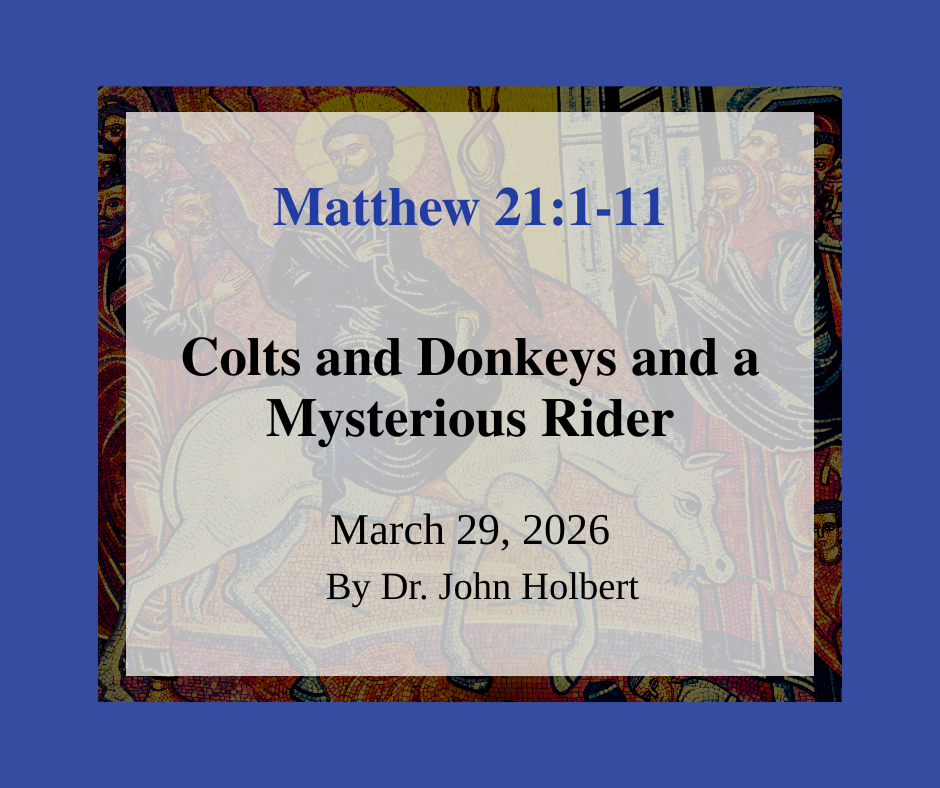
This very familiar account of Jesus’s entry into Jerusalem at the beginning of what we now call Palm Sunday of Holy Week, is actually not as familiar as we may think. Matthew uses the account of Mark 11:1-11 as the basis of his account, but by his omissions from the Markan account, and his rather selective use of texts from the Hebrew Bible (albeit from the Greek translation, the Septuagint in the main) he focuses the reader’s attention on one of his central concerns throughout his gospel, namely the myriad ways that the actions and words of Jesus fulfill the scripture. It is abundantly clear that Matthew’s audience is primarily Jewish, and he is always anxious to prove to them that their own texts are the backdrop of, and the prefiguring for, the ministry of Jesus of Nazareth. If they will but listen to their own Bible, they can only conclude that Jesus is their long-expected Messiah of God.
Jesus and his disciples come near to Jerusalem, to a place known as Bethphage (“house of figs,” or “unripe figs” or “early figs”—the exact meaning is finally uncertain), then to the Mount of Olives, a spot just east of Jerusalem, and the place, according to Zech 14:4, where a great eschatological battle is to be fought at the end of days. Matthew has already loaded his narrative with tensions from the ancient texts. Jesus then orders his disciples to procure from the nearby village “an ass tied and a colt with it” (Mt.21:2). While Mark’s account adds the repetition of this command by describing the actions of the disciples, Matthew does not show the disciples’ actions. In this way, he sharpens his interest in the fulfillment of scripture, by using two passages from the first testament to demonstrate how what happens fulfills the older text. “Tell the daughter of Zion (Is.62:11), ‘Look! Your king comes to you, meek and seated upon an ass and upon a colt, the foal of a beast of burden’ (Zech.9:9). Importantly, Matthew omits from the Zechariah reference “righteous and victorious is he,” thus emphasizing Jesus’ meekness, as opposed to the possible warlike image that Zechariah may imply. Thus is Matthew contrasting the donkey-riding Jesus with any warriors astride a war horse. In a quite famous and influential account of The Final Week, Marcus Borg and John Dominic Crossan paint this contrast by suggesting that while Jesus is riding in to Jerusalem on his lowly donkey, Pilate may be riding in from his residence in Cesarea Phillipi on the sea, aboard a stallion befitting an important leader with a great show of Roman legionnaires in his train. This is a graphic portrait, wholly unprovable, but quite memorable.
What is of greater and rather confusing interest is the way Matthew quotes the Zechariah passage. He is absolutely literal, assuming that the prophet has referred to two animals in his vision, an ass and a colt, that is a young donkey. Matthew thus, hilariously, has Jesus riding both animals, teetering one foot on one and one on another (?), circus-like, or somehow perched on the two riding side-by-side. This portrait has long been an unintentionally funny one, the result of Matthew’s apparent lack of awareness of the way ancient poetry works, namely that the second line of poetry often mirrors the first in the way of repetition; the two lines are in fact saying the same thing, not referring to two separate beasts. Still, for Matthew, it is the language itself that must be taken with utmost seriousness. Jesus, absolutely literally, fulfills the words of Zechariah. Matthew extends his plural interest in two animals even into vs.7: “and he sat upon them,” the “them” referring both to the garments placed on the animals, but also to the animals themselves.
Then more scripture determines the next actions of the scene. “The crowds that went before him and those that followed shouted out, saying: ‘Hosanna to the Son of David. Blessed is he who comes in the name of the Lord. Hosanna in the highest’” (Mt.21:9). “Hosanna” is a Greek transliteration of Hebrew/ Aramaic hosiana, meaning “save, please,” or “save now.” It would seem that the appropriate appellation would be a greeting of homage, but I suggest that both meanings may be intended here. The crowd may be welcoming Jesus, but their welcome may include a fervent desire for help from their Roman oppressors. The remainder of the sentences come from Ps.118:26, a psalm riddled with potential references to the ministry of Jesus, used often by early Christian commentators.
“The whole city shook (the Greek is a powerful word often used to describe the effects of an earthquake), saying, ‘Who is this?’ The crowds said, ‘This is the prophet Jesus who is from Nazareth of Galilee’” (Mt.21:10-11). This is an odd ending to the scene. Matthew says that the “whole city” was under an earthquake-like shock at the coming of Jesus into the city, and they (the whole city?) asks the question Matthew is intent to answer: who is this? Of course, the answer here is only half right: Jesus surely is a prophet, and he surely is from Nazareth, but the subsequent tale of his rejection, death, and resurrection will make his identity all the clearer. And that identity, Matthew has said again and again, is rooted deeply in the scriptures of the Jews. At this point in the story, Jesus is as much mysterious as he is known, but by the end of the gospel he will be revealed as the Messiah of Israel, the Son of God, the true fulfillment of ancient scripture.