
Birth of a Nation - Reflections on Exodus 14:19-31, Sixteenth Sunday After Pentecost, Year A
by John C. Holbert on Sunday, June 21, 2026
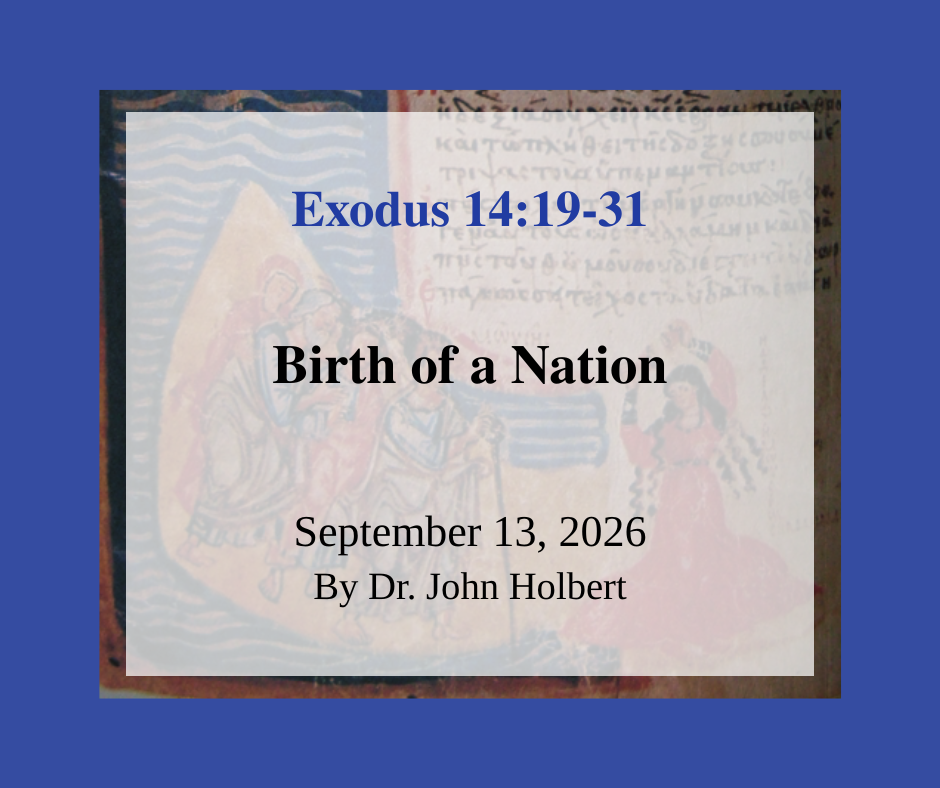
The text today stands at the very heart of the theological history of the people of Israel. It is nothing less than the Israelite resurrection story—on the west bank of the Sea of Reeds (this is the literal Hebrew, not the familiar “Red Sea”) the escaping Israelites are still the slaves of Egypt, but on the east bank of that same sea they are the people of YHWH. Perhaps all of you reading this essay have seen—at least once—the ubiquitous Cecil B. DeMille epic 1956 movie, “The Ten Commandments.” (You may not know that the only academy award garnered by that movie was for special effects, specifically the parting of the waters of the sea which was done with the use of 300,000 gallons of water in an enormous studio tank and took fully six months to complete.) As usual, the biblical text itself is rather more complex than the movie representation suggests. However, the certain lack of historicity of this singular event should not blunt the power of what the tale proclaims: YHWH has chosen the people of Israel to effect YHWH’s will in the world.
Chapter 14 begins the story of the Sea with what may only be termed a divine ambush. God first tells Moses in great detail exactly where the people are to encamp, facing the waters of the Sea of Reeds, a place that can never be discovered since we are hardly dealing with history here, but theology. The specificity of the names, supposedly describing some exact location of the encampment—“Pi-Hahiroth,” “Migdol,” and “Baal-Zephon”—are each Hebrew words, meaning, respectively, “mountains’ mouth,” “tower,” and “Baal of the North.” None of these are to be found on any map! Nevertheless, we are to imagine a specified place, a place that causes pharaoh to think the Hebrew people are lost. He intones a small couplet to his people, urging them to pursue the escaped slaves: “They are confounded in the land; the wilderness has closed them in” (Ex.14:3). And that conception moves YHWH once again to “toughen (or “harden” in the more familiar translation) pharaoh’s heart, and he will pursue them, “that I may gain glory through pharaoh and through his army, and the Egyptians will know that I am YHWH” (Ex.14:4). YHWH’s control of pharaoh, along with the forces of nature, will prove beyond any doubt that YHWH alone is God, and that the Israelites are YHWH’s people.
The encamped people, facing the Sea, and soon endangered by pharaoh and all his chariots chasing them from the rear, are “very afraid,” and cry out to YHWH, “Was it for lack of graves in Egypt that you took us to die in the wilderness?” They claim to have said this while in Egypt (although the text never says it), “Leave us alone, that we may serve Egypt, for it is better for us to serve Egypt than to die in the wilderness!” (Ex.14:11-12). Moses’ reply is justly famous: “Do not be afraid. Take your stand and see YHWH’s deliverance done for you today, for all these Egyptians you see today, you shall not see them again for all time. YHWH will do battle for you, and you, you will keep still” (Ex.14:13-14).
And then comes the miracle, but the miracle does not appear in one way only. Two accounts of the event at the Sea are folded into the text, but each one is in itself miraculous, no matter how astonishing one seems to be more than the other. Of course, the most familiar one is the “walls of water” scene, as found in Ex.14:22 and 29. This is Cecil B. DeMille’s depiction, perhaps forever rooted in our minds, the instantaneous movement of the waters of the Sea into walls at the command of Moses’s (aka Charleton Heston) raised staff. However, a closer reading of the tale yields a completely different version. At Ex.14:21, when Moses “stretches out his hand over the sea, “YHWH led the sea with a mighty east wind all night, and made the sea dry land.” This account echoes the famous description of the creation of the world in Gen.1 when God forces the primeval ocean back “in order that the dry land should appear” (Gen.1:9). Also, this scene prefigures the Israelite march through the Jordan River on their way into the land of promise, where again waters “pile up” in order to create dry land on which the people may walk (Joshua 3:14-17). The depiction here appears to be one of a tide, slowly moving back to reveal a dry land walk across the sea bed.
And then things become particularly strange. As the Israelites head into the now dry sea floor, “the Egyptians pursued and came after them, all pharaoh’s horses, his chariots, and his riders, into the sea” (Ex.14:23). Then, “in the morning watch YHWH looked out over the camp of Egypt,…and panicked the camp” (Ex.14:24). The verb “panicked” is used in several other places in the Hebrew Bible to indicate a direct defeat of Israel’s enemies by the hand of YHWH (Josh.10:10; Jud.4:15; 1 Sam.7:10). There is in those places, as well as here, a sense of confusion engendered by YHWH’s actions, and as a result, the Egyptians flee directly toward the returning flow of the sea, instead of away from it, and are drowned in the sea (Ex.14:27). In a brutal irony, the Israelite slave children who were threatened by pharaoh with drowning earlier in the story (Ex.1:22), are now saved, while the pharaoh and all his army are drowned in the sea.
And one more idea from the story may be named. The movement through the waters, led by a man who was saved from the waters when a baby, represents nothing less than the literal birth of a nation, birthed by the waters of the sea. A story that begins with the threat of a death by drowning to a new-born child concludes triumphantly with the birth of a new nation, passing though the waters of God. This rich story yields multiple meanings, all of which resound throughout the long history of Israel and Judaism.