
Another Prophet Rejected - Reflections on Acts 7:55-60, Fifth Sunday of Easter, Year A
by John C. Holbert on Tuesday, March 17, 2026
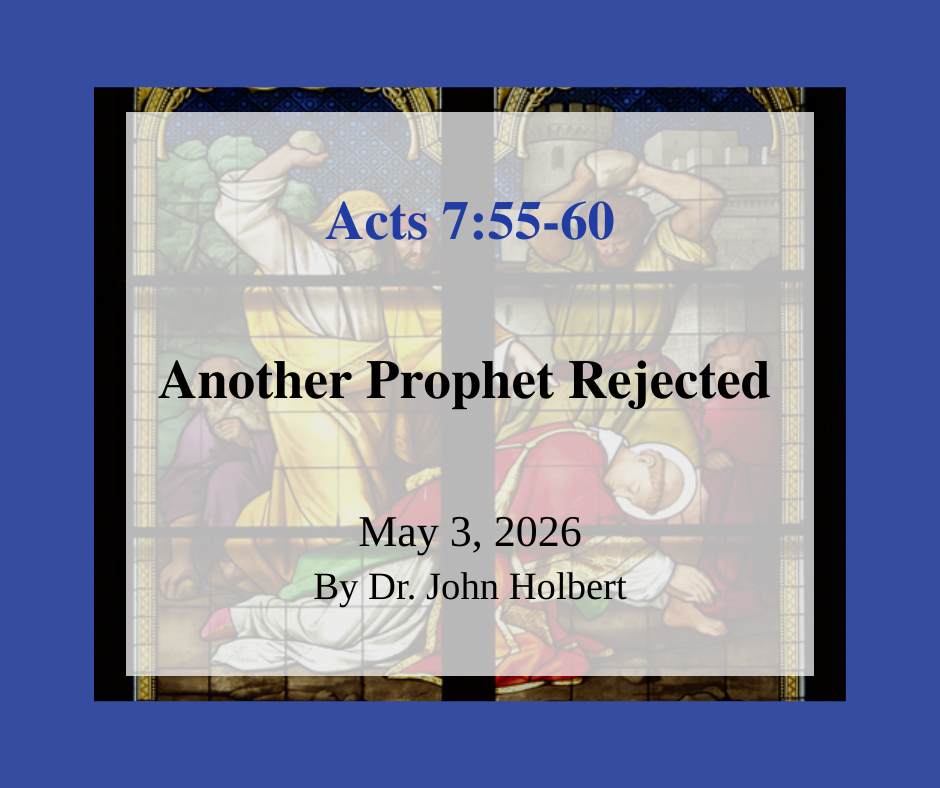
Luke is ever intent in this second volume of his literary look at the rise of Christianity to demonstrate the continual desire of the religious authorities of first-century Judaism to assault and destroy the emerging Christian communities by murdering their prophets. Just as Jesus was maligned, arrested, tortured, and hung on a cross, so now in Acts 7, the apostle Stephen is likewise arrested, brought up before the Sanhedrin on charges of “blasphemous words against Moses and God” (Acts 6:11), commanded by the chief priest to answer the charges (Acts 7:1), and in the longest speech in Acts (Acts 7:2-53), berates his accusers, saying they are “stiff-necked (like pharaoh in Egypt) people, uncircumcised both in hearts and ears. You are always resisting the Holy Spirit! As your fathers did, so do you” (Acts 7:51). It is more than certain how the Jewish leaders will respond to such offensive and pointed denunciations!
“They were enraged (literally “they were ripped through their hearts,” the heart being the seat of will and intelligence in first-century anthropology) and ground their teeth at him” (Acts 7:54). “Grinding the teeth” is a familiar act of fury, especially of the wicked against the righteous (Job 16:19 and numerous Psalms). It is noteworthy that the phrase “grinding the teeth” is used at Luke 13:28 to describe those not included in God’s coming rule. Stephen’s speech has rendered the Sanhedrin quite literally apoplectic, exhibiting physical manifestations of out-of-control behaviors, racing hearts and grinding teeth.
Meanwhile, Stephen “filled with the Holy Spirit,” a sign that earlier was seen to be a designation for a prophet about to be rejected as usual by these Jewish leaders (Acts 7:51), “gazed into heaven and saw the glory of God and Jesus standing at God’s right hand” (Acts 7:55). Stephen’s lengthy speech made it plain that the “God of glory” appeared to Abraham (Acts 7:2); in the same way Stephen now sees that same glory. In addition, Jesus’s resurrection is especially marked by God’s glory (Luke 9:31-32 and Acts 3:13). Hence, Stephen is witness to that glory as he faces his own imminent martyrdom.
In the face of this obvious revelatory experience, the Sanhedrin “shouted loudly, held (covered?) their ears, and all rushed at him” (Acts 7:57). This sentence has a certain comic connection to a modern action when we stick our fingers in our ears so as not to hear what we do not wish to hear, babbling “la-la-la-la” to cover the unwelcome sound. The Sanhedrin tries in vain to avoid any aural contact with Stephen’s ecstatic experience, and then runs at him to try to shut him up. They grabbed him, “threw him out of the city, and stoned him” (Acts 7:58). In early Jewish texts, it is stated a person to be stoned must be removed from the place of the court, and stoned, citing Lev.24:14, where a cursed person was to be stoned outside the camp. Stoning, of course, is a particularly horrific and humiliating death, evidenced by broken bones, massive blood loss, and monstrous disfigurement, leading to the demise of the victim. It is surely the equivalent to death on a cross, though it may have gone on even longer than that.
Stephen’s reaction to his stoning is of course noteworthy. “Lord Jesus,” he cries, “receive my spirit” (Acts 7:59). This echoes Jesus’s last words at Luke 23:46, which itself is an echo of Ps.30:6. Also, Stephen is quite directly “calling on the name of the Lord” to fulfill that prophecy from Joel employed by Peter at Acts 2:21. And before he dies, Stephen then echoes Jesus’ great act of forgiveness for his murderers from the cross at Luke 23:34. Stephen cries, “Lord, do not hold this sin against them” (Acts 7:60).
While Luke is reminding his readers of the many connections between Jesus’s actions and words and those of his followers, he also cleverly slips in the first appearance of that person who will stand front and center in his ongoing narrative. “And the witnesses placed their clothing at the feet of a young man named Saul” (Acts 7:58); Now this Saul, Luke says “agreed with his being killed” (Acts 8:1). In fact, according to Luke, “Saul continued to inflict outrage against the church, going into one house after another, dragging out both men and women, and handing them over to prison” (Acts 8:3). This terrible persecutor of Christians will become in Luke’s story the unique apostle of Jesus, Paul, who will spread the gospel throughout the known world.
It has been said that the church was born in the blood of its martyrs, and Stephen, like Jesus, was one of the most prominent of those. He claims that the followers of Jesus are in reality the true agents of God in the world, and that the Jews of his day have long stood in opposition to those true followers, forever killing prophets and apostles in the attempt to stop the growth of the new communities. Luke all too well represents the sharp and deadly divisions that early Christianity brought to the religious world of the first century, divisions that all too often are still evident in our own 21st century world. Nevertheless, Luke always demonstrates superb literary skill as he crafts his memorable tales of the emerging church, tales that live still in the consciousness of Christians through the 2000 years since his telling.