
Akedah - Reflections on Genesis 22:1-14, Fifth Sunday after Pentecost, Year A
by John C. Holbert on Wednesday, April 8, 2026
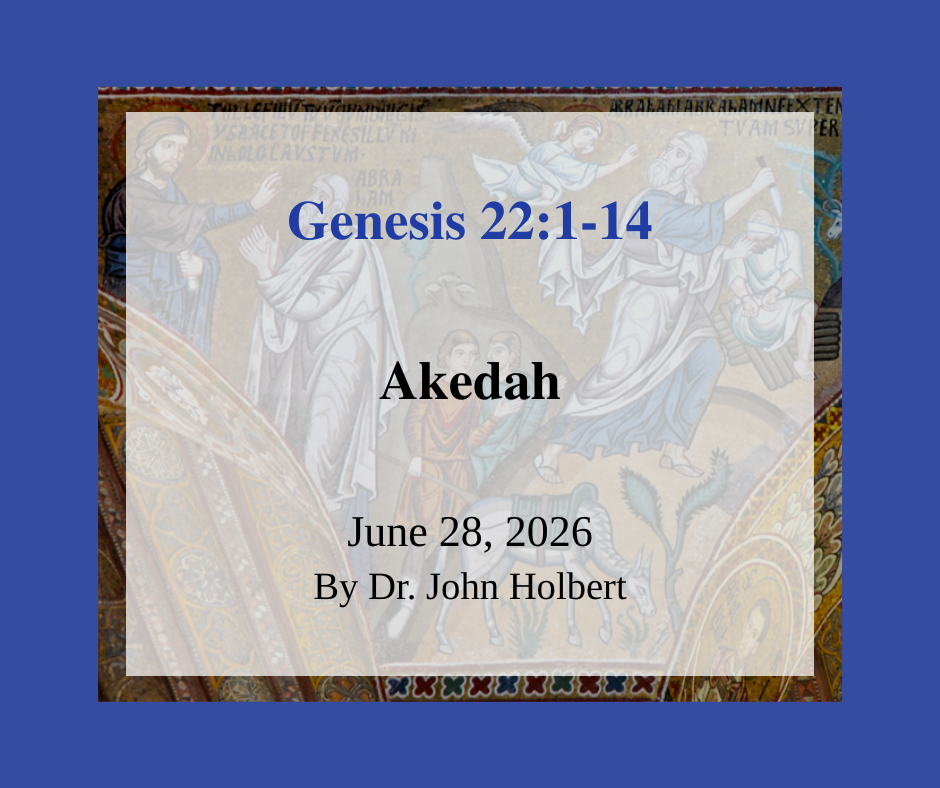
The title of today’s essay comes from the way Jewish readers refer to this extraordinary text: akedah is from the Hebrew verb found in Gen.22:9 where it is said that Abraham “binds” his son, Isaac, to the altar for sacrifice. The verb is found only here in the Hebrew Bible and thus contains more than a hint of mystery. Indeed, this amazing tale is filled to the brim with mystery, terror, and surprise enough for a whole book full of texts. Little wonder that it has captured commentary from many of the finest readers of the Hebrew Bible of the past 100 years: Gerhard von Rad, Claus Westermann, and E.A. Speiser have offered superb accounts of the possible meanings of the story, and the first chapter of Erich Auerbach’s magnificent literary tour de force, Mimesis, titled “Odysseus’ Scar,” is well worth reading more than once. I can hardly expect to add anything genuinely new to this panoply of amazing readers.
However, I do wish to make one thing quite clear: according to the careful literary construction of this story, Abraham has every intention of sacrificing his son on Mt. Moriah—he is in no sense dissembling about this intention—and is only denied the act by the intervention of a “testing” Elohim. The tale is primarily a test, and Abraham passes the test with flying colors. But he only does so precisely because he is fully willing to sacrifice Isaac. The rich textual detail makes that fact certain.
I cannot prove that reality in the sort of matching detail the text deserves, but I can point out some salient places where we are led in that direction. It is first made plain that it is Isaac that Elohim wishes for a sacrifice: “Take your son (which one, we might ask; after all Abe has two sons), your only son (yet both are only sons), the one you love (does he not love them both?), Isaac, (finally Elohim reveals the divine desire), and go to the land of Moriah (a word built on Hebrew “to see”) and offer him there as a burnt offering on one of the mountains that I will show you” (Gen.22:2). Without a single word to anyone, either his wife or his servants, he prepares to do just that. “Abraham rose early, saddled his donkey, took two of his young men with him, and his son Isaac. He cut wood for the burnt offering, and left to go to the place that Elohim had shown him” (Gen.22:3). There is no indication at all that Abraham is not fully ready to do the terrible thing that Elohim has asked.
We well remember Gen.18:16-33, where in the face of God’s desire to obliterate Sodom and Gomorrah, Abraham argues vociferously with his God, demanding that God act appropriately and not destroy any place where one might find even one righteous person. That arguing Abraham in Gen.18 has now become the silent and obedient Abraham who dutifully is ready to kill his son for God. We remember too that Abraham and Sarah have waited fully 100 years for this child; yet, he is going to murder the boy on the mountain!
When they arrive at the mountain, Abraham tells his young men: “Stay here with the donkey. The boy and I will go over there, and worship, and then will return to you” (Gen.22:5). Really? Just how will Isaac come back with his father? In a jar of ash? Some have assumed that by saying this Abraham intimates that he knows that Elohim will not in the end demand this thing of him. I disagree. He is merely making his servants comfortable, hiding from them what he is about to do. “Abraham took the wood for the burnt offering and laid it on Isaac, his son, and he himself carried the fire and the knife. The two of them walked on together”(Gen.22:6). Abraham lays the non-dangerous wood on his son, while he carries fire and knife. This fact brings forth a question from Isaac: “Father,” he says, and Abraham replies in typical Hebrew fashion, “Here I am, my son” (Gen.22:7). We hardly need to be told just who are father and son by this time, but the narrator grinds into us the idea that this father is about to kill his son and the son is completely ignorant of the entire affair. So, Isaac asks in all innocence, “Here are fire and wood (no mention of the threatening knife!), but where is the lamb for the burnt offering?” (Gen.22:7). “God, even God will provide the lamb for the burnt offering—my son,” and the “son” concludes the reply, suggesting that it is precisely this son that will be the sacrifice.
They arrive at the place of sacrifice where Abraham arranges the wood, “binds” his son to the altar, laying him on top of the wood. He then grabs the knife and prepares to kill his son, but an angel of YHWH calls out to him from the sky, shouting, “Do not lay your hand on the boy or do anything to him, for now I know that you worship Elohim, since you have not withheld you son, your only son, from me” (Gen.22:12). Abraham then sees a ram, caught by its horns in a nearby thicket, grabs the beast and offers it on the altar in place of his son. Henceforth, the place will be named, “YHWH will see,” and even to this day, we are told, “on the mountain of YHWH it (or “God”) shall be seen” (Gen.22:13-14). “Seeing” is a lite motif in the story which ends with God being seen and Abraham doing the seeing.
The tale has long been thought of as a rebuke of child sacrifice, a pagan practice rejected by the Israelites. It is quite true that various texts of the Hebrew Bible suggest that child sacrifice was once seen as a legitimate worship practice (see Ex.22:29-30 and Ezekiel 20:25-26 for two examples). However, Micah 6 appears to be a complete repudiation of such practice (vss.7-8). Yet, here Abraham’s willingness to sacrifice Isaac is a genuine act of worship. God’s substitution of the ram does not deny Abraham’s willingness, but instead proves quite openly that Abraham has passed the terrible test of his faith and trust set by his God. It is perhaps too easy to imagine this story is about a rejection of child sacrifice. It appears to the contrary to be another example of the deep mystery of God, a God well beyond simple human morality, a God whose ways are not ours. It may be a good model of our constant desire to squeeze God into a box of our own construction, whereas our God’s ways are certainly not always ours. The akedah holds mystery, a mystery we would do well to embrace as we imagine just who our God may be.