
A Patriarch's Weakness, a Matriarch's Fury-Reflections on Gen 21:8-21, Fourth Sunday after Pentecost
by John C. Holbert on Monday, April 6, 2026
The stories of Genesis are eternally fascinating and richly elusive. Many of them turn on the ambiguities of the Hebrew language, and the one we address today is no exception. Because the stories of Isaac and his parents, Abraham and Sarah, always revolve around that verb for “laughter,” the verb stands at the center of the tale of Isaac’s astonishing birth to the aged couple. “Isaac” is a name built on the Hebrew meaning “laugh,” though the word may also be translated “to play.” That linguistic ambiguity will be evidenced by the various translations of some key verses in the story, as we will see.
The larger context of the tale in Gen.21 is important. The birth of Isaac is accompanied by much hilarity and good fun. “Sarah conceived and bore Abraham a son in his old age (not to mention hers!)” (Gen.21:2). After the old father circumcises his son, Sarah speaks two delightful, yet problematic, sentences. She first says, “Elohim has made laughter for me; everyone who hears will laugh at me” (Gen.21:6) The NRSV translation reads here “laugh with me,” but the Hebrew preposition is far more often read as “at.” After all, the aged Sarah may well laugh at her good fortune, while others may find her unlikely birth as a sort of joke. In any case, we ought not hear the tale as a simple one of unmitigated joy; there is complexity here, as we soon shall see. Sarah’s second response to Isaac’s birth is: “Whoever would have spoken to Abraham, ‘Sarah is suckling sons!’ For I have borne him in my old age’” (Gen.21:7). There is genuine pleasure here, because this is the same Sarah who in Gen.18 had spoken to herself of her shriveled body (Gen.18:12); now that aged body has produced a son! But now pleasure gives over to trouble.
On the day of a great feast, celebrating the weaning of Isaac, Sarah “saw the son of Hagar, the Egyptian, whom she had borne to Abraham, laughing” (Gen.21:9). The NRSV here translates the verb as “playing,” and adds “with her son Isaac,” additions from both the Greek Septuagint and the Latin Vulgate. However, I suggest that we read “laughing” here and reject any other addition as not needed. Sarah sees Ishmael, that now in her eyes secondary child, birthed by the “slave girl,” as she now churlishly names her, laughing. Yet, it is Isaac who is the “son of laughter.” How dare this unwelcome brat laugh, thus pretending to emulate Sarah’s miraculous son? She reacts with rage. She turns to Abraham, and shouts, “Toss out this slave woman and her son, for the son of this slave woman shall not inherit along with my son, with Isaac” (Gen.21:10).
Abraham’s response to this cruel demand is both ambiguous and problematic. “This thing was evil in Abraham’s eyes because of his son” (Gen.21:11). The NRSV’s reading, “this matter was very distressing to Abraham” is to me not nearly strong enough. What Sarah has asked of him is to him plainly “evil.” To evict his paramour, along with his first-born child is nothing short of evil! And to which son does he refer at the end of the sentence? It appears obvious that it is Ishmael, yet might he also have Isaac in mind? What will Isaac imagine as he sees his father throw his half-brother out of the camp at the behest of his enraged mother? Might he wonder whether he could be subject to a later parental whim? That could put Gen.22 in a different light, when Abraham prepares to sacrifice Isaac on a mountain.
But the tale then says that God assures Abraham that he should listen to his wife’s demands, since God has plans for both boys; the older will become progenitor of a nation (Gen.21:13), while the younger one shall be the source of “offspring named for you” (Gen.21:12). Without another word to anyone, Abraham rose early in the morning (as he will later do before his trip to sacrifice Isaac), , took bread and a skin of water, and gave it to Hagar, putting it on her shoulder, and he gave her the child, and sent her away. So she wandered in the wilderness of Beer-sheba” (Gen.21:14). The fact that Beer-sheba means either “well of seven” or “well of an oath,” makes it nearly certain that the tale will have a good ending, there are wells in the area, but no thanks to Abraham and Sarah.
I find Abraham’s actions here as reprehensible as Sarah’s. Yes, he does hear from God about the future of his two sons, but gives little if any thought to Hagar’s future—just how is she to survive in the deserts of Beer-Sheba? He merely gives her some bread and one skin of water and sends her away! One can imagine this pleased Sarah greatly; she is finally rid of both a rival wife and a rival son. Meanwhile, Abraham says nothing! This is reminsicent of that weak-willed action of the patriarch back in Egypt where he lies about his wife to pharaoh, claiming she is his sister (Gen.12:10-20).
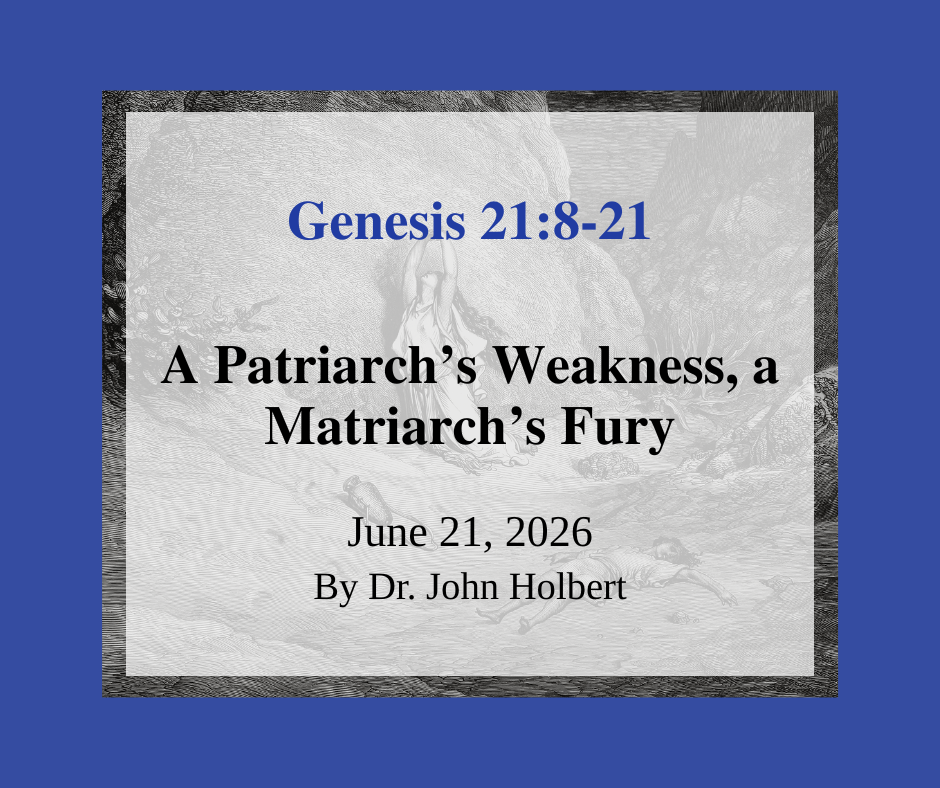
Hagar, the distraught mother, soon runs out of water and food, and in utter desperation, places her child under a bush, and goes a distance away from him, “about a bowshot,” presaging what her son will become as he grows up, that is a master of the bow (Gen.21:20). She simply cannot stand to watch and hear her Ishmael die! But God intervenes, and hears the cries both of Hagar and Ishmael, indicates a nearby well, and promises the two of them that they will find a new life in Paran, a western wilderness in the vicinity of the southern deserts.
Neither Abraham nor Sarah come off well in the story. But, of course, the Bible’s tales rarely if ever are designed as models for our behavior. Rather than suggest that we ought to “become like Abraham and Sarah,” the Bible seems to suggest that we ARE like them, and once we recognize that fact, we need to try to do something about that! These classic tales energize, surprise, titillate, and bring sadness and joy to us, as they have done for countless centuries. Both weak Abraham and furious Sarah are characters that will live forever and will remain the source of endless discussion and debate. The stories, as Thomas Mann once said, are like deep wells. One might throw a pebble into them, but wait in vain for the answering plink—in short they are bottomless in their wonder.