
A Fanciful Areopagus - Reflections on Acts 17:22-31, Sixth Sunday of Lent, Year A
by John C. Holbert on Wednesday, March 18, 2026
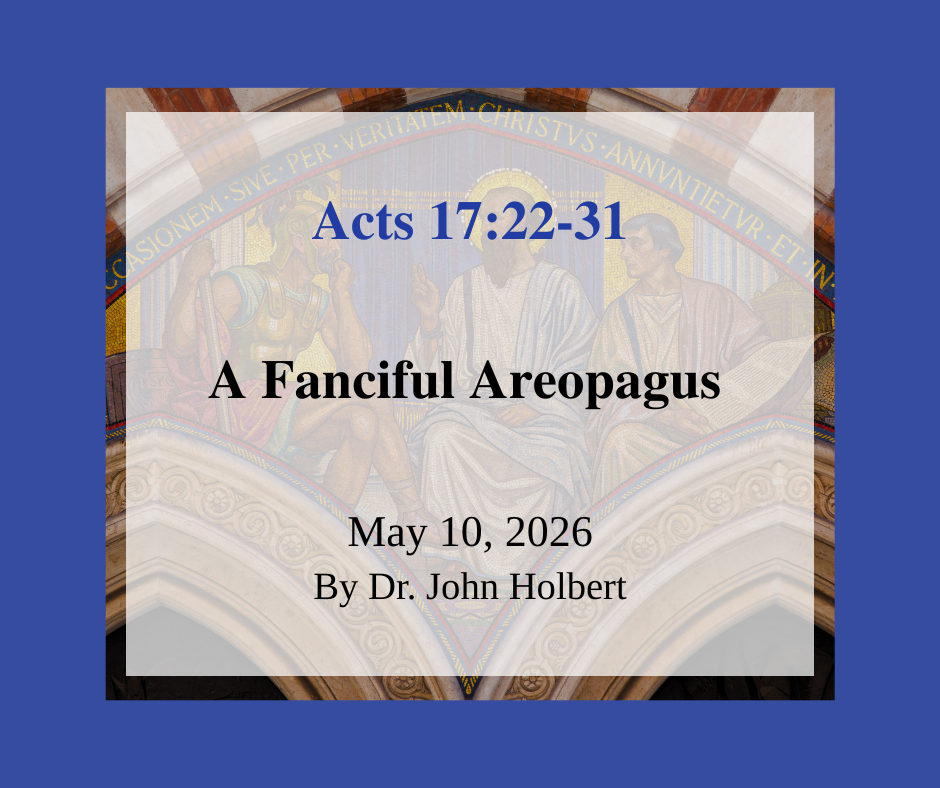
I well remember my first trip to Athens, Greece which included a hike up the Areopagus, a hilly enclave, some 150 feet below and NW of the much more famous Acropolis and its magnificent temple structure, with the agora, the ancient market place of the city, spread out below. It is a stunning spot, the place on which Paul in 51 CE or so, was said by Luke to have delivered an unforgettable sermon to the unknown gods of Athens. The hill is also known as Mars Hill, perhaps deriving its name from the Athenian god of war, Ares, though others think the word may come from the Greek arai (“curses”), representing the tale of the Furies, whose cave may be found on a nearby slope of the hill. However, the name is to be understood, signs all around the place announced that indeed St. Paul had preached there, taking on the many Stoic and Epicurean philosophers who were to be found in Athens, and in the process converting Dionysius, the Areopagite, who became the patron saint of Athens, and traditionally its first bishop and a Christian martyr.
The guide we followed that day filled us with all these tales concerning Paul and his debates with the Athenian philosophers, attempting with their own rhetorical logic to prove to them that the statue he saw on his way up the hill—“to an unknown god” (Acts 17:23)—was in reality a sign of the God he had come to know and worship. The story became a philosopher vs. theologian, an Athens over against Jerusalem, a believer vs. skeptic narrative, and Luke has beautifully structured it to make it well-nigh unforgettable. Our guide was convinced of its historical truth and told the story to us as absolute fact, bidding us to imagine the famous apostle standing toe-to-toe with the greatest minds of the day at a certain time on that very spot. All the signs erected there made it quite clear that we were witnesses to factual history.
I must say, and I must tell what I know to be true, that I doubt the entire event is historical. We do know that Paul did spend some time in Athens (1 Thess.3:1), but that time was so uneventful, at least according to his own letters, that nothing much may have occurred with regard to the mission the apostle was on. Athens was, I imagine, merely a brief stopover between the longer stay in Thessaloniki, and the far more significant time—perhaps as much as 18 months—in Corinth. Yet, Luke has fashioned this story as one of his more impressive scenes. Luke Johnson makes this point as well as I have heard it expressed: “As in other such set-pieces, we discover here not what happened but Luke’s idealized version of what ought to have happened, so marvelously wrought that for its readers it provided the emblem of what possibly could happen.” (Luke Timothy Johnson, The Acts of the Apostles, 318.) When Paul confronts the great philosophers of Athens, trading sharp insights with the superb thinkers of the day, he becomes for Luke more than a wandering preacher, but evolves into a clever and careful purveyor of intellectual thought, no mere evangelist for Jesus, but a superb advocate of the careful thinking and potent rhetoric beloved of the Greeks for centuries before Paul was ever born. In short, if Paul ever did find himself up against the wonderful minds of the first century, he would do more than hold his own.
In truth, Athens had by the time of Paul’s visit seen better days. The halcyon time of Socrates, Plato, and Aeschylus, were far in the past, and the great city of Rome had long ago been the center of the known world. Athens was only a somewhat faded memory in the time of Paul. Still, for Luke, and probably others who could read and appreciate the wonders of the Athenian past, Athens remained a living symbol of all that the Greek past had to offer in the way of profound and crucial thought and practice. It was quite true that the school of Epicurean and Stoic philosophers had their origins in Athens, the former founded by Epicurus, and the latter by Zeno at about the same time, perhaps 300BCE. The Stoics could be said to be more overtly religious, concerned as they were with providence and divine immanence; two of their greatest practitioners were Marcus Aurelius and Epictetus, both of whom played out the practical implications of this school in their famous writings and lives. On the other hand, the Epicureans could be called “impious,” in the sense that they focused far more on the early science of Democrites’ insistence on the reality of atomic particles as the basis for all things, which led their followers to a rejection of religion.
Upon hearing Paul speak of “This God (whom they called “unknown”) as the one who made the world and everything in it” (Acts 17:24), the philosophers use a rather funny name to malign Paul’s attempts at argumentation. They call him “babbler” (NRSV), a word cluster that could be translated “busybody.” Greek spermologos is a word rising from the image of a bird picking up and dropping seed (sperma), hence he is a gossip, or more specifically here, a sort of peddler of second-rate opinions. Of course, that is exactly the opposite of what Luke wants his readers to hear in the language of Paul. Paul in fact is a first-rate debater, a world-class philosopher, and in the end Dionysius will be convinced by him into conversion to Christianity.
Luke wishes to tell us that the new movement of Christianity is able to withstand the intellectual onslaughts of even the finest thinkers of any age. This Way of Jesus not only speaks to the poor and forgotten of the world, but it also offers insightful power to those who fancy themselves beyond such wild nostrums as resurrection and belief in a universal divinity. I admit that when I went to the Aeropagus those years ago, I already had my suspicions that what I was seeing was not an historical site, but a living tale of the broad wonders of Christianity. I felt then, as I do now, that my attempts to learn all I could about the faith, and to teach it as faithfully as I could to all manner of people, was my attempt, however feeble, to follow in the way that Luke had suggested by his imaginative Athenian story of so many centuries before. And I would also imagine that that is what you have tried to do in your own ministries, to speak the truth as you have studied it, as carefully and as lovingly as you are able. Luke has given us a fine example in his wonderful scene of Paul and the philosophers on the Areopagus. Truth need hardly be historical to be actual truth.