
A Call in the Night - Reflections on 1 Samuel 3:1-10, (11-20), 2nd Sunday after Epiphany, Year B
by John C. Holbert on Monday, November 23, 2026
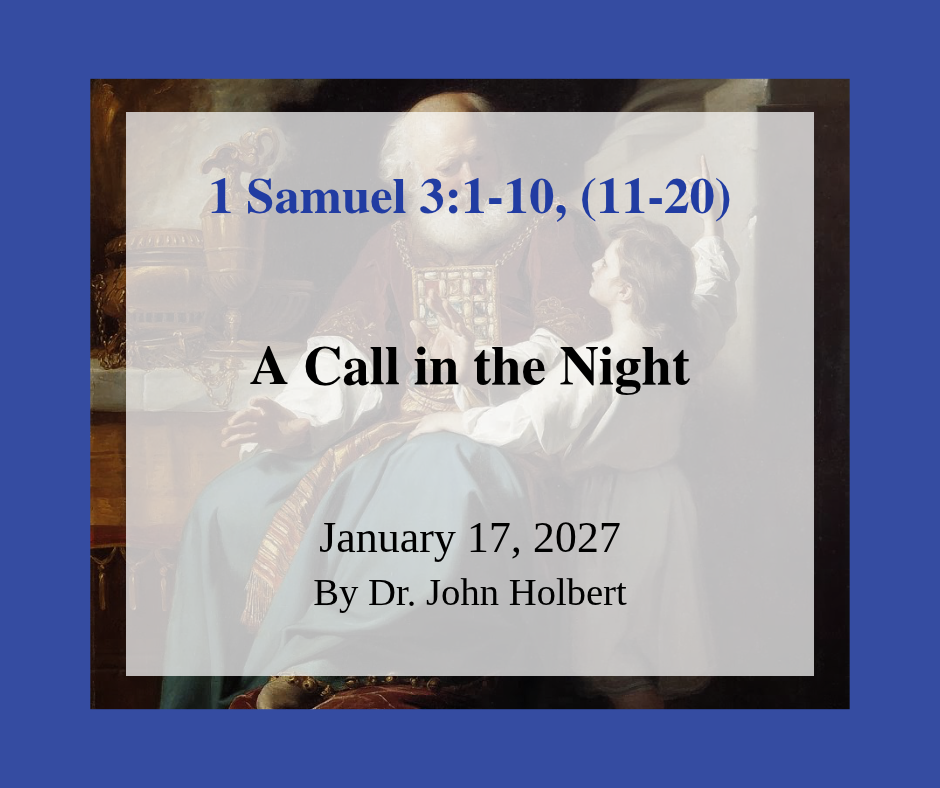
This call of Samuel to be a prophet for YHWH is justly famous. It bears all the marks of a folk tale: the youngster as conduit of the word of God rather than the elder priest; the three-fold character of the night calling; the confusion, both from the old priest and the young soon-to-be prophet concerning who is calling; the obvious elements of an old man in decline—blindness, confusion, devotion to the caller—and the eager vitality of the younger, seen by openness to the call, anxiety about calling the mentor into question, continuing actions toward the work of the temple. Clearly, the story is about the changeover in Israel from a failing priesthood to a new sort of prophet, whose “words never fall to the ground.” It is, in short, a classic account of a call from God.
Having said all that, which is undoubtedly true about the tale, I have long thought there is much more going on here than meets a first reading. The story of Samuel, Saul, and David that comprises the bulk of the books of 1 and 2 Samuel is a fabulously rich and complex tale of power, deceit, and the overtly devious ways of prophets and kings. Very little in these grand tales can and should be taken at face value, and even here, when Samuel receives his call from YHWH, we must not be taken in by a too-facile acceptance of the surface of the narrative. Too often, readers have concluded that Samuel is the perfect prophet of God, while Saul is the bad first king of Israel, and David is the perfect king who follows Saul to the throne. A more nuanced reading is demanded by these authors, and certain clues to that nuance are offered here in 1 Sam.3.
I wish to point to two places in this story that call for a careful evaluation. The first is found in the most basic structure of the call narrative itself. Samuel is sleeping in the temple at Shiloh, and immediately we are warned that “the word of YHWH was rare in those days, vision was not spread about,”( 1 Sam.3:1) that is, the usual ways of knowing and dispensing the word of YHWH to the people were both rare and unlikely. The fact that Eli, the long-time priest of the Shiloh sanctuary, was in fact blind, although the “lamp of God had not yet gone out,” is another way of saying that God’s word is not common at this time. Samuel lies in “the temple of YHWH in which was the Ark of God” (1 Sam.3:3). Samuel sleeps near the famous Ark, that box said to hold the Ten Words of Moses, while Eli slumbers alone in his blindness.
Suddenly, “God called to Samuel,” and the boy replies in the way he should, “Here I am,” imagining that the doddering old priest has some need of him, perhaps to change his clothes, soiled again with bowels no longer controllable. But Eli has not called, as we are soon to discover. Twice more God summons the boy, and twice more Samuel goes to Eli’s room to ask what he needs. But finally Eli realizes that It was “YHWH who was calling the boy” (1Sam.3:8). Eli urges his charge to “go lie down, and if someone should call you, say, ‘Speak, for your servant is listening’” (1 Sam.3:9). Sure enough, YHWH calls again, and Samuel responds as Eli suggested (1 Sam.3:10).
But now comes the first hint warning us about the mission to which Samuel is called. What Samuel must do is appalling! YHWH tells him, “I am about to do such a thing in Israel that whoever hears of it, both their ears will ring. On that day I will fulfill against Eli all that I have spoken concerning his house, from beginning to end” (1 Sam.3:12). YHWH continues to accuse Eli of being a very bad father, refusing to restrain his two sons who have been “scorning God,” as we have been told earlier about their stealing meat from the sacrificial pot (1 Sam.2:11-18), thus profaning the sacrifice in the temple, a terrible act for sons of a priest. Finally, YHWH concludes that Eli has no way of atoning for this evil, either by sacrifice or offering, the priestly way to atone. In short, Samuel is told by YHWH that he is to tell his old mentor that his day is past, and that YHWH has rejected him.
In this way, we see that Samuel’s prophetic call begins with a prophecy of doom. This suggests that the prophet Samuel will be an unrelenting negative force in the future of Israel, and though it is often said that he is God’s perfect prophet, that his words “never fall to the ground,” that is, they always come true, the substance of that prophecy is overwhelmingly dark. And so it shall prove to be.
The second complexity comes soon after Samuel has received his call. The boy is understandably reluctant to bring this painful word to old Eli, “lying in his bed until morning” (1 Sam.3:15), afraid to tell the vision to the priest. But Eli demands that he tell all to him. “What is the thing God spoke to you? Look, do not conceal any of it from me. May God do anything at all to you if you dare conceal from me anything God said!” (1 Sam.3: 17). And Samuel dutifully tells to Eli the entire dreadful content of the word from YHWH—his sons are evil, he did nothing to stop them, and thus his priestly vocation is over.
His reply to this terrible vision is quite ambiguous. “It is YHWH. God always does what is good in God’s eyes” (1Sam.3:18). This might be a pious reply, allowing the actions of God always to be right and always to be accepted no matter what. It may well be read like that. “Whatever God does is good,” Eli may mean. However, it could also have another meaning. God’s actions are always “good” in God’s eyes, but in the eyes of those who experience those actions, it is very difficult to discern just how such actions are good. Hence, Eli may be saying, “Whatever God does, God does, and we humans have nothing to say about it, good or bad.” The rest of the long story to follow presents the actions of God—God’s rejection of Saul after choosing him; God’s choice of the foul David as king instead of Saul; God’s choice of Solomon to follow David, though Solomon gains the throne on a river of blood—those divine actions are distinctly problematic in our eyes, however much they might be good in God’s eyes.
Samuel will be a complex prophet in Israel; Saul will be a complex king; David will be a very complex and problematic king. All this is warned by the call of Samuel to be YHWH’s prophet. The tale is an astonishingly real account of power corrupted, religious inflexibility, and royal deceit that leads directly to murder. It is a great story indeed, and our Bible has given it to us without fear or favor. Such a story is well worth many readings to see just how current its tale may be.