
A Branch-Filled Procession - Reflections on Psalm 118:1-2, 19-29, Liturgy of the Palms, Year A
by John C. Holbert on Tuesday, January 27, 2026
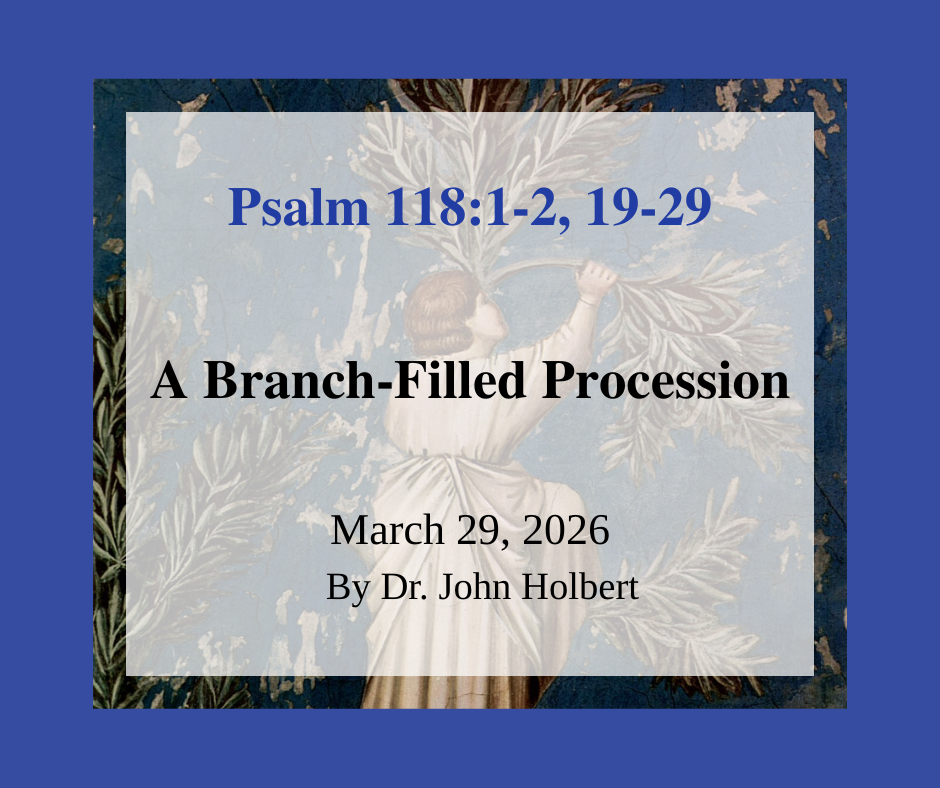
For reasons left unexplained, the framers of the lectionary for Palm Sunday provide only Psalm 118 to represent the text from the Hebrew Bible. As we nonetheless can see, it is a very good choice. The psalm is replete with familiar phrases, many of which turn up in the New Testament, and describes a procession into the temple in Jerusalem, accompanied by branches that end up on the famous four-horned altar of that temple (Psalm 118:27). In that way, Ps.118 provides an ancient description of that scene that will be played out in many of our sanctuaries on Palm Sunday, including the waving of branches (palms or some other equivalent greenery), a festive procession down one or more church aisles, and loud and joyous singing, usually from the children of the congregation, though in the church I currently attend more than a few adults join in the singing and processing. It is quite clear that the Christians who first celebrated Jesus’ entry into Jerusalem, astride that infamous donkey, took Ps.118 as a key text to shape their memorial scene.
In addition, we should note the obvious fact that Ps.118 is filled with lines that Christian worshippers throughout the years have employed either to begin or end services of worship, or to add flavor to the movement of those services. Ps.118:1,29: “Give thanks to YHWH whose unbreakable love (chesed) lasts forever!” Ps.118:14: “My vigorous strength is YHWH who has become my salvation!” Ps.118:24: “This is the day that YHWH has made! Let us rejoice and and be thrilled in it!” Few worship experiences lack one or more of these phrases.
But on Palm Sunday two other lines are ubiquitous. Ps.118:22-23: “The stone rejected by the builders has become the keystone! This is YHWH’s action, and it is wonderful in our sight!” Ps.118:26: “Blessed (happy) is the one who comes in YHWH’s name; we bless you from YHWH’s house!” The proverbial saying from Ps.118:22 finds its way into the New Testament in several places: in Mt.21:42 this phrase caps Matthew’s use of the parable of the wicked tenants, suggesting that the coming rejection of Jesus will reveal that he is in reality the keystone of any follower’s life. In Acts 4:11 it serves as a key element of Peter’s sermon to the council of Jewish elders who have arrested Peter and John for preaching about Jesus; the fact that “Jesus has been rejected and yet has become the keystone,” leads Peter to proclaim that “there is salvation in no one else.” And in Ephesians 2:20, that author structures his notion of the unity of the community on the fact of Jesus as the keystone of the building.
Also, in Ps.118:26, the line has found its way into regular communion services as a reference to Jesus “who comes in the name of the Lord.” In the context of this processional psalm, however, the one blessed (or “happy;” the Hebrew can mean either) is clearly the pilgrim on the way to the temple, a pilgrim who is welcomed with blessing by those already in God’s house. In Judaism, Psalm.118 has long been identified as the closing psalm of a group of poems comprising the “Egyptian Hallel” psalms (113-118), each of which were associated with major festivals; Ps.118 is connected with the Festival of Tabernacles. This is so because Ps.118:19-25 certainly describes a liturgical procession, probably of king and people, at the opening of the Tabernacle Festival, as it reaches the gates leading into the court of the temple. Such a procession is fully reminiscent of two other processional psalms, 15 and 24.
As the procession comes to the place of worship, the leader moves to the altar (four-horned as described in that grisly story from 1 Kings 2:28 where Joab rushes to the temple to escape the wrath of the new king, Solomon, and grabs onto “the horns of the altar,” expecting safety. Instead, he is dragged out of the temple and murdered by Benaiah, Solomon’s new hitman), and places there a collection of branches (Ps.118:27b). Though the text is not completely clear, the action of the leader appears to be a kind of binding of these branches to the altar’s horns, protuberances on each side of the stone altar. In like fashion, leaders of our modern Palm Sunday processions will collect the palm branches and place them at the front of the sanctuary. Many churches will then gather these branches and burn them to create next year’s ashes for Ash Wednesday services, creating a full circle of Jesus’s story from triumphal entry into Jerusalem to our own need, in light of his death and resurrection, to confront our mortality as we begin another Lent.
Ps.118 is simply replete with words and phrases that have illustrated and illuminated our celebrations of Palm Sundays through the years. May your palms wave and may you sing with joy as you once again remember the movement of Jesus into Jerusalem. At the same time, may you never forget where this joyous procession will lead—to rejection and death and the hope of new life.